Pound Sterling rises against US Dollar, Fed rate cut anticipated
- The Pound Sterling gains against its major currency peers as BoE members support gradual monetary easing.
- Investors await the Fed’s monetary policy announcement.
- The Fed is expected to cut interest rates, citing employment risks.

The Pound Sterling (GBP) trades 0.16% higher to near 1.3320 against the US Dollar (USD) during the European trading session on Wednesday. The GBP/USD pair gains as the US Dollar drops slightly amid caution ahead of the Federal Reserve’s (Fed) monetary policy announcement at 19:00 GMT.
At the time of writing, the US Dollar Index (DXY), which tracks the Greenback’s value against six major currencies, is down 0.1% around 99.10.
The US Dollar has come under pressure as the Fed is almost certain to cut interest rates by 25 basis points (bps) to 3.50%-3.75%. According to the CME FedWatch tool, the probability of the Fed cutting interest rates in this meeting is 87.6%. This will be the third interest rate cut by the Fed in a row.
Firm Fed dovish expectations are built on concerns about the US labour market, which has shown signs of weak job growth in the last few months. In the October monetary policy meeting, Fed Chair Jerome Powell also acknowledged that the “labour demand has clearly softened”. However, he strongly argued against reducing interest rates in the last meeting of 2026. “December cut is not for sure, far from it,” Powell said.
In late November, New York Fed President John Williams also warned of downside employment risks, but shared a contrarian view from Powell, stating that there is room for further interest rate cuts as the policy is still moderately restrictive.
Investors will also focus on the Fed’s monetary policy statement, dot plot, and Chairman Powell’s press conference this Wednesday to get fresh cues on the monetary policy outlook.
The Fed is unlikely to endorse an aggressive monetary easing stance as inflation has remained well above the 2% target for a long period.
Daily digest market movers: Pound Sterling gains as BoE favors gradual policy easing
- The Pound Sterling rises against its major currency peers on Wednesday as Bank of England (BoE) rate-setting members have favoured the gradual removal of monetary policy restrictiveness over aggressive easing.
- On Tuesday, both BoE Deputy Governors Clare Lombardelli and Dave Ramsden supported a moderate monetary easing cycle, citing that risks to inflation are still on the upside.
- “I worry more about the upside risks to inflation,” Lombardelli said, adding that she is less convinced than other members about “how restrictive monetary policy is at the moment, as in how far we are from reaching the end of the cutting cycle" before the Treasury Select Committee on Tuesday, The Wall Street Journal (WSJ) reported.
- Separately, BoE’s Ramsden stated that a “gradual policy restraint’s removal remains appropriate” as it will allow the Monetary Policy Committee (MPC) to assess carefully the “balance of risks to inflation as the evidence evolves”, Reuters reported.
- In the upcoming monetary policy announcement next week, the BoE is expected to cut interest rates by 25 basis points (bps) to 3.50%-3.75%.
- For more cues on the BoE’s monetary policy, investors will focus on comments from Governor Andrew Bailey in a pre-recorded fireside chat on financial stability at the Financial Times (FT) Global Boardroom Conference in London on Wednesday.
- On the fiscal front, United Kingdom (UK) Chancellor of the Exchequer Rachel Reeves said during the European trading session on Wednesday that she can rule out capital gains tax on primary residences in this parliament.
Technical Analysis: GBP/USD stays above 20-day EMA
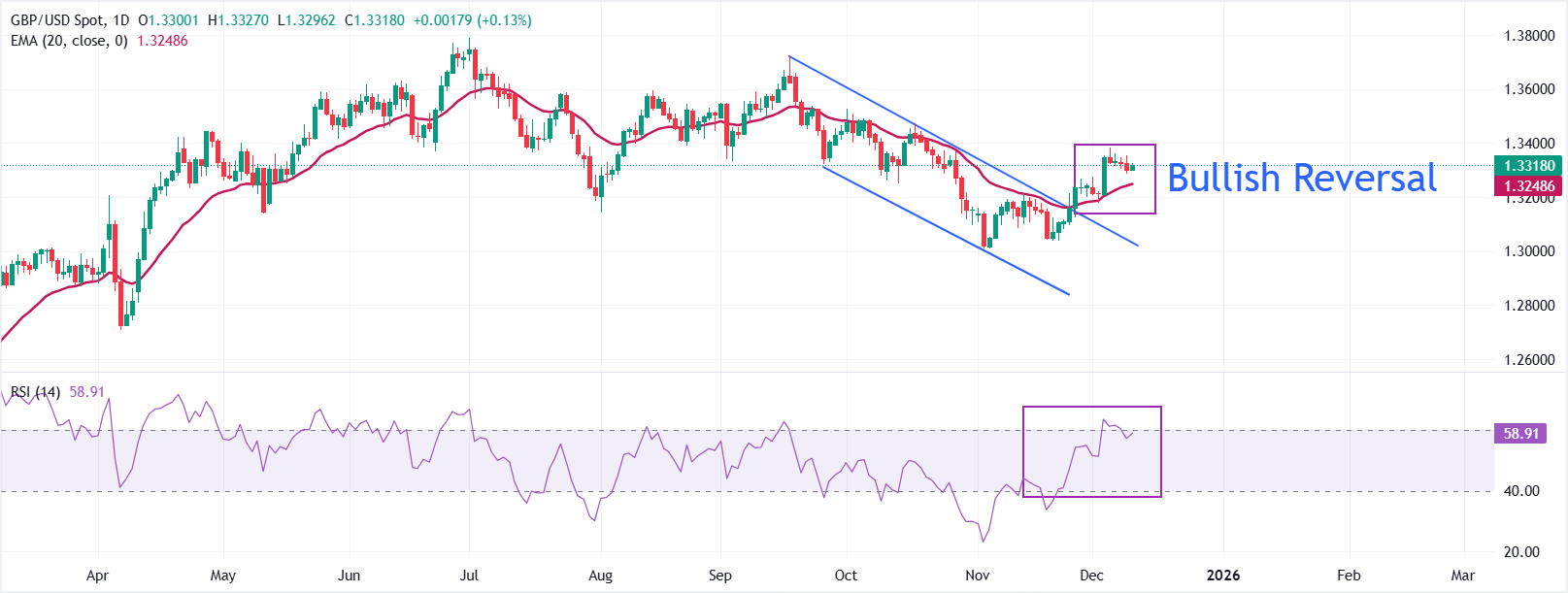
On the daily chart, GBP/USD trades at 1.3318. Price holds above the rising 20-day EMA at 1.3249, keeping the short-term uptrend intact. The average has turned higher in recent sessions, and dips would meet dynamic support near that gauge. A descending trend line from 1.3726, the September 17 high, was broken at 1.3026, removing overhead pressure and reinforcing a bullish bias.
The Relative Strength Index (RSI) at 58.9 stands above 50 and rising, confirming bullish momentum without overbought risk. If the pair maintains traction above the 20-day EMA at 1.3249, bulls could extend the advance, while failure to do so would expose a retracement toward the broken descending trend line around 1.3026.
(The technical analysis of this story was written with the help of an AI tool)
Central banks FAQs
Central Banks have a key mandate which is making sure that there is price stability in a country or region. Economies are constantly facing inflation or deflation when prices for certain goods and services are fluctuating. Constant rising prices for the same goods means inflation, constant lowered prices for the same goods means deflation. It is the task of the central bank to keep the demand in line by tweaking its policy rate. For the biggest central banks like the US Federal Reserve (Fed), the European Central Bank (ECB) or the Bank of England (BoE), the mandate is to keep inflation close to 2%.
A central bank has one important tool at its disposal to get inflation higher or lower, and that is by tweaking its benchmark policy rate, commonly known as interest rate. On pre-communicated moments, the central bank will issue a statement with its policy rate and provide additional reasoning on why it is either remaining or changing (cutting or hiking) it. Local banks will adjust their savings and lending rates accordingly, which in turn will make it either harder or easier for people to earn on their savings or for companies to take out loans and make investments in their businesses. When the central bank hikes interest rates substantially, this is called monetary tightening. When it is cutting its benchmark rate, it is called monetary easing.
A central bank is often politically independent. Members of the central bank policy board are passing through a series of panels and hearings before being appointed to a policy board seat. Each member in that board often has a certain conviction on how the central bank should control inflation and the subsequent monetary policy. Members that want a very loose monetary policy, with low rates and cheap lending, to boost the economy substantially while being content to see inflation slightly above 2%, are called ‘doves’. Members that rather want to see higher rates to reward savings and want to keep a lit on inflation at all time are called ‘hawks’ and will not rest until inflation is at or just below 2%.
Normally, there is a chairman or president who leads each meeting, needs to create a consensus between the hawks or doves and has his or her final say when it would come down to a vote split to avoid a 50-50 tie on whether the current policy should be adjusted. The chairman will deliver speeches which often can be followed live, where the current monetary stance and outlook is being communicated. A central bank will try to push forward its monetary policy without triggering violent swings in rates, equities, or its currency. All members of the central bank will channel their stance toward the markets in advance of a policy meeting event. A few days before a policy meeting takes place until the new policy has been communicated, members are forbidden to talk publicly. This is called the blackout period.
Author

Sagar Dua
FXStreet
Sagar Dua is associated with the financial markets from his college days. Along with pursuing post-graduation in Commerce in 2014, he started his markets training with chart analysis.