BoC Governor Macklem: We still think growth will be modest

Governor Tiff Macklem took questions from reporters, offering more detail on the central bank’s thinking. His remarks followed a widely expected decision to leave the policy rate unchanged at 2.25%.
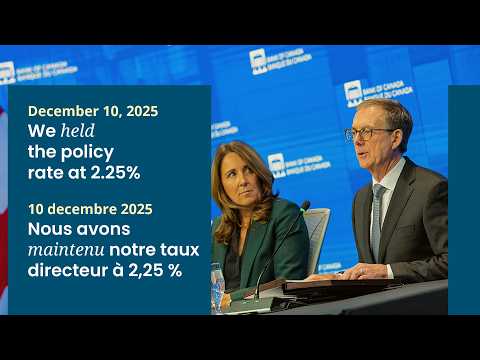
BoC press conference highlights
Businesses are careful about hiring and investment plans.
Recent jobs data hasn't changed our economic outlook.
Impact of the federal budget would depend on the speed and effectiveness of execution.
The federal budget was not adding a lot of additional inflationary pressures.
Markets could count on decisions being taken one at a time.
Markets would be assessing data relative to their outlook.
StatsCan had a very tough job.
What we don't want is prices coming down.
Both supply and demand look stronger.
The output gap is now smaller.
Q3 was strong largely because imports were really weak; final domestic demand was actually flat.
We expect Q4 to be weak.
We still think the economy shows an excess of supply.
This section below was published at 14:45 GMT to cover the Bank of Canada's policy announcements and the initial market reaction.
As most market watchers expected, the Bank of Canada (BoC) kept its policy rate at 2.25% on Wednesday. Now all eyes shift to Governor Tiff Macklem’s upcoming press conference at 15:30 GMT, where investors will be looking for clues on what comes next.
BoC policy statement key highlights
The BoC reiterates that the current rate is at about the right level to keep inflation close to 2% as long as the economy and inflation evolve in line with projections.
BoC reiterates that if the outlook changes, it is prepared to respond.
CPI inflation will remain close to the 2% target as economic slack roughly offsets cost pressures linked to trade reconfiguration.
Underlying inflation is still around 2.5%.
Q4 GDP growth is likely to be weak; final domestic demand will grow in Q4 but will be offset by a decline in net exports.
The Canadian labour market is showing some signs of improvement.
Q3 GDP growth in Canada was surprisingly strong, largely reflecting trade volatility.
Market reaction
The Canadian Dollar (CAD) trades with decent losses on Wednesday, prompting USD/CAD to advance to weekly highs around 1.3860 in the wake of the BoC’s interest rate decision.
Canadian Dollar Price Today
The table below shows the percentage change of Canadian Dollar (CAD) against listed major currencies today. Canadian Dollar was the strongest against the Australian Dollar.
| USD | EUR | GBP | JPY | CAD | AUD | NZD | CHF | |
|---|---|---|---|---|---|---|---|---|
| USD | -0.12% | -0.21% | -0.27% | 0.08% | 0.02% | 0.00% | -0.38% | |
| EUR | 0.12% | -0.09% | -0.16% | 0.20% | 0.14% | 0.12% | -0.26% | |
| GBP | 0.21% | 0.09% | -0.06% | 0.29% | 0.23% | 0.22% | -0.17% | |
| JPY | 0.27% | 0.16% | 0.06% | 0.36% | 0.30% | 0.28% | -0.10% | |
| CAD | -0.08% | -0.20% | -0.29% | -0.36% | -0.06% | -0.08% | -0.46% | |
| AUD | -0.02% | -0.14% | -0.23% | -0.30% | 0.06% | -0.01% | -0.40% | |
| NZD | -0.01% | -0.12% | -0.22% | -0.28% | 0.08% | 0.00% | -0.39% | |
| CHF | 0.38% | 0.26% | 0.17% | 0.10% | 0.46% | 0.40% | 0.39% |
The heat map shows percentage changes of major currencies against each other. The base currency is picked from the left column, while the quote currency is picked from the top row. For example, if you pick the Canadian Dollar from the left column and move along the horizontal line to the US Dollar, the percentage change displayed in the box will represent CAD (base)/USD (quote).
This section below was published as a preview of the Bank of Canada's (BoC) monetary policy announcements at 10:00 GMT.
The Bank of Canada is expected to keep its interest rate at 2.25%.
- The Canadian Dollar remains firm, dragging USD/CAD to multi-week lows.
- The BoC reduced its policy rate by a quarter-point in late October.
- The BoC could start hiking rates by mid-2026.
The Bank of Canada (BoC) is widely expected to maintain its benchmark interest rate at 2.25% at its meeting on Wednesday. That would follow two consecutive quarter-point rate cuts in September and October.
Indeed, the central bank trimmed its benchmark rate by 25 basis points in late October, exactly what everyone was expecting.
Furthermore, policymakers signalled they’re pretty comfortable with where rates are now: low enough to support the economy as it adjusts to the fallout from the US-driven trade tensions, but still tight enough to keep inflation hovering around target.
The issue of inflation continues to persist: Headline CPI deflated to 2.2% YoY in October, while the core CPI climbed to 2.9%. The BoC’s preferred measures, Common, Trimmed, and Median CPI, eased a tad, although they remain comfortably above the target at 2.7%, 3.0%, and 2.9%, respectively.
Previewing the BoC’s interest rate decision, analysts at the National Bank of Canada (NBC) noted, “The Bank of Canada is set to leave its policy rate unchanged at 2.25%, after declaring in October that it is ‘at about the right level’ to keep inflation near target and help the economy through a structural adjustment.”
When will the BoC release its monetary policy decision, and how could it affect USD/CAD?
The Bank of Canada will announce its policy decision on Wednesday at 14:45 GMT, followed by a press conference with Governor Tiff Macklem at 15:30 GMT.
Markets anticipate the central bank to maintain its current stance, with a projected tightening of approximately 33 basis points by the end of 2026.
Pablo Piovano, Senior Analyst at FXStreet, points out that the CAD has been appreciating steadily against the Greenback since the November lows north of 1.4100, sending USD/CAD back to the 1.3800 neighbourhood. He also notes that the technical setup still leans toward further losses if spot keeps the trade below its key 200-day SMA at 1.3904.
From here, Piovano says a return of bullish momentum could send USD/CAD up to test the November high at 1.4140 (November 5), and if that breaks, the next target would be the April ceiling at 1.4414 (April 1).
On the other hand, he highlights initial support at the December base of 1.3799 (December 8), seconded by the September floor at 1.3726 (September 17) and the July valley at 1.3556 (July 3).
“Momentum favours extra declines,” he adds, noting that the Relative Strength Index (RSI) is hovering below the 36 level and the Average Directional Index (ADX) above 26, which hints that the current trend is gathering steam at a firm pace.
Bank of Canada FAQs
The Bank of Canada (BoC), based in Ottawa, is the institution that sets interest rates and manages monetary policy for Canada. It does so at eight scheduled meetings a year and ad hoc emergency meetings that are held as required. The BoC primary mandate is to maintain price stability, which means keeping inflation at between 1-3%. Its main tool for achieving this is by raising or lowering interest rates. Relatively high interest rates will usually result in a stronger Canadian Dollar (CAD) and vice versa. Other tools used include quantitative easing and tightening.
In extreme situations, the Bank of Canada can enact a policy tool called Quantitative Easing. QE is the process by which the BoC prints Canadian Dollars for the purpose of buying assets – usually government or corporate bonds – from financial institutions. QE usually results in a weaker CAD. QE is a last resort when simply lowering interest rates is unlikely to achieve the objective of price stability. The Bank of Canada used the measure during the Great Financial Crisis of 2009-11 when credit froze after banks lost faith in each other’s ability to repay debts.
Quantitative tightening (QT) is the reverse of QE. It is undertaken after QE when an economic recovery is underway and inflation starts rising. Whilst in QE the Bank of Canada purchases government and corporate bonds from financial institutions to provide them with liquidity, in QT the BoC stops buying more assets, and stops reinvesting the principal maturing on the bonds it already holds. It is usually positive (or bullish) for the Canadian Dollar.
Interest rates FAQs
Interest rates are charged by financial institutions on loans to borrowers and are paid as interest to savers and depositors. They are influenced by base lending rates, which are set by central banks in response to changes in the economy. Central banks normally have a mandate to ensure price stability, which in most cases means targeting a core inflation rate of around 2%. If inflation falls below target the central bank may cut base lending rates, with a view to stimulating lending and boosting the economy. If inflation rises substantially above 2% it normally results in the central bank raising base lending rates in an attempt to lower inflation.
Higher interest rates generally help strengthen a country’s currency as they make it a more attractive place for global investors to park their money.
Higher interest rates overall weigh on the price of Gold because they increase the opportunity cost of holding Gold instead of investing in an interest-bearing asset or placing cash in the bank. If interest rates are high that usually pushes up the price of the US Dollar (USD), and since Gold is priced in Dollars, this has the effect of lowering the price of Gold.
The Fed funds rate is the overnight rate at which US banks lend to each other. It is the oft-quoted headline rate set by the Federal Reserve at its FOMC meetings. It is set as a range, for example 4.75%-5.00%, though the upper limit (in that case 5.00%) is the quoted figure. Market expectations for future Fed funds rate are tracked by the CME FedWatch tool, which shapes how many financial markets behave in anticipation of future Federal Reserve monetary policy decisions.
Author

FXStreet Team
FXStreet
Composed of a group of economic journalists and FX experts, the FXStreet content team produces and oversees all content published on FXStreet. It provides a purely journalistic approach to the Forex market.