Pound Sterling outperforms US Dollar ahead of US ADP Employment data
- The Pound Sterling rises against its major currency peers despite firm BoE dovish expectations.
- The UK’s OBR raised its GDP growth forecast for 2025 to 1.5% from prior projections of 1%.
- Investors await the US ADP Employment Change and the ISM Services PMI data for November.

The Pound Sterling (GBP) trades 0.5% higher to near 1.3280 against the US Dollar (USD) during the European trading session on Wednesday. The GBP/USD pair gains as the US Dollar faces selling pressure amid firming speculation that White House Economic Adviser Kevin Hassett could replace Jerome Powell as the next Federal Reserve (Fed) chairman.
At the press time, the US Dollar Index (DXY), which tracks the Greenback’s value against six major currencies, posts a fresh monthly low near 99.00
On Tuesday, United States (US) President Donald Trump said, while responding to reporters at the White House event, that he has narrowed his choices for Fed Powell’s replacement to just one, which will be announced in early 2026, and teased the name of White House Economic Adviser Kevin Hassett.
“I guess a potential Fed chair is here too. Am I allowed to say that? Potential. He’s a respected person, that I can tell you. Thank you, Kevin," Trump said, Reuters reported.
The scenario of Hassett’s selection as the Fed’s next chair will be unfavorable for the US Dollar, given that he has supported lower interest rates several times in various interviews.
US Dollar Price Today
The table below shows the percentage change of US Dollar (USD) against listed major currencies today. US Dollar was the weakest against the British Pound.
| USD | EUR | GBP | JPY | CAD | AUD | NZD | CHF | |
|---|---|---|---|---|---|---|---|---|
| USD | -0.32% | -0.60% | -0.25% | -0.26% | -0.34% | -0.25% | -0.33% | |
| EUR | 0.32% | -0.27% | 0.09% | 0.06% | -0.01% | 0.08% | -0.01% | |
| GBP | 0.60% | 0.27% | 0.35% | 0.33% | 0.26% | 0.35% | 0.26% | |
| JPY | 0.25% | -0.09% | -0.35% | -0.01% | -0.09% | -0.01% | -0.08% | |
| CAD | 0.26% | -0.06% | -0.33% | 0.00% | -0.07% | 0.00% | -0.07% | |
| AUD | 0.34% | 0.01% | -0.26% | 0.09% | 0.07% | 0.09% | -0.00% | |
| NZD | 0.25% | -0.08% | -0.35% | 0.01% | -0.00% | -0.09% | -0.09% | |
| CHF | 0.33% | 0.00% | -0.26% | 0.08% | 0.07% | 0.00% | 0.09% |
The heat map shows percentage changes of major currencies against each other. The base currency is picked from the left column, while the quote currency is picked from the top row. For example, if you pick the US Dollar from the left column and move along the horizontal line to the Japanese Yen, the percentage change displayed in the box will represent USD (base)/JPY (quote).
Daily digest market movers: Pound Sterling outperforms across the board
- The Pound Sterling trades higher against its major currency peers, except antipodeans, on Wednesday. The British currency appears to be extending its last week’s budget relief recovery, in which United Kingdom (UK) Chancellor of the Exchequer Rachel Reeves announced a tax hike amounting to an annual 26 billion pounds to fund the fiscal hole, and made a buffer for unforeseen circumstances.
- Sterling’s relief rally was also backed by upwardly revised Gross Domestic Product (GDP) growth projections for the current year. The Office for Budget Responsibility (OBR) raised economic growth projections for 2025 to 1.5%, higher than the prior forecast of 1%.
- Meanwhile, the Bank of England (BoE) has warned of escalating financial risks in its half-yearly Financial Stability Report released on Tuesday. The BoE stated that threats to Britain's financial system had risen this year due to stretched valuations of companies investing in artificial intelligence, risky lending, and bets with borrowed money in government bond markets, Reuters reported.
- On Tuesday, BoE Governor Andrew Bailey also highlighted the need to maintain focus on financial stability, which has become more important than ever.
- The British currency gains even as traders remain increasingly confident that the central bank will cut interest rates in its next monetary policy announcement on December 18.
- Major triggers behind the firm BoE's dovish expectations are weakening job market conditions and signs of softening inflation growth in the United Kingdom (UK) economy. The latest employment report showed that the ILO Unemployment Rate rose to 5% in the three months ending September, the highest level in four years. The Consumer Price Index (CPI) report for October showed that overall inflationary pressures grew moderately.
- In Wednesday’s session, the GBP/USD pair will be influenced by the US ADP Employment Change and the ISM Services Purchasing Managers’ Index (PMI) data for November, which will be published during the North American session.
- Economists expect private employers to have added 5K fresh workers, significantly lower than 42K in October. The ISM Services PMI is expected to come in lower at 52.1 from 52.4 in October.
- The impact of the US ADP Employment Change data will be significant on market expectations for the Federal Reserve’s (Fed) monetary policy outlook, amid delayed Nonfarm Payrolls (NFP) data due to the government shutdown, which will finally be released on December 16.
- Several Federal Open Market Committee (FOMC) members have been expressing concerns over the job demand and have favoured further monetary policy expansion to support the same.
Technical Analysis: GBP/USD's trend turns bullish on breakout above 1.3200
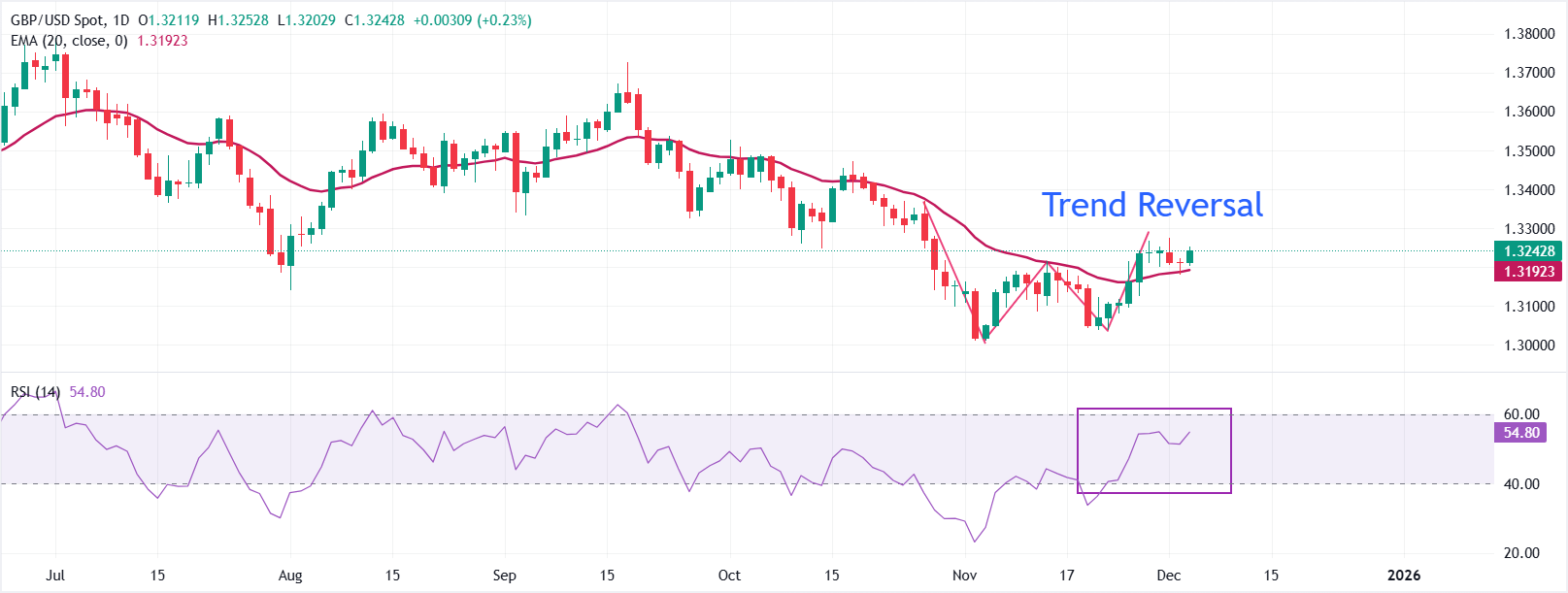
The Pound Sterling jumps to near 1.3250 against the US Dollar on Wednesday. The GBP/USD pair holds above the 20-day Exponential Moving Average (EMA) at 1.3192, demonstrating a positive trend in the near term.
The 14-day Relative Strength Index (RSI) at 54.80 stands above the 50 mid-line, confirming improving momentum.
A fresh Higher Low- Higher High formation on the daily chart signifies a trend reversal, which will keep Pound Sterling bulls on the front foot.
Looking down, the psychological level of 1.3000 will remain a key support zone for the pair. On the upside, the Cable could extend its upside towards the October 28 high of 1.3370.
Fed FAQs
Monetary policy in the US is shaped by the Federal Reserve (Fed). The Fed has two mandates: to achieve price stability and foster full employment. Its primary tool to achieve these goals is by adjusting interest rates. When prices are rising too quickly and inflation is above the Fed’s 2% target, it raises interest rates, increasing borrowing costs throughout the economy. This results in a stronger US Dollar (USD) as it makes the US a more attractive place for international investors to park their money. When inflation falls below 2% or the Unemployment Rate is too high, the Fed may lower interest rates to encourage borrowing, which weighs on the Greenback.
The Federal Reserve (Fed) holds eight policy meetings a year, where the Federal Open Market Committee (FOMC) assesses economic conditions and makes monetary policy decisions. The FOMC is attended by twelve Fed officials – the seven members of the Board of Governors, the president of the Federal Reserve Bank of New York, and four of the remaining eleven regional Reserve Bank presidents, who serve one-year terms on a rotating basis.
In extreme situations, the Federal Reserve may resort to a policy named Quantitative Easing (QE). QE is the process by which the Fed substantially increases the flow of credit in a stuck financial system. It is a non-standard policy measure used during crises or when inflation is extremely low. It was the Fed’s weapon of choice during the Great Financial Crisis in 2008. It involves the Fed printing more Dollars and using them to buy high grade bonds from financial institutions. QE usually weakens the US Dollar.
Quantitative tightening (QT) is the reverse process of QE, whereby the Federal Reserve stops buying bonds from financial institutions and does not reinvest the principal from the bonds it holds maturing, to purchase new bonds. It is usually positive for the value of the US Dollar.
Author

Sagar Dua
FXStreet
Sagar Dua is associated with the financial markets from his college days. Along with pursuing post-graduation in Commerce in 2014, he started his markets training with chart analysis.