Pound Sterling trades lower against US Dollar ahead of US ADP Employment data
- The Pound Sterling retraces to near 1.3700 against the US Dollar as the latter gains on surprisingly upbeat US JOLTS Job Openings data for May.
- Fed Chair Powell reiterates a “wait and see” approach on the monetary policy outlook.
- BoE Governor Bailey warns of cooling labor market conditions amid global market risks.

The Pound Sterling (GBP) corrects to near 1.3700 against the US Dollar (USD) during the European trading session on Wednesday from the fresh three-and-a-half-year high around 1.3800 posted the previous day. The GBP/USD pair faces selling pressure as the United States (US) currency gains ground, following upbeat JOLTS Job Openings data for May.
The data showed on Tuesday that US employers posted fresh 7.769 million job vacancies, surprisingly higher than 7.395 million in April. Economists expected US firms to have posted 7.3 million jobs.
At the time of writing, the US Dollar Index (DXY), which tracks the Greenback’s value against six major currencies, rises to near 96.90. The DXY gained ground on Tuesday, closing the day at 96.64 after bottoming near 96.40 and following a nine-day losing streak.
Meanwhile, investors await the ADP Employment Change data for June, which will be published later in the day, at 12:15 GMT. US private employers are expected to have hired 95K fresh workers, significantly higher than 37K in May. The US private labor market data will influence market expectations for the Federal Reserve's (Fed) monetary policy outlook.
Going forward, the major trigger for the US Dollar will be the US Nonfarm Payrolls (NFP) data for June, which is scheduled to be released on Thursday.
Pound Sterling falls while BoE Taylor guides five interest rate cuts this year
- The Pound Sterling weakens against its major peers on Wednesday as Bank of England (BoE) Governor Andrew Bailey has warned of downside United Kingdom (UK) labor market risks and firms’ reluctance to accelerate investment decisions due to global economic uncertainty, while speaking in an interview with CNBC at the European Central Bank (ECB) summit in Sintra, Portugal.
- “Internationally, there is an increase in uncertainty, which is coming through in terms of economic activity and growth," Bailey said. He added that the labor market is “softening” and explained that when he talks to businesses “what they tell me is that they are putting off investment decisions".
- At the ECB summit, Bailey didn’t provide any cues about the likely interest rate action in the August monetary policy meeting, but reiterated that the path of interest rates will continue to be “gradually downwards". Meanwhile, traders see the BoE reducing interest rates twice in the remainder of the year.
- Meanwhile, BoE Monetary Policy Committee (MPC) member Alan Taylor has also warned of labor market risks at the ECB summit during European trading hours. "Starting to see cracks in labor market," Taylor said.
- However, he has guided an aggressive monteray policy easing cycle stating that "five interest rate cuts are needed" this year. According to his estimates, the UK neutral real rate to be about 0.75 to 1 percent, putting the neutral nominal rate at around 2.75 to 3 percent. BoE Taylor was one of three MPC members who supported to reduce interest rates by 25 basis points (bps) in the June policy meeting where majority voted in favor of holding them steady.
- Broadly, the US Dollar remains under pressure as it continues to face backlash due to United States (US) President Donald Trump’s attack on the Fed’s independence, uncertainty surrounding the July 9 tariff deadline and Trump’s so-called “Big Beautiful Bill”.
- Trump has criticized Fed Chair Jerome Powell again for not lowering interest rates on a handwritten note stating how much other central banks have reduced their key borrowing rates. Contrary to US president’s support for interest rate cuts, Powell has reiterated the need to learn more about the impact of new economic policies on the economy before considering monetary policy adjustments, while speaking at the ECB summit on Tuesday.
- On the fiscal front, Trump’s tax and spending cut bill has been passed by the Republican-controlled Senate and has moved to the president’s desk for final approval. This has prompted fears of ballooning US debt, which were already escalated as Moody’s rating downgraded the US Sovereign Credit in May.
- Analysts at National Australia Bank (NAB) said, "The confirmation that Trump’s bill is an increase in issuance, an increase in government spending well beyond its means, is not necessarily good news for the Treasury market, and it's arguably one of the reasons the US Dollar's going down."
Technical Analysis: Pound Sterling holds key 20-day EMA
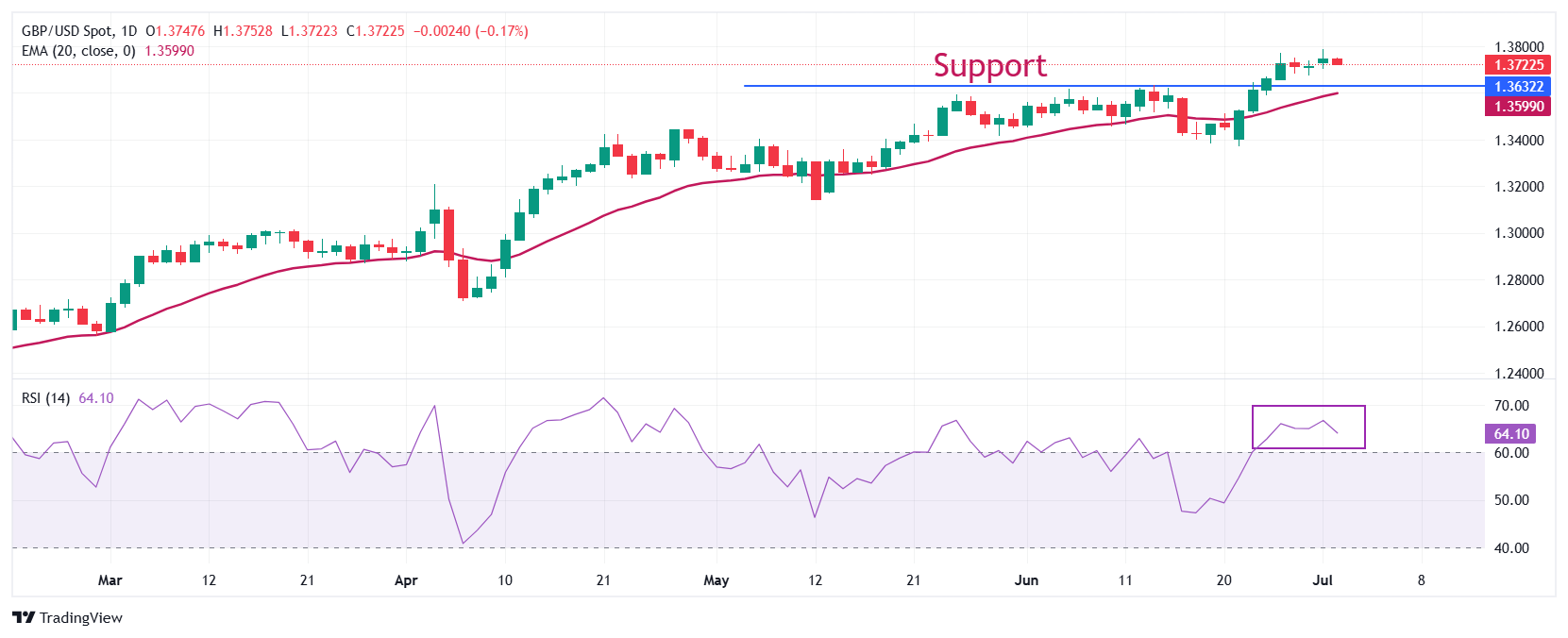
The Pound Sterling falls to near 1.3700 against the US Dollar on Wednesday. The overall trend of the pair remains bullish as it trades close to its three-and-a-half-year high around 1.3800 posted on Tuesday.
The upward-sloping 20-day Exponential Moving Average (EMA) near 1.3600 suggests that the near-term trend is bullish.
The 14-day Relative Strength Index (RSI) oscillates inside the 60.00-80.00 range, suggesting that the momentum is on the upside.
Looking down, the June 13 high around 1.3630 will act as a key support zone. On the upside, the psychological level of 1.4000 will act as a key barrier.
Economic Indicator
ADP Employment Change
The ADP Employment Change is a gauge of employment in the private sector released by the largest payroll processor in the US, Automatic Data Processing Inc. It measures the change in the number of people privately employed in the US. Generally speaking, a rise in the indicator has positive implications for consumer spending and is stimulative of economic growth. So a high reading is traditionally seen as bullish for the US Dollar (USD), while a low reading is seen as bearish.
Read more.Next release: Wed Jul 02, 2025 12:15
Frequency: Monthly
Consensus: 95K
Previous: 37K
Source: ADP Research Institute
Traders often consider employment figures from ADP, America’s largest payrolls provider, report as the harbinger of the Bureau of Labor Statistics release on Nonfarm Payrolls (usually published two days later), because of the correlation between the two. The overlaying of both series is quite high, but on individual months, the discrepancy can be substantial. Another reason FX traders follow this report is the same as with the NFP – a persistent vigorous growth in employment figures increases inflationary pressures, and with it, the likelihood that the Fed will raise interest rates. Actual figures beating consensus tend to be USD bullish.
Author

Sagar Dua
FXStreet
Sagar Dua is associated with the financial markets from his college days. Along with pursuing post-graduation in Commerce in 2014, he started his markets training with chart analysis.

















