Pound Sterling weakens against US Dollar ahead of key US data
- The Pound Sterling faces pressure against its major currency peers amid dovish BoE expectations.
- UK PM Starmer seeks lower rates to boost economy, BoE’s Greene to support rate cuts if employment and consumption fall further.
- Weak US ISM Manufacturing PMI data indicate a soft demand environment.

The Pound Sterling (GBP) drops to near 1.3190 against the US Dollar (USD) during the European trading session on Tuesday. The GBP/USD pair falls as the US Dollar extends Monday's recovery move despite weak United States (US) ISM Manufacturing Purchasing Managers’ Index (PMI) data for November.
At press time, the US Dollar Index (DXY), which tracks the Greenback’s value against six major currencies, rises 0.1% to near 99.50.
The US economic data showed on Monday that activities in the factory sector contracted for the ninth month in a row. Also, the pace of contraction in the manufacturing sector activity was faster than projected. The Manufacturing PMI landed at 48.2, lower than estimates of 48.6 and from 48.7 in October.
In addition to the Manufacturing PMI, other sub-components of the non-service sector, such as New Orders and Employment Indexes also came in significantly lower than their former readings. The overall weakness in the manufacturing sector exhibits a weak demand environment, which, in theory, underpins the need for further interest rate cuts by the Federal Reserve (Fed).
Currently, traders are increasingly confident that the Fed will cut interest rates again this year. The central bank has already reduced the Federal Fund Rate by 75 basis points (bps) to 3.75%-4.00% this year. According to the CME FedWatch tool, there is an 87.2% chance that the Fed will cut rates by 25 basis points (bps) to 3.50%-3.75% in the December monetary policy meeting.
Daily digest market movers: Pound Sterling drops on dovish BoE expectations
- The Pound Sterling trades slightly lower against its major peers on Tuesday as United Kingdom (UK) Prime Minister (PM) Keir Starmer stresses the need to bring inflation and interest rates down to boost business investment and economic growth.
- While addressing reporters on Monday, UK PM Starmer said, “The most important things that we can do for growth, the most important things that we can do for business is first to drive inflation down so that interest rates come down further, and the cost of business investment comes down with it,” Reuters reported.
- These comments from Starmer came while praising the Autumn budget announced by Chancellor of the Exchequer Rachel Reeves last week, in which she raised taxes by 26 billion pounds by 2029-30 to fill the fiscal gap.
- The scenario of lower UK interest rates bodes poorly for the Pound Sterling.
- Meanwhile, traders are also confident that the Bank of England (BoE) will cut interest rates in the monetary policy meeting this month amid weakness in the job market and slowing inflation growth.
- Contrary to firm dovish BoE market expectations, policymaker Megan Greene stated on Monday that she would support interest rate cuts only if the labour market and consumption deteriorate further.
- Going forward, major triggers for the GBP/USD pair will be the ADP Employment Change and the ISM Services PMI data for November, which are scheduled for Wednesday. The ADP report is expected to show that private employers added 10K fresh workers, significantly lower than 42K in October. Meanwhile, the ISM Services PMI is seen lower at 52.1 from 52.4 in October.
Pound Sterling Price Today
The table below shows the percentage change of British Pound (GBP) against listed major currencies today. British Pound was the weakest against the Australian Dollar.
| USD | EUR | GBP | JPY | CAD | AUD | NZD | CHF | |
|---|---|---|---|---|---|---|---|---|
| USD | 0.02% | 0.14% | 0.33% | 0.08% | -0.09% | 0.21% | -0.01% | |
| EUR | -0.02% | 0.13% | 0.33% | 0.09% | -0.10% | 0.19% | -0.03% | |
| GBP | -0.14% | -0.13% | 0.19% | -0.06% | -0.24% | 0.07% | -0.15% | |
| JPY | -0.33% | -0.33% | -0.19% | -0.25% | -0.42% | -0.13% | -0.35% | |
| CAD | -0.08% | -0.09% | 0.06% | 0.25% | -0.17% | 0.12% | -0.09% | |
| AUD | 0.09% | 0.10% | 0.24% | 0.42% | 0.17% | 0.29% | 0.06% | |
| NZD | -0.21% | -0.19% | -0.07% | 0.13% | -0.12% | -0.29% | -0.22% | |
| CHF | 0.01% | 0.03% | 0.15% | 0.35% | 0.09% | -0.06% | 0.22% |
The heat map shows percentage changes of major currencies against each other. The base currency is picked from the left column, while the quote currency is picked from the top row. For example, if you pick the British Pound from the left column and move along the horizontal line to the US Dollar, the percentage change displayed in the box will represent GBP (base)/USD (quote).
Technical Analysis: GBP/USD sees more upside above 1.3270
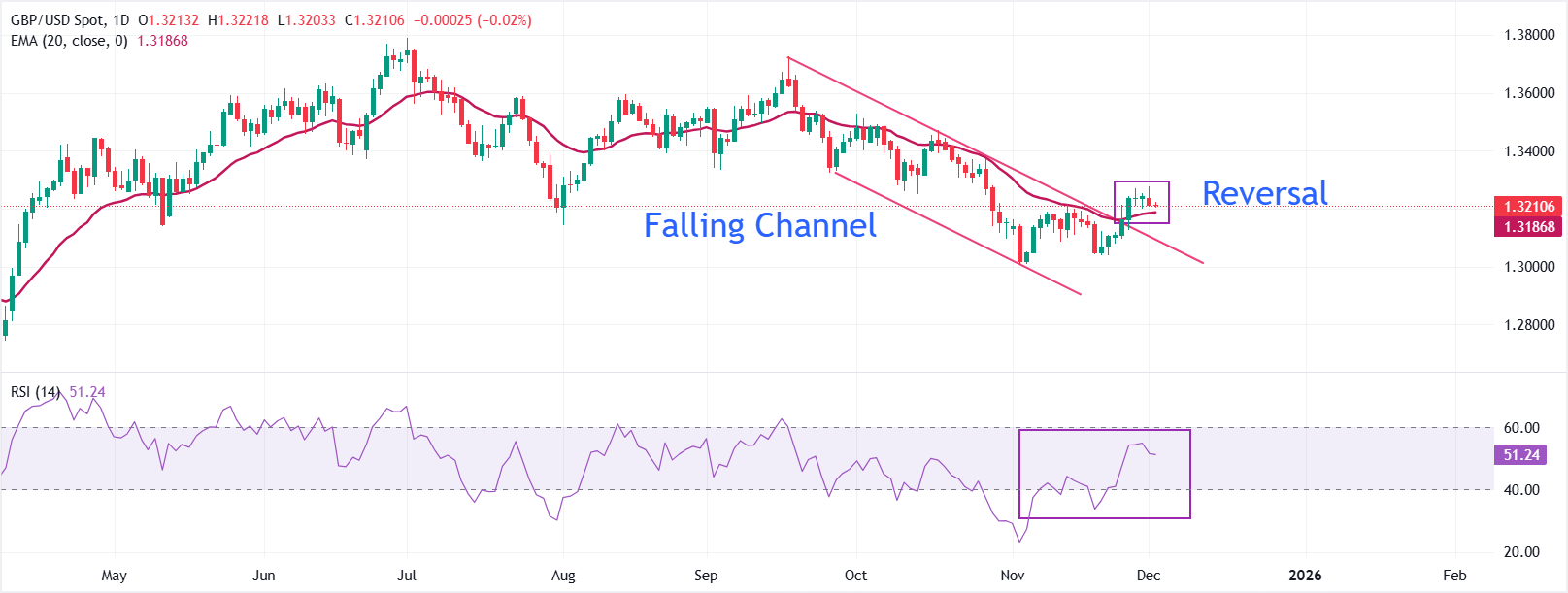
GBP/USD trades at 1.3211 during the European trading session on Tuesday on the daily chart. The pair holds marginally above the rising 20-day Exponential Moving Average (EMA) at 1.3187, keeping the short-term bias pointed higher. The average has begun to turn up after a flattening phase, signaling improving trend conditions.
The 14-day Relative Strength Index (RSI) stands at 51.24, neutral, as momentum stabilizes after the recent rebound.
The break above the descending trend line, coming from 1.3726, at 1.3085 earlier in the move, confirmed a shift in bias, with the former cap no longer obstructing the topside.
With the trend-line breach validated, dips would stay contained while buyers defend higher lows. A pullback toward 1.3085 could attract demand, whereas a daily close beneath that area would negate the bullish bias and risk a deeper retracement towards the psychological level of 1.3000.
(The technical analysis of this story was written with the help of an AI tool)
Economic Indicator
ISM Services PMI
The Institute for Supply Management (ISM) Services Purchasing Managers Index (PMI), released on a monthly basis, is a leading indicator gauging business activity in the US services sector, which makes up most of the economy. The indicator is obtained from a survey of supply executives across the US based on information they have collected within their respective organizations. Survey responses reflect the change, if any, in the current month compared to the previous month. A reading above 50 indicates that the services economy is generally expanding, a bullish sign for the US Dollar (USD). A reading below 50 signals that services sector activity is generally declining, which is seen as bearish for USD.
Read more.Next release: Wed Dec 03, 2025 15:00
Frequency: Monthly
Consensus: 52.1
Previous: 52.4
Source: Institute for Supply Management
The Institute for Supply Management’s (ISM) Services Purchasing Managers Index (PMI) reveals the current conditions in the US service sector, which has historically been a large GDP contributor. A print above 50 shows expansion in the service sector’s economic activity. Stronger-than-expected readings usually help the USD gather strength against its rivals. In addition to the headline PMI, the Employment Index and the Prices Paid Index numbers are also watched closely by investors as they provide useful insights regarding the state of the labour market and inflation.
Author

Sagar Dua
FXStreet
Sagar Dua is associated with the financial markets from his college days. Along with pursuing post-graduation in Commerce in 2014, he started his markets training with chart analysis.

















