Pound Sterling declines against US Dollar as Greenback gains of US-Iran tensions
- The Pound Sterling slips below 1.3400 against the US Dollar amid escalating tensions between the US and Iran.
- Market sentiment turns risk-averse as the US strikes Iran’s nuclear sites.
- Investors await the UK-US flash PMI data for June.

The Pound Sterling (GBP) slumps to near 1.3370 against the US Dollar (USD) during European trading hours on Monday. The GBP/USD pair weakens as investors rush to safe-haven assets, following the escalation of tensions between the United States (US) and Iran.
The demand for the US Dollar as a safe-haven asset has increased, with the US Dollar Index (DXY) refreshing the three-week high around 99.40.
During the European session, Iran threatened to retaliate against the unexpected attack by the US on Tehran’s three nuclear facilities over the weekend.
An Iranian army spokesperson, Ebrahim Zolfaqari, said that recent hostile action by the US expanded the scope of legitimate targets for Iran’s armed forces, adding that the US should expect heavy consequences for its actions.
Over the weekend, US President Donald Trump said on Truth.Social that Washington’s military forces have successfully demolished Iranian nuclear facilities: Fordow, Natanz, and Isfahan. Trump’s claim that Tehran’s nuclear sites have been destroyed has been challenged as Israeli officials have stated that Iran managed to shift its uranium stockpiles before the attack, according to the New York Times.
Meanwhile, the Iranian parliament has passed the proposal of closing the Strait of Hormuz to Iran’s Supreme National Security Council, a move that could potentially diminish the global Oil supply, Iran’s Press TV reported.
Upbeat flash UK PMI fails to strengthen Pound Sterling against US Dollar
- Although investors have underpinned the US Dollar against the Pound Sterling, it is outperforming its other peers, following the release of the better-than-projected United Kingdom (UK) flash S&P Global Purchasing Managers’ Index (PMI) data for June. The PMI report showed that the overall business activity grew at a faster-than-expected pace, driven by outperformance in both the service and the manufacturing sectors. The Composite PMI came in at 50.7, higher than estimates of 50.5 and the prior release of 50.3.
- On the monetary policy front, the BoE has maintained a “gradual and careful” monetary easing guidance on Thursday following the interest rate decision in which it held borrowing rates steady at 4.25%.
- BoE Governor Andrew Bailey said in a press conference that interest rates remain on a “gradual downward path”. Bailey also guided that the central bank will closely monitor softening labor market conditions and rising energy prices amid escalating Middle East tensions, which will be key risks to the economy.
- In the US, investors also await the preliminary US S&P Global PMI data for June, which will be published at 13:45 GMT. Financial market participants will pay close attention to the impact of tariffs on input costs.
- Federal Reserve (Fed) Governor Christopher Waller argued on Friday in favor of an interest rate reduction in the July policy meeting. Waller stated that he expects a limited impact of tariffs on inflation and warns of cracks in the labor market, which prompts the need for monetary policy expansion. “The tariffs should pose a one-off level effect on prices and not be a persistent boost to inflation," Waller said and added, “The Fed should not wait for the job market to crash in order to cut rates." FXStreet's Fedtracker, which gauges the tone of Fed officials' speeches on a dovish-to-hawkish scale from 0 to 10 using a custom AI model, rated Waller's words as dovish with a score of 3.4.
Technical Analysis: Pound Sterling stays below 20-day EMA
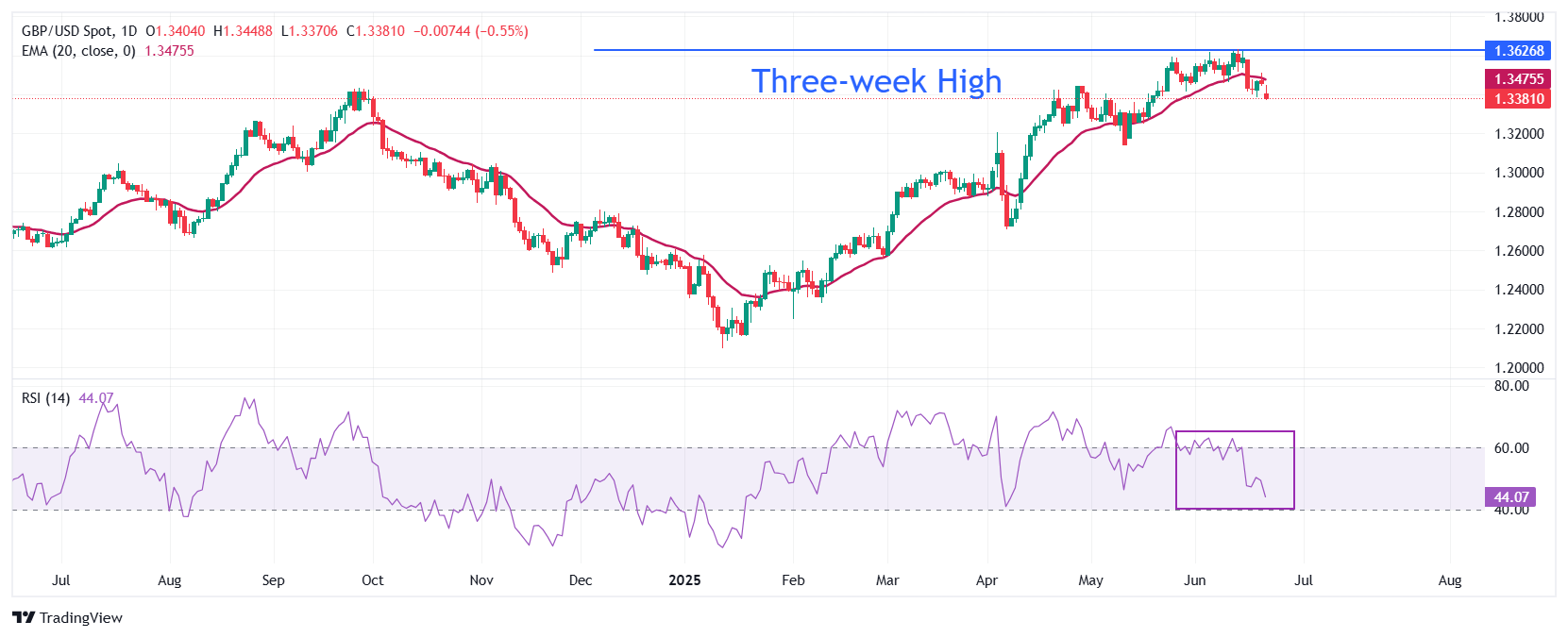
The Pound Sterling falls below 1.3400 against the US Dollar on Monday. The near-term trend of the GBP/USD pair remains bearish as it stays below the 20-day Exponential Moving Average (EMA), which is at around 1.3477.
The 14-day Relative Strength Index (RSI) oscillates inside the 40.00-60.00 range, close to the 50 neutral level, indicating a sideways performance in the near term.
Looking down, the May 16 low around 1.3250 will act as a key support zone. On the upside, the three-year high around 1.3630 will act as a key barrier.
Economic Indicator
S&P Global Composite PMI
The S&P Global Composite Purchasing Managers Index (PMI), released on a monthly basis, is a leading indicator gauging US private-business activity in the manufacturing and services sector. The data is derived from surveys to senior executives. Each response is weighted according to the size of the company and its contribution to total manufacturing or services output accounted for by the sub-sector to which that company belongs. Survey responses reflect the change, if any, in the current month compared to the previous month and can anticipate changing trends in official data series such as Gross Domestic Product (GDP), industrial production, employment and inflation. The index varies between 0 and 100, with levels of 50.0 signaling no change over the previous month. A reading above 50 indicates that the private economy is generally expanding, a bullish sign for the US Dollar (USD). Meanwhile, a reading below 50 signals that activity is generally declining, which is seen as bearish for USD.
Read more.Next release: Mon Jun 23, 2025 13:45 (Prel)
Frequency: Monthly
Consensus: -
Previous: 53
Source: S&P Global
Author

Sagar Dua
FXStreet
Sagar Dua is associated with the financial markets from his college days. Along with pursuing post-graduation in Commerce in 2014, he started his markets training with chart analysis.

















