|

Palladium Price Analysis: XPD/USD conquers $3,000 level for the first time ever

  • XPD/USD reaches the $3000 mark for the first time on record.
  • Overbought conditions on the daily chart call for a correction.
  • Buy-the-dips are likely to be a key strategy for Palladium.

The buying interest in Palladium (XPD/USD) remains unabated, as the white metal reaches fresh record highs at $3,012 in the last hour.

The pair extends its bullish momentum into the second straight session on Friday, shrugging off the broad-based US dollar rebound.

Growing concerns over supply-demand in equilibrium continue to power the gains in the industrial metal. These come amid rising supply disruptions after Russian mining giant and the world's largest palladium producer, Nornickel, said that mine closures due to flooding are likely to cause the production of platinum group metals to fall by 710,000 ounces this year.

Against this backdrop, the demand prospects for the metal improve as the global economy recovers from the coronavirus crisis while the stimulus from major central banks and governments also helps in ramping up the economic turnaround.

Palladium has wider applications as an industrial metal.

Price of Palladium

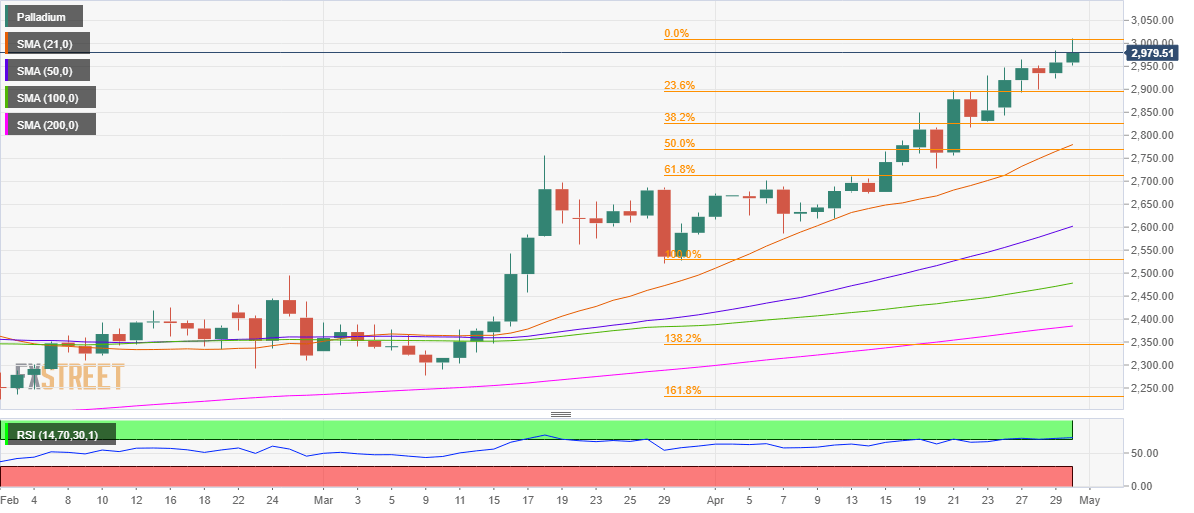
Technically, XPD/USD risks a correction amid overbought conditions on the daily Relative Strength Index (RSI).

Therefore, the latest pullback could extend towards the 23.6% Fibonacci Retracement level of the rally from March 29 lows to record highs. That level aligns at $2,898.

Meanwhile, to the upside, the XPD bulls could retest the all-time high, above which doors open up towards the $3,050 psychological level.

At the time of writing, the metal trades with sizeable gains at $2,980. Every dip could draw bargain hunters, as the fundamental factors remain well in favor of Palladium in the short to medium term.

Palladium price chart: Daily
Author

Dhwani Mehta

Dhwani Mehta

FXStreet

Residing in Mumbai (India), Dhwani is a Senior Analyst and Manager of the Asian session at FXStreet. She has over 10 years of experience in analyzing and covering the global financial markets, with specialization in Forex and commodities markets.


More from Dhwani Mehta
Share:

Editor's Picks

GBP/USD appears well offered near 1.3160

GBP/USD builds on Tuesday’s losses, although it now manages to pick up some pace and bounce off earlier multi-month troughs near 1.3140. The Greenback’s solid performance and continued political turmoil in the UK are keeping Cable under persistent pressure, with little sign of a meaningful recovery.

EUR/USD rebounds from lows, back to 1.1360

After bottoming out near 1.1320, EUR/USD gathers some traction and reclaims the 1.1350-1.1360 band as the NA session draws to a close on Wednesday. The pair’s drop to multi-month lows comes in response to the continuous leg higher in the US Dollar, which remains propped up by hawkish Fed expectations and uncertainty over the outcome of US-Iran peace negotiations.

Gold pressured near fresh 2026 lows

Gold accelerates its decline and gyrates around the key $4,000 mark per troy ounce on Wednesday, its lowest level since November 2025. In the meantime, tighter-for-longer Fed expectations and a broadly firmer US Dollar continue to weigh on the yellow metal, while uncertainty surrounding a potential US-Iran peace agreement has done little to revive demand for the safe haven space.

XRP nears key support as Fed hike risks suppress demand
Ripple (XRP) continues to face significant selling pressure, trading around $1.05 at the time of writing on Wednesday. This decline mirrors the broader weakness in the crypto market, exacerbated by mounting macroeconomic headwinds and persistent geopolitical uncertainties.
US-Iran talks: The next 60 days will decide where Oil prices go next
Oil markets received some encouraging news after weeks of rising tensions in the Middle East. But let’s not get ahead of ourselves: we’re far from victory, and markets just seem to have priced out the worst-case scenario. The US and Iran have reportedly made "substantive progress" in talks in Switzerland and agreed on a framework for working toward a broader deal within 60 days.
Regime change: Inside Kevin Warsh's first move to make the Fed unreadable on purpose

The rate did not move. That was the least interesting thing about Kevin Warsh's first meeting in charge of the Fed. The FOMC held its benchmark at 3.50%-3.75% for the fourth straight meeting, exactly as priced, and then the new chair used his first press conference to dismantle the machinery the market has leaned on for a decade.














