|

NZD/USD declines on Monday, falls back into 0.6190 in early week action

  • The Kiwi backslid to kick off the new trading week.
  • Risk appetite favored the US Dollar on Monday despite US market holiday.
  • Asia market sees China GDP, Retail Sales figures due on Wednesday.

The NZD/USD skidded back into near-term lows on Monday, falling through the 0.6200 handle as the Kiwi (NZD) sold off against the US Dollar (USD) in a broad-market Greenback bid as markets rebalanced with US markets shuttered in observance of Martin Luther King Day.

Antipodean traders will be keeping an eye out for China’s headline data prints on Wednesday, with Chinese Gross Domestic Product (GDP) and Retail Sales figures slated for early in the mid-week trading session.

China’s fourth-quarter GDP is forecast to increase from 4.9% to 5.3% for the year ended December, while annualized Retail Sales through December are expected to hold flat at 6.6%. QoQ China GDP is expected to settle from 1.3% to 1.0%.

New Zealand’s NZIER QoQ Business Confidence Survey rebounded in December but still printed negative, coming in at -2% compared to the previous quarter’s -52%. The NZIER Business Outlook has printed in negative territory since July of 2021.

NZD/USD Technical Outlook

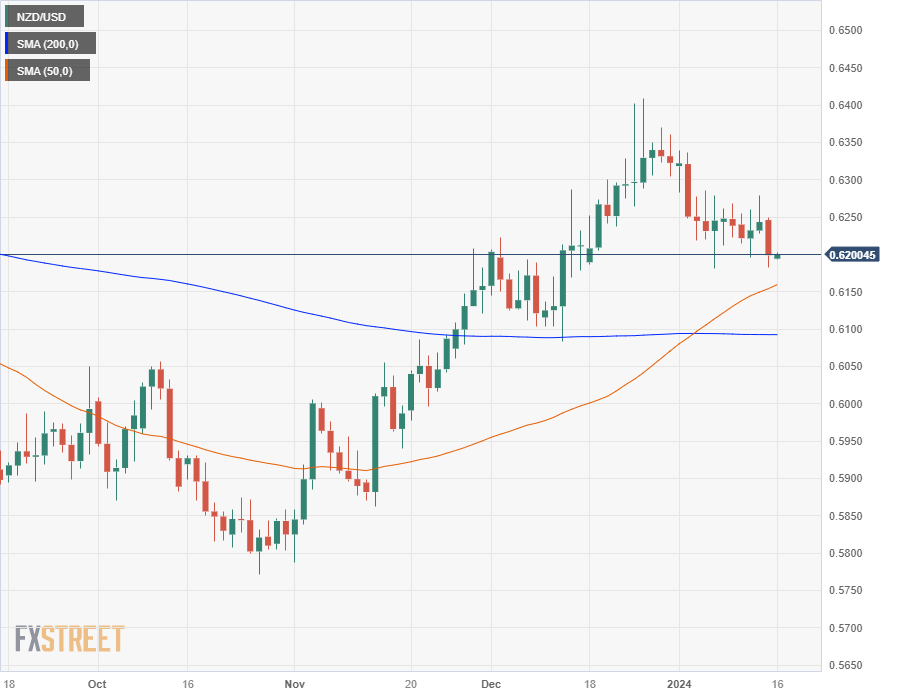
The Kiwi broke into the low side of a rough consolidation range that has plagued the NZD/USD since declining into the current chart range at the outset of 2024’s trading, testing back into the 0.6200 handle.

Monday’s backslide brings the NZD/USD closer to a technical floor at the 50-day Simple Moving Average (SMA) near 0.6150, with a bullish crossover of the 200-day SMA providing a possible bottom of near-term bearish momentum from the 0.6100 handle.

NZD/USD Hourly Chart

NZD/USD Daily Chart
NZD/USD Technical Levels

Author

Joshua Gibson

Joshua joins the FXStreet team as an Economics and Finance double major from Vancouver Island University with twelve years' experience as an independent trader focusing on technical analysis.


More from Joshua Gibson
Share:

Editor's Picks

AUD/USD: The 0.7000 level holds the downside…for now

AUD/USD has clinched its fourth consecutive daily pullback on Thursday, coming closer to the key 0.7000 region while breaking below the critical 200-day SMA at the same time. The Aussie’s decline comes on the back of further gains in the Greenback in a context of rising yields and Fed rate hike bets.

USD/JPY keeps the red near 158.00 as Japanese Yen firms up

USD/JPY retreats from three-week highs and holds losses near 158.00 in the Asian session on Thursday. Surging Japanese bond yields lift the Yen amid looming intervention risks, while the US Dollar preserves overnight gains to a two-month high amid hawkish Fed bets and elevated US bond yields.

Gold bounces off lows, still below $4,300

Gold builds on Wednesday’s retracement, briefly slipping back below $4,250 per troy ounce to attempt a lacklustre rebound afterwards. The better tone in the US Dollar, rising US Treasury yields and expectation of extra rate hikes by the Fed continue to weigh on the precious metal in the latter part of Thursday’s NA session.

XRP is flashing three bullish signals heading into a historically weak October
XRP (XRP) is still flashing 3 bullish signals across its holders, derivatives, and ETF data. These signals come as the token gave back part of its September gains on Thursday. The token traded near $1.50 at press time, down about 6.3% over 24 hours, according to BeInCrypto Markets data. The pullback still leaves XRP up over 15.6% on the week, a gain that tracks a broader market rally.
Advanced economies: From one example of resilience to another
History tends to repeat itself in advanced economies. Once again, growth ultimately fell short of expectations by only a small margin in the first half of 2026, despite the conflict in Iran. As early as 2025, the impact of tariffs was less severe than feared.
BoJ Recap: Not as hawkish as expected

The Bank of Japan (BoJ) raised its short-term interest-rate target to 1.25% from 1.00% in a 7-2 vote, marking another step in the normalisation of monetary policy and widely matching what everyone has been expecting for weeks.