|

NZD/USD bulls move up against possible bearish commitments

  • NZD/USD ended Friday strong due to a risk-on market following NFP.
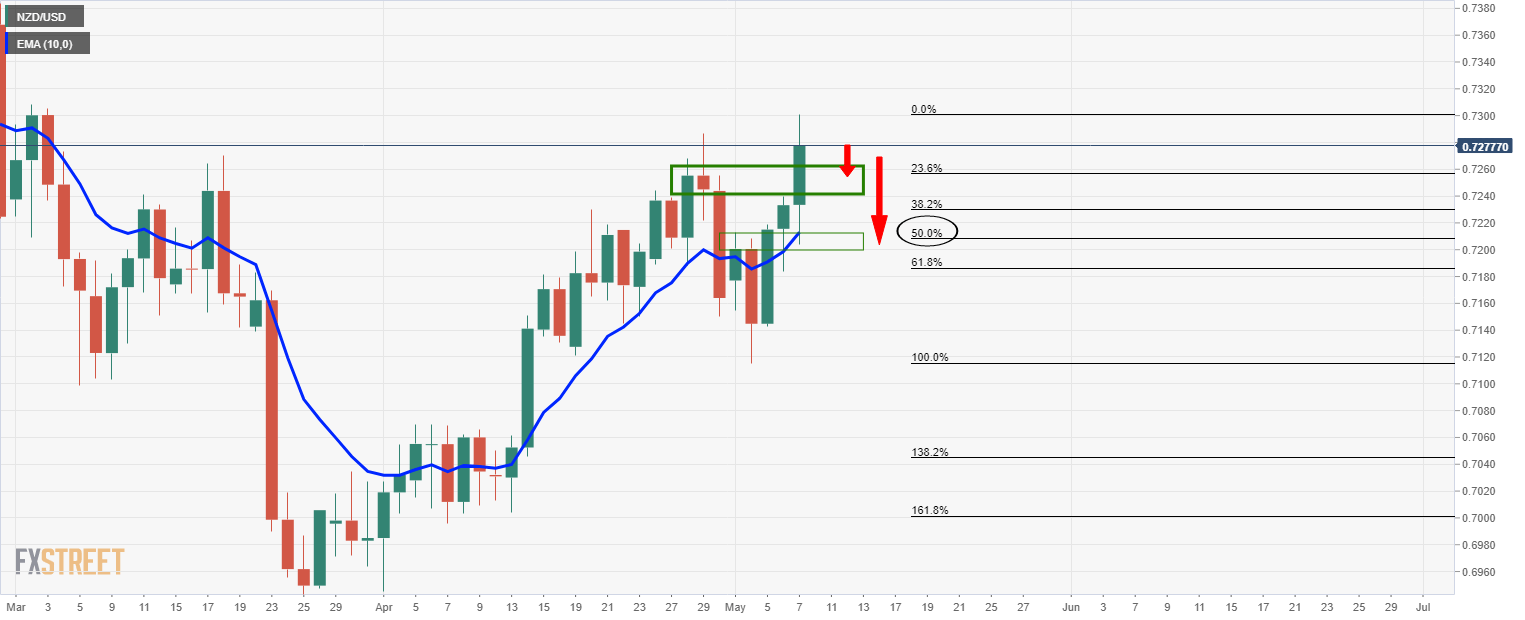
  • Technically, there is a compelling case for a daily correction. 

The NZD was bid at the end of the week as the greenback fell in the wake of the dismal jobs report. 

Nonfarm Payrolls only climbed 266k in April versus market expectations for over one million. 

Also, the unemployment rate crept up to 6.1% vs 6.0% and average earnings rose 0.7% MoM but the annual rise fell to 0.3% YoY (4.2% YoY), again owing to base effects.

However, as analysts at ANZ Bank explained, the report ''wasn’t all bad''.

''There was progress in some of the social elements to which the Fed is playing close attention. The data nonetheless push back against overheating arguments for now and underpin the Fed’s patient guidance, supporting risk.''

Higher beta FX was boosted owing to risk-on markets whereby investors were taking the view that the Fed will be lower for longer.

''With inflation expectations still rising that may give pricing power back to companies, further fuelling equities and commodity prices, and by association, the NZD,'' the analysts at ANZ Bank explained.

''Global risk markets certainly feel very glass-half-full at the moment, and if that continues, the NZD is likely to be a beneficiary. Local drivers of NZD remain absent.

NZD/USD techcnial analysis

Meanwhile, there is scope for a daily correction as follows:
Author

Ross J Burland

Ross J Burland, born in England, UK, is a sportsman at heart. He played Rugby and Judo for his county, Kent and the South East of England Rugby team.


More from Ross J Burland
Share:

Editor's Picks

AUD/USD consolidates above 0.7000; remains close to monthly top

AUD/USD holds steady above 0.7000 during the Asian session on Friday, trading just below the previous day's monthly low amid diverging forces. A hawkish RBA continues to support the Aussie, while the recent decline in US bond yields keeps the US Dollar depressed near a three-week low. However, oil-driven inflation fears reinforce Fed hike bets, which, along with geopolitical risks, could benefit the safe-haven buck and cap the currency pair.

USD/JPY bounces off one-month low; climbs to 157.00 amid reviving USD demand

USD/JPY rebounds from the 156.00 neighborhood, or a one-month low touched during Friday’s Asian session, with bulls looking to extend momentum beyond 157.00 amid the emergence of some US Dollar buying. Meanwhile, Japan's National CPI rose to a nine-month peak and reaffirmed BoJ rate-hike bets, which could support the Japanese Yen and cap gains for the currency pair.

Gold holds above $4,000/three-month low as Fed hike bets and firm USD cap upside

Gold struggles to capitalize on its modest recovery from levels below the $4,000 psychological mark, or a three-month low set earlier this Friday, and retains a bearish tone through the first half of the European session. Federal Reserve officials recently signaled there is no urgency to raise interest rates. Traders, however, are still pricing in around an 80% chance that the US central bank will raise borrowing costs again at its December policy meeting.

Bitcoin, Ethereum, and Ripple rebound as major support levels cap recent sell-off

Bitcoin, Ethereum and Ripple rebound modestly on Friday after correcting and testing their key support zone the previous day. BTC holds the 50-day EMA, ETH finds support around the 100-day EMA, while XRP holds the horizontal floor near $1.300. The price action of these top three cryptocurrencies suggests a recovery if this critical support zone holds; a decisive close below these levels suggests a deeper correction.

The week ahead – UK budget, Shell, BP and HSBC and NatWest results
Financial markets have undergone another turbulent week with concerns about public sector debt levels, the impact of energy policy and higher oil and gas prices, and what events in France might mean for the UK economy going forward.
What November 3 means for the Fed's rate path and the US Dollar

The USD faces a decisive period ahead of the November 3 midterm elections. While markets anticipate another interest rate increase from the Fed in December, the battle for control of Congress could reshape fiscal policy expectations and, indirectly, the path of US monetary policy in 2027.