Nvidia stock sinks 3% after China scrutinizes Mellanox deal
- A Chinese regulator is probing Nvidia for anti-monopoly practices.
- The scrutiny follows US curbs on US exports of AI chips and semiconductor equipement to China.
- The Chinese probe is focused on Nvidia's 2020 acquisition of Israel's Mellanox Technologies.
- With NVDA stock down 3%, expect further selling to commence.
Nvidia (NVDA) has sold off more than 3% at the front end of Monday after news emerged that the Chinese government has begun an antitrust probe into the leading semiconductor firm. NVDA shares have fallen to the $138s at the time of writing.
The Dow Jones Industrial Average (DJIA) sank 0.2% at the time of writing, not as bad as the NASDAQ’s 0.5% sell-off. The market appears to be somewhat wary of the November Consumer Price Index (CPI) to be released on Wednesday, and Wall Street appears to be cashing in on gains registered following the election of President-elect Donald Trump one month ago.
Nvidia stock news
China’s The State Administration for Market Regulation agency has opened an investigation into the circumstances surrounding Nvidia’s acquisition of the Israeli Mellanox Technologies. At the time of the acquisition in 2020, China approved the deal with the requirement that Nvidia not discriminate against Chinese companies.
Now that the Biden administration has added a number of regulations against selling certain semiconductor components, chips and equipment to build those chips, Nvidia could be in breach of some of those provisions.
The new decision comes after Beijing halted the export of some rare earth minerals used in semiconductors to the US, including gallium, germanium and antimony, last week. In a parallel move, China has begun scrutinizing end-users in the US over graphite exports.
This move by China follows the US recently banning high-bandwidth memory chips to China used in artificial intelligence (AI) workloads. US-based Micron Technology (MU), a purveyor of memory chips, has also faced scrutiny over its business practices in China over the past year. Micron chips were banned from being used in "critical infrastructure".
"This isn’t just a regulatory issue; it’s a calculated geopolitical manoeuvre,” said Nigel Green, CEO of financial advisory deVere Group, in an article by Bloomberg. “China is sending a strong message that it won’t hesitate to push back, and Nvidia’s targeting is a harbinger of more aggressive measures to come."
Nvidia stock chart
Nvidia stock has momentarily ducked below the 50-day Simple Moving Average (SMA), but that support could hold for the present time. A break there would like send NVDA share down to the 100-day SMA near $127, which is quite the drop. Nvidia, however, already fellow below the 50-day SMA momentarily on November 27.
The $115 and $105 levels have also offered general support over the past six months, and the 200-day SMA trends just below the $115 level. Of interest, many traders have noticed that Nvidia has not benefited as much as other Magnificent Seven stocks in the aftermath of Trump's victory in the presidential contest on November 5. NVDA shares had extended to $149 over a two-week period in November before selling off.
Continued tit-for-tat policies between an incoming Trump administration and China are likely to place more pressure on Nvidia since much of the regulatory dueling involves AI technology. Nvidia currently occupies upwards of 70% of the AI chip market.
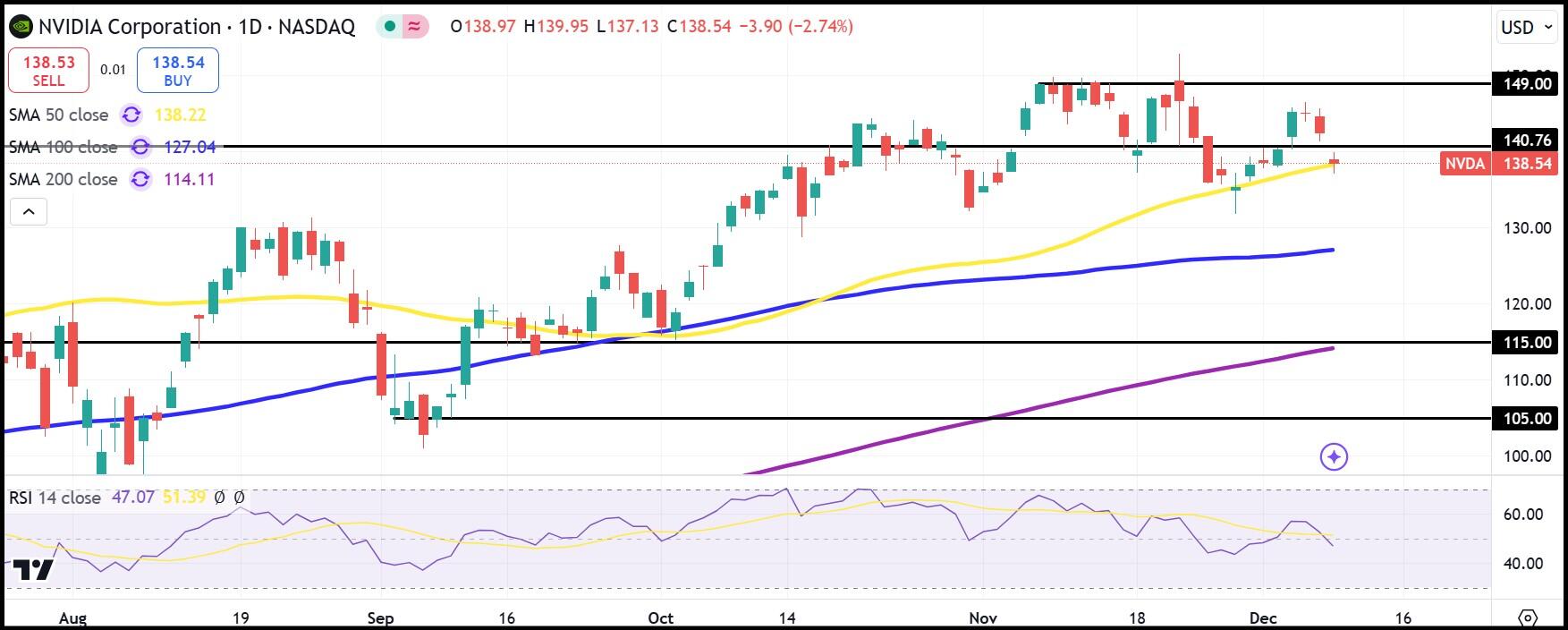
NVDA daily stock chart
Author

Clay Webster
FXStreet
Clay Webster grew up in the US outside Buffalo, New York and Lancaster, Pennsylvania. He began investing after college following the 2008 financial crisis.