Nvidia plunges more than 13% on competition from China's DeepSeek
- Nvidia dove 13% lower on Monday morning as the market digested reports about DeepSeek.
- NVDA hasn't traded at this level near $123 since early October.
- Reports allege that DeepSeek's AI model was built for a fraction of the cost of US-based models.
- DeepSeek's suggestion that it used H800 chips could upend more profitable H100 market.


Nvidia (NVDA) stock collapsed at the open on Monday, down more than 13.7% at the time of writing, due to China releasing an artificial intelligence (AI) platform called DeepSeek that many experts say could dethrone US company’s lead in the AI realm.
Nvidia shares have plunged to near four-month lows below $123, a level it hasn’t traded at since early October.
The NASDAQ shed more than 3% at the open as a number of tech giants sold off in the ensuing massacre tied to AI. The Dow Jones Industrial Average (DJIA) looks comparably safe, down just 0.16% despite containing Nvidia as one of its holdings.
Nvidia stock news
DeepSeek is the name of the Chinese AI research lab founded just two years ago by Liam Wenfeng, who is likewise the founder of the hedge fund that funded the project.
Its open-source AI large language model (LLM) is called DeepSeek-R1, and it’s already a leading download on Apple’s (AAPL) App Store.
Reviewers claim that it already rivals or even outperforms OpenAI's ChatGPT o1 model but required an astoundingly small amount to build. While Microsoft-backed OpenAI racked up many billions of dollars in order to build its LLM, the DeepSeek V3 model on which DeepSeek-R1 is built cost just $5.57 million.
Other experts estimate that the model cost about 96% less than US-based AI models. However, this comparison appears to only include AI training costs and not prior research investments. Bernstein’s Stacy Rasgon denied Deepseek’s price tag was real altogether, which parallels other reporting alleging that DeepSeek appears to have as many as 50,000 H100 chips that it isn’t disclosing. The H800 chips themselves were purchased before the Biden administration extended the semiconductor sanctions to them as well.
"This affordability can democratize access to locally run, cutting-edge AI,” Roth Capital wrote in a research note. “Unlike most frontier models, DeepSeek-R1 is open for reuse under an MIT license, allowing researchers to study, modify and expand the model.”
Its open-source nature, therefore, makes it more likely to overtake its predecessors. What’s more, the lab that produced the model used a much lower number of Nvidia’s H800 chips. The H800 chip is the one that Nvidia built that uses slower data transfer rates in order to circumvent US AI chip sanctions against China.
Researchers say that DeepSeek used just 2,048 H800 chips but built a better LLM than Meta’s Llama 3.1 despite only using 10% of the compute time. This is due to DeepSeek engineers fine-tuning algorithms and software to optimally comport with the H800.
The risk for Nvidia is that other AI shops will reduce their demand for the more profitable H100 chips or similar substitutes and opt for cheaper versions. Both Wedbush Securities and Societe Generale put out investor notes saying that the sell-off was overblown. Both shops agreed that US techs had a better purchase on long-term success but were undeniably impressed with DeepSeek’s breakthrough.
Nvidia stock forecast
Nvidia stock has fallen back into the bottom ascending support region (shown in green below). Although NVDA used it as intraday support in September 2024, Nvidia shares haven't dropped into it since last August. This means that Monday's sell-off might be the real deal and that trades should expect further declines.
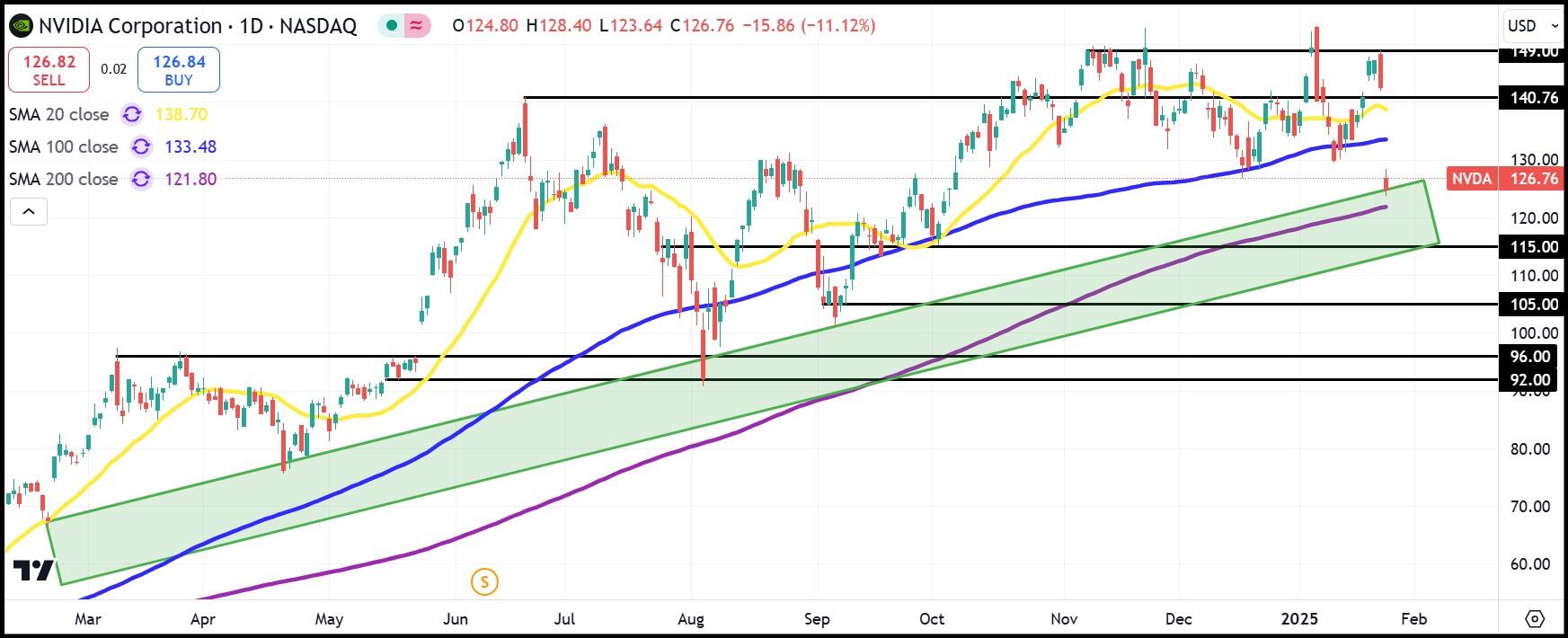
NVDA daily stock chart (zoomed out)
Another data point is that NVDA is within spitting distance of the 200-day Simple Moving Average (SMA), something it hasn't touched since January 2023. Hence, Monday's correction is historic.
While the 200-day SMA, momentarily sitting at $121.79, will be expected to hold, traders may look to the $115 and $105 levels of past support as suitable entry points as well. Below there lie the $92 and $96 levels that have surved as support and resistance in the past year.
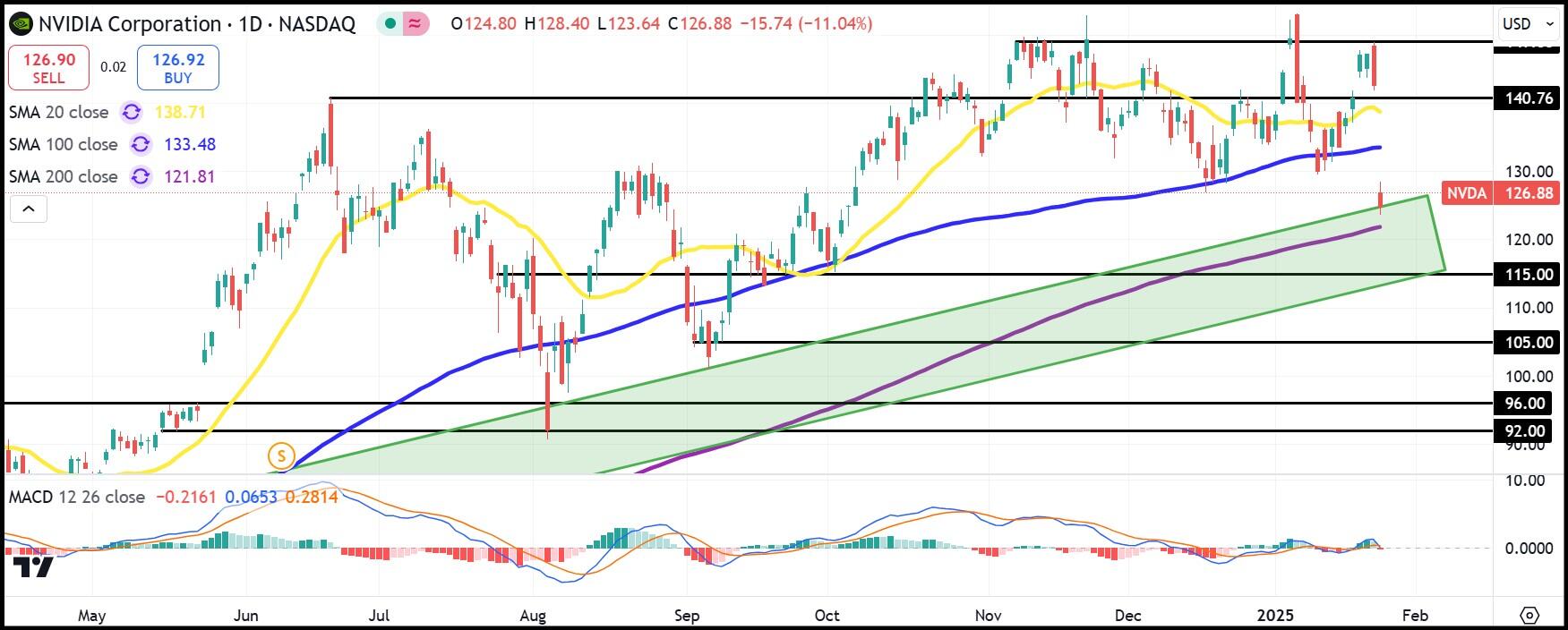
NVDA daily stock chart (zoomed in)
Author
Clay Webster
FXStreet
Clay Webster grew up in the US outside Buffalo, New York and Lancaster, Pennsylvania. He began investing after college following the 2008 financial crisis.