Dow Jones Industrial Average pares recent losses, but tech darlings still swoon
- The Dow Jones tumbled during the overnight session before Monday’s opening bell.
- Trade war fears are back on the table after Trump gets into a political scuffle with Colombia.
- Fresh rate cut hopes are bolstering equities from early week lows.

The Dow Jones Industrial Average (DJIA) dipped into the 44,000 handle during Monday’s early overnight session, driven lower by a fresh bout of souring in investor risk appetite after a Chinese company globally released an open-source competitor to US-based AI models that have been largely proprietary up to this point. Investor sentiment was driven further into the floorboards by a political spat between United States (US) President Donald Trump and Colombia over the weekend after a disagreement between the two countries over the return of Colombian migrants from the US led to President Trump losing his cool and threatening a 50% tariff on all goods imported into the US from Colombia.
Equities rallied in the early hours of the US market session as investor focus pivoted to rate cut hopes from the Federal Reserve (Fed). The Fed is due to deliver its latest rate call later this week, and although the US central bank is broadly expected to stand pat on rates for the time being, traders are ramping up their bets of further rate cuts in 2025. According to the CME’s FedWatch Tool, rate markets are pricing in a full 50 bps of rate trims through the rest of the year, up from last week’s bets of 25 bps.
The tech sector got rattled after a Chinese artificial intelligence lab released their DeepSeek-R1 AI model, making it open source and proving that anybody can develop a heavy-hitter AI model without heavy investment in expensive US-produced silicon and microchips, something that US trade barriers were explicitly instituted to keep out of the hands of the Chinese. With DeepSeek making waves in the AI space, investors are questioning the point of keeping up silicon trade barriers with China and investors who have bought into US-based tech companies providing chip solutions for AI projects are getting nervous.
Dow Jones news
Despite struggling to pare losses and return to Friday’s closing bids, most of the Dow Jones’ listed securities are on the rise during Monday’s US trading session. However, losses are largely contained within key tech darlings, keeping the DJIA off-kilter. Nvidia (NVDA) is taking it on the chin on Monday, down around 17% on the day and trading below $118 per share with the silicon-puncher’s dominance in the AI space getting threatened by spunky Chinese upstart DeepSeek hinting that Nvidia’s market dominance may not last forever, or even for the rest of the year.
What is DeepSeek, and why is it important?
Dow Jones price forecast
The Dow Jones kicked off the new trading week with a fresh test of the 44,000 handle, but the index’s early pivot into the bearish side is facing a fresh upshot from bidders, and it has climbed back into range of 44,400. Despite near-term declines, the major equity index is still tilted firmly toward the bullish side, closing in the green for all but two of the last ten consecutive trading days.
The Dow Jones is still trading on the wrong side of record highs above 45,000 posted last November. Still, equity traders are pushing stocks back up the same old hill as the DJIA climbs from the last major swing low into the 41,700 region.
Dow Jones daily chart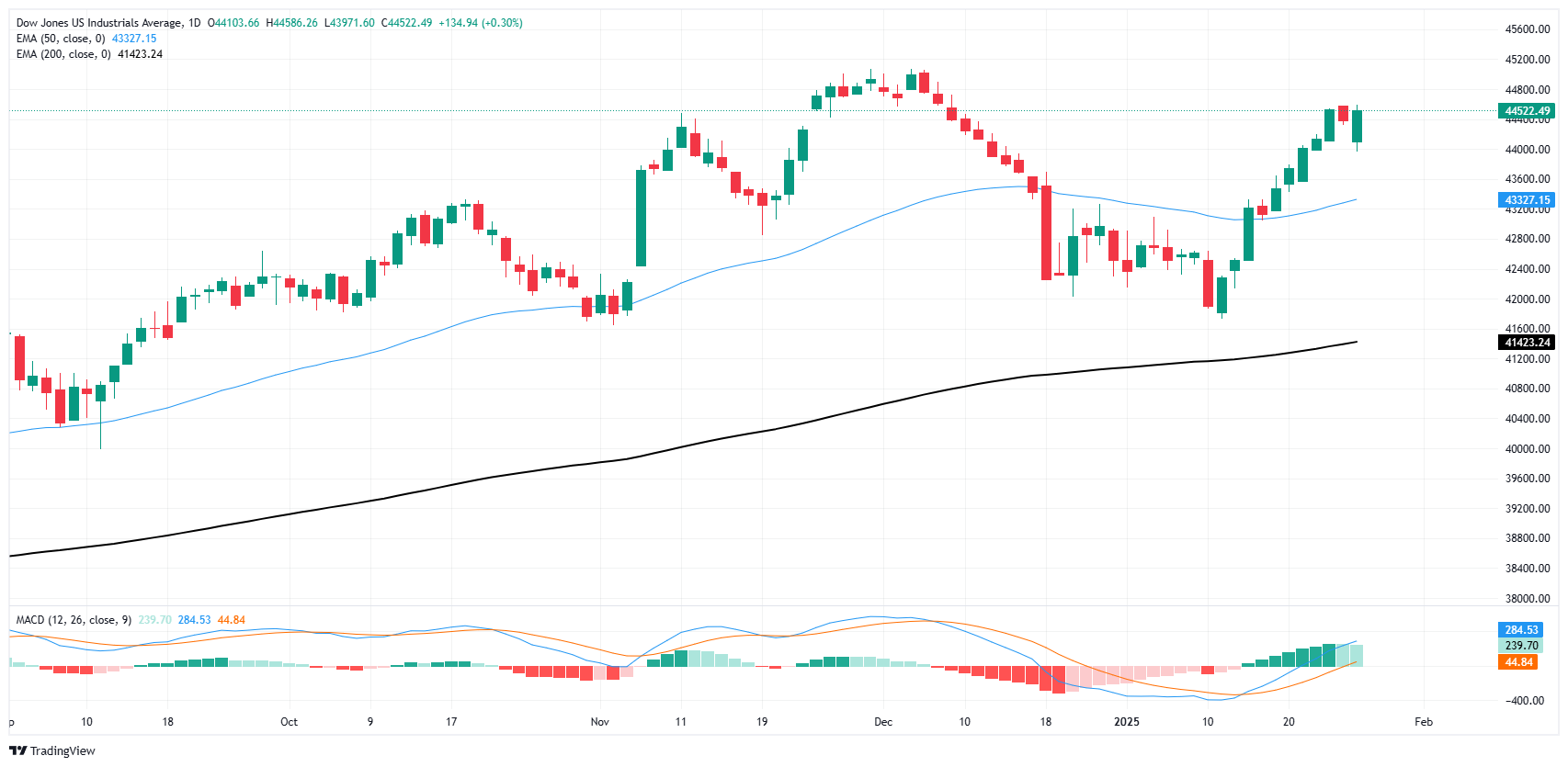
Dow Jones FAQs
The Dow Jones Industrial Average, one of the oldest stock market indices in the world, is compiled of the 30 most traded stocks in the US. The index is price-weighted rather than weighted by capitalization. It is calculated by summing the prices of the constituent stocks and dividing them by a factor, currently 0.152. The index was founded by Charles Dow, who also founded the Wall Street Journal. In later years it has been criticized for not being broadly representative enough because it only tracks 30 conglomerates, unlike broader indices such as the S&P 500.
Many different factors drive the Dow Jones Industrial Average (DJIA). The aggregate performance of the component companies revealed in quarterly company earnings reports is the main one. US and global macroeconomic data also contributes as it impacts on investor sentiment. The level of interest rates, set by the Federal Reserve (Fed), also influences the DJIA as it affects the cost of credit, on which many corporations are heavily reliant. Therefore, inflation can be a major driver as well as other metrics which impact the Fed decisions.
Dow Theory is a method for identifying the primary trend of the stock market developed by Charles Dow. A key step is to compare the direction of the Dow Jones Industrial Average (DJIA) and the Dow Jones Transportation Average (DJTA) and only follow trends where both are moving in the same direction. Volume is a confirmatory criteria. The theory uses elements of peak and trough analysis. Dow’s theory posits three trend phases: accumulation, when smart money starts buying or selling; public participation, when the wider public joins in; and distribution, when the smart money exits.
There are a number of ways to trade the DJIA. One is to use ETFs which allow investors to trade the DJIA as a single security, rather than having to buy shares in all 30 constituent companies. A leading example is the SPDR Dow Jones Industrial Average ETF (DIA). DJIA futures contracts enable traders to speculate on the future value of the index and Options provide the right, but not the obligation, to buy or sell the index at a predetermined price in the future. Mutual funds enable investors to buy a share of a diversified portfolio of DJIA stocks thus providing exposure to the overall index.
Author

Joshua Gibson
FXStreet
Joshua joins the FXStreet team as an Economics and Finance double major from Vancouver Island University with twelve years' experience as an independent trader focusing on technical analysis.

















