|premium|

Nike beat on earnings, so why the panic as NKE stock slides 10%?

  • Nike released earnings on Thursday, beating on the top and bottom lines.
  • Nike reported having higher inventory than wanted.
  • NKE  fell nearly 10% in afterhours trading.

Nike (NKE) was on the minds of investors Thursday as the sportswear giant unveiled its latest set of quarterly earnings. The headline results looked promising, but the stock still tanked 10% afterhours.

Nike stock news

Earnings per share (EPS) was forecast at $0.92, and it came in at $0.93. The revenue consensus forecast was at $12.2 billion and again the figure came in ahead at $12.7 billion. So far so good, right? Well, the devil is always in the details.

Inventories were up nearly $10 billion versus a year ago, a large increase. Margins were down to 44.3%, nearly two percentage points lower than last year. Margins were hit by logistics costs and that old chestnut, the strong dollar. Get ready for a swath of dollar-related margin issues in the Q3 earnings season. Nike said for 2023 it expects a $4 billion headwind from the strong dollar and a $900 million hit to bottom line EBITDA.

"Based on current spot rates, net of hedging activity, we estimate the full-year negative impact of foreign exchange on reported revenue and EBIT to now be approximately $4 billion and $900 million, respectively, creating a wide divergence in constant versus real dollar performance. [...] For the second quarter specifically, we expect reported revenue to grow low double digits on strong consumer demand despite 900 basis points of foreign exchange headwinds" said Nike CFO Matthew Freind.

Nike stock forecast

Nike was already in a powerful downtrend, and this has only added to it. Post or premarket, whichever is your fancy, Nike stock has cracked the psychological $90 area and then the pandemic support step at $92. This now opens the door to an extended decline to $60, the pandemic low. This is a huge discount to current levels but is the long-term trend.

Adding to the bearish outlook is the fact that Nike stock has cracked the 200-week moving average. This is a feat rarely achieved. The next key support is $84.26. This needs to be watched in the regular session for a reaction from the Relative Strength Index (RSI). Currently, we have a bullish divergence, which could indicate a possible short-term bottom. 
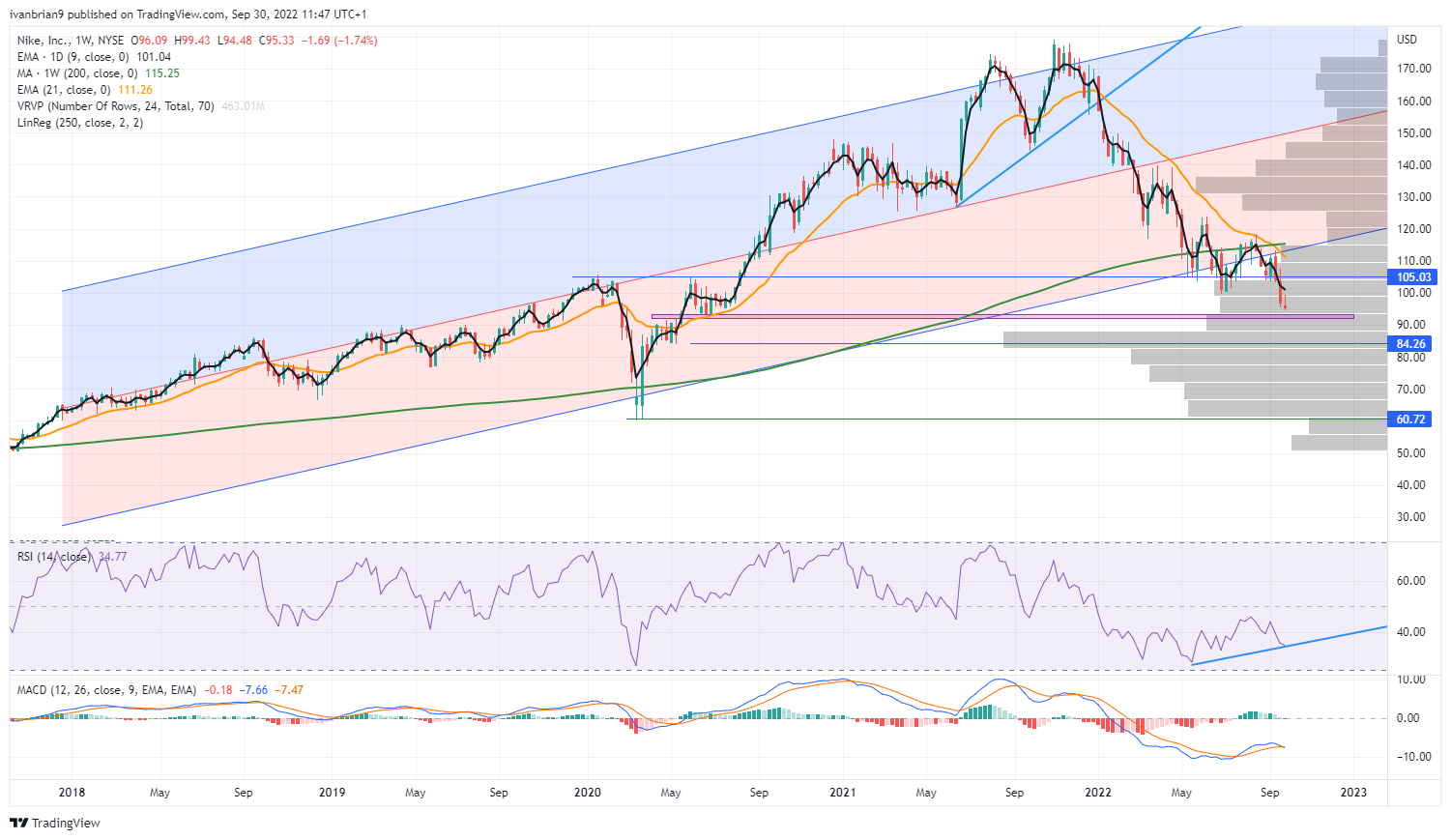
NKE weekly chart

Premium

You have reached your limit of 3 free articles for this month.

Start your subscription and get access to all our original articles.

Subscribe to PremiumSign In

Author

Ivan Brian

Ivan Brian

FXStreet

Ivan Brian started his career with AIB Bank in corporate finance and then worked for seven years at Baxter. He started as a macro analyst before becoming Head of Research and then CFO.


More from Ivan Brian
Share:

Editor's Picks

GBP/USD bounces off lows, back above 1.3200

After bottoming out near 1.3160, GBP/USD manages to regain a bit of shine and reclaim the 1.3200 mark and beyond at the end of the week. Stronger-than-expected UK Retail Sales data seem to be helping the British Pound limit its losses, while the chaotic UK political environment keeps the bulls at bay for now.

EUR/USD looks consolidative around 1.1460

EUR/USD stages a modest rebound after slipping to a three-month low below 1.1420 at the end of the week. That said, the pair now looks to consolidate humble gains just above 1.1460 despite growing uncertainty surrounding the next round of US-Iran negotiations, which keeps the US Dollar’s downside contained.

Gold slips back to six-day lows, targets $4,100

Gold retreats for the third consecutive day on Friday, eroding gains seen in the first half of the week and approaching the key $4,100 mark per troy ounce. Indeed, the precious metal continues to face headwinds from the Fed's hawkish stance and renewed uncertainty surrounding the next round of US-Iran negotiations.

Breaking: Iran closes the Strait of Hormuz amid ceasefire deal violation
Iran says it is closing the Strait of Hormuz after accusing the United States (US) and Israel of violating the ceasefire. According to Iran, the decision came over the continued Israeli strikes in Lebanon. The Iranian Revolutionary Guard Corps Navy issued a warning to all vessels: "Do not approach the Strait of Hormuz; otherwise, your security will be jeopardized."
The Iran war didn't break the US economy, but what happens next?

Nearly four months after the start of the Iran war, the US economy remains remarkably resilient. While the conflict initially triggered a severe disruption to global energy markets and a sharp rise in Oil prices, recent diplomatic progress between Washington and Tehran has eased concerns about a prolonged supply shock.

Regime change: Inside Kevin Warsh's first move to make the Fed unreadable on purpose

The rate did not move. That was the least interesting thing about Kevin Warsh's first meeting in charge of the Fed. The FOMC held its benchmark at 3.50%-3.75% for the fourth straight meeting, exactly as priced, and then the new chair used his first press conference to dismantle the machinery the market has leaned on for a decade.

Nike beat on earnings, so why the panic as NKE stock slides 10%?














