|

New Zealand labor report sinks NZD

New Zealand labor report sinks NZD

Statistics New Zealand has released the employment as follows:

  • New Zealand Unemployment Rate Q4: 3.4% (est 3.3%; prev 3.3%).
  • Employment Change (QoQ) Q4: 0.2% (est 0.3%; prev 1.3%).
  • Employment Change (YoY) Q4: 1.3% (est 1.5%; prev 1.2%).
  • Participation Rate Q4: 71.7% (est 71.7%; prev 71.7%).

NZD/USD is breaking structures in a 27 pips drop:
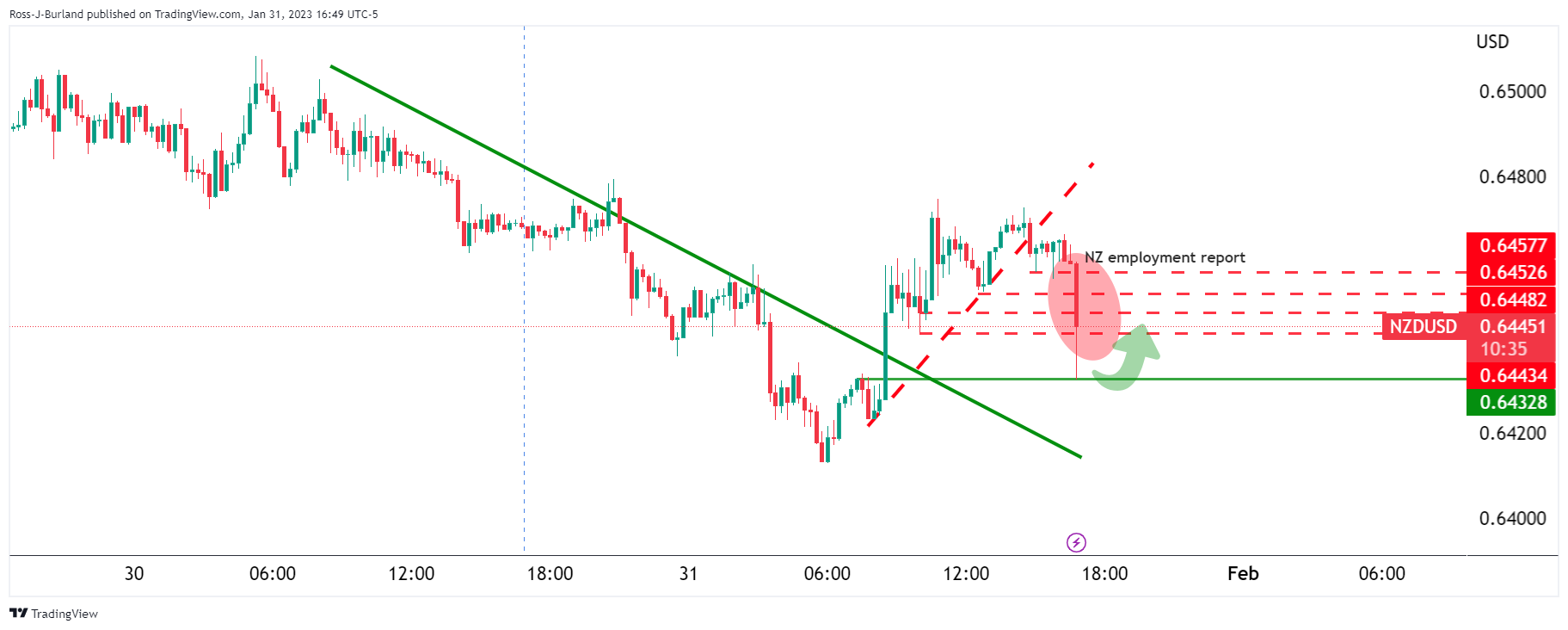
The data is not as strong as the market was expecting and hence the Kiwi is losing ground at a rapid pace.

About New Zealand employment data 

Statistics New Zealand releases employment data on a quarterly basis. The statistics shed a light on New Zealand’s labor market, including unemployment and employment rates, demand for labor and changes in wages and salaries. These employment indicators tend to have an impact on the country’s inflation and Reserve Bank of New Zealand’s (RBNZ) interest rate decision, eventually affecting the NZD. A better-than-expected print could turn out to be NZD bullish.

Author

Ross J Burland

Ross J Burland, born in England, UK, is a sportsman at heart. He played Rugby and Judo for his county, Kent and the South East of England Rugby team.


More from Ross J Burland
Share:

Editor's Picks

AUD/USD recovers from YTD low; bulls seem hesitant below 0.6650

AUD/USD kicks off the new week on a positive note, snapping a three-day losing streak to the YTD low set Friday, though  the upside seems limited. The US Dollar trades near April 2025 highs amid firming Fed rate-hike bets and geopolitical uncertainties. This, along with Australia’s dismal flash PMIs and the RBA’s dovish tilt, could cap the Aussie.

USD/JPY climbs back to 159.00 amid BoJ uncertainty, bullish USD undertone

USD/JPY attracts buyers at the start of the week, reversing part of Friday’s fall to an over one-week low as uncertainty over the pace of BoJ rate hikes undermines the Japanese Yen. Meanwhile, the US Dollar sits near April 2025 highs amid hawkish Fed bets and Middle East jitters, further supporting the currency pair, though intervention risks could cap gains.

Gold bounces off September 2025 low; seems vulnerable below $3,600

Gold opens with a modest gap up on Monday as bears turn cautious after the recent slump to $3,500, or the September 2025 low, touched on Friday. Meanwhile, the US Dollar sits near a 19-month high amid geopolitical uncertainties and hawkish Fed expectations, capping upside for non-yielding bullion and warranting caution for bulls.

The week ahead: Flash PMIs and PCE inflation in focus ahead of Thanksgiving
The US dollar extended its rally this week, continuing to be driven by the hawkish market repricing of the Fed’s implied rate path. Following the strong nonfarm payrolls for October, the hotter-than-expected CPI data for the same month and hawkish remarks by several Fed officials, investors became convinced that the Fed will press the hike button when it meets on December 8-9.
Week ahead – Flash PMIs and PCE inflation in focus ahead of Thanksgiving

US flash PMIs and PCE inflation data could shape Fed rate expectations. Eurozone and UK PMIs will offer an early look at business activity. Australia’s CPI data could influence expectations for the RBA’s next move.

Gold's 14-month low looks mild next to Silver's fall from $121 to $44
Gold has lost a third of its value since January as traders bet on more Federal Reserve rate increases. Silver has lost nearly two-thirds, because the buyers still holding Gold up have no equivalent in the Silver market. Gold is trading below $3,700 for the first time since September 2025, a little more than a third under the record near $5,600 it set in late January.