Mullen Automotive Stock Forecast: MULN price trades higher amid manipulation lawsuit
- Mullen is suing TD Ameritrade, Charles Schwab, National Finance Services for alleged stock manipulation.
- MULN stock has lost the initial share price gain from the lawsuit announcement.
- NASDAQ 100 futures have ticked slightly higher on Thursday.
- Mullen is represented by Christian Attar and Warshaw Burstein law firms.

Mullen Automotive (MULN) stock rose 1% at the start of trading on Thursday, alongside the NASDAQ Composite that has risen nearly 0.5% as the market views a November interest rate hike as less and less likely. MULN shed 5.2% on Wednesday despite the announcement earlier in the week that the company was suing several of the nation’s largest brokerages for alleged stock manipulation.
The lawsuit comes on the heels of Mullen’s inability to keep its share price above $1.00 – the level required for ten consecutive sessions leading up to September 5 in order to remain listed on the NASDAQ exchange.
MULN closed Wednesday at $0.5641 per share.
Mullen stock news
On Tuesday, Mullen management announced the lawsuit brought through lawyers hired from law firms Christian Attar and Warshaw Burstein in the Southern District of New York. The EV automaker argues that TD Ameritrade, Charles Schwab, National Finance Services and others were “engaged in a scheme to manipulate the share price of [Mullen’s] securities.”
“I have been extremely frustrated by the performance of our stock and long-suspected illegal short-selling activities,” said Mullen CEO David Michery in a statement.
The “illegal short-selling activities” specified by Michery likely involve what is termed “naked short-selling”. This is when a short-seller bets against the stock price of a security like MULN without first borrowing the shares on the open market.
Earlier this summer, Mullen had already hinted that the lawsuit was in the making as Michery had announced the hiring of the Share Intel firm to research whether or not an illegal short-selling campaign was taking place.
None of the brokers commented on the ongoing lawsuit, for which Mullen is seeking compensatory damages. The news initially sent MULN stock up above $0.67 on Tuesday before selling off for a slight loss in the session.
The same day Mullen said it had so far spent $5.6 million of its $25 million board-approved buyback policy, which runs through the end of the year, in order to repurchase common stock. The company repurchased 2 million more shares since announcing the purchase of 3.7 million shares on August 17.
However, the repurchase scheme would seem to be too little, too late as the company needed to push its share price above $1.00 by August 23 in order to meet the strictures of the NASDAQ exchange for remaining listed. The exchange told Mullen management back in May that it would need to keep its share price above that level for ten consecutive trading sessions before September 5 in order to remain listed. Despite two reverse stock splits in 2023, Mullen has been unable to achieve price stability above the $1.00 level.
Mullen Automotive FAQs
What is Mullen Automotive?
Mullen Automotive is a publicly-traded development-stage electric vehicle company based in Brea, California that typically uses outside partnerships to manufacture its vehicles. The company was founded in 2014 and currently sells self-designed electric delivery vehicles. Besides its commercial offerings, Mullen plans to begin manufacturing its Mullen FIVE EV crossover in late 2024 or early 2025. Mullen Automotive went public on the NASDAQ exchange through a reverse merger in late 2021.
Who is the team behind Mullen Automotive?
David Michery has been the company’s CEO since he founded and incorporated the company in 2014. The existing company came from the merging of CODA Automotive and Mullen Motor Cars through acquisition. Michery is joined by Chief Financial Officer Jonathan New, Chief Commercial Officer John Schwegman and President of the Automotive Division Calin Popa.
What vehicles does Mullen Automotive currently offer?
Through a partnership with Randy Marion Automotive Group, Mullen distributes its Mullen One delivery van that has an electric range of 110 miles. Through an agreement with a Chinese manufacturer and distributor based in Ireland, the company also distributes the Mullen-GO Commercial Urban Delivery EV in Europe. In July 2023, Mullen will begin commercial production at its facility in Mississippi of its Class 3 EV Cab Chassis long-haul truck for immediate delivery. Through its 60% ownership stake in Bollinger Motors, Mullen will also reap the benefits of that company’s B1 SUV and B2 pickup truck, as well as other commercial vehicles in the future. The Mullen FIVE crossover vehicle is not slated for production until at least late 2024, but it is already taking reservations.
Why does MULN stock trade for such a low share price?
Mullen has been diluting its stock since going public in late 2021. This is because the company as of yet currently has little revenue from operations and no profits. The stock has fallen over 99% since the company’s reverse merger in November 2021, and the rapid dilution is mostly to blame. Taking into account Mullen’s 1-for-25 reverse stock split on May 4, 2023, Mullen had 33,338,727 shares outstanding on September 30, 2022, but 126,281,274 shares on March 31, 2023. The company is allowed to sell up to 200 million shares under current authorization.
Mullen stock forecast
Mullen stock has been unable to sustain any stock rally in 2023 after an extremely dilutive bout of management’s renewed share sales. Now that MULN is headed to the pink sheets or over-the-counter market, even fewer shareholders want to hang onto the stock. Expect MULN to retouch and then break through the $0.39 floor created on August 23.
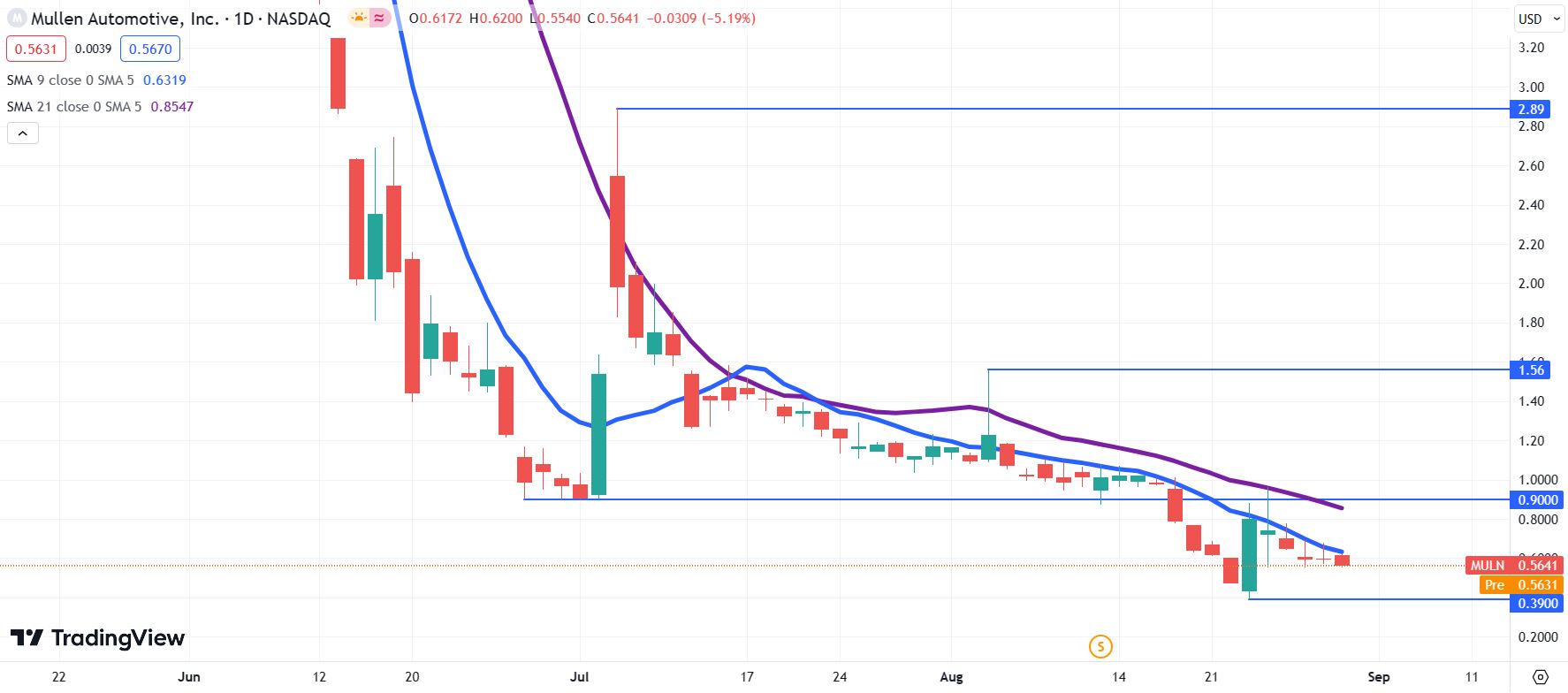
MULN daily chart
Author

Clay Webster
FXStreet
Clay Webster grew up in the US outside Buffalo, New York and Lancaster, Pennsylvania. He began investing after college following the 2008 financial crisis.