Mexican Peso makes gains on positive lift from market sentiment
- The Mexican Peso trades higher in its key pairs on the back of a posiitve shift in market sentiment.
- USD/MXN is impacted by a perceived change in stance from the Federal Reserve after a speech by its Chairman Powell on Tuesday.
- In Europe, political factors relating to up-and-coming elections impact EUR/MXN and GBP/MXN

The Mexican Peso (MXN) trades higher in its most traded pairs on Wednesday, helped by upbeat market sentiment. European bourses rose as investor's expect lower borrowing costs for companies following a fall in Eurozone Producer Price Index (PPI) inflation data. This was backed up by commentary from European Central Bank (ECB) officials saying there could be further interest-rate cuts before the end of the year.
In the US, meanwhile, the S&P 500 is edging higher as the US session gets underway although the good mood from the morning has subsided somewhat. The US Dollar (USD) is weakening against the Mexican Peso, however, after a speech by the Chairman of the Federal Reserve (Fed) Jerome Powell on Tuesday reflected a change in stance from the more cautious rhetoric that preceded it.
Heightened political risk in Europe, meanwhile, ahead of key elections in France and the United Kingdom is causing volatility for the Euro and capping gains for the Pound Sterling.
At the time of writing, one US Dollar (USD) buys 18.19 Mexican Pesos, EUR/MXN trades at 19.62, and GBP/MXN at 23.17.
Mexican Peso rises versus the US Dollar after Powell speech
The Mexican Peso is rising against USD after a speech by Fed Chairman Jerome Powell on Tuesday took investors by surprise after the hitherto cautious commentary of his colleagues. Powell touted progress on inflation, which suggested the Fed was now closer to cutting interest rates. Lower interest rates are negative for a currency as they reduce foreign capital inflows.
The US Dollar’s downside is capped, however, by an increase in the chances that former US President Donald Trump could win the US presidential election in November. One hurdle on his path to the White House was removed on Monday when the US Supreme Court ruled he had partial immunity from charges he incited the uprising that followed his election defeat in 2020. Meanwhile, his rival, President Joe Biden is facing questions about his mental capacity following several gaffs made during a televised debate last Thursday.
Europe on the march
The Euro is holding up better against the Mexican Peso as risks subside that the far-right French National Rally (RN) party will gain an overall majority in the second round of the French elections on July 7. Although RN won the biggest share of the vote during the first round, the remaining centrists and socialists have formed a coalition to try to prevent RN from winning an outright majority in the second round.
This coalition has left many moderate voters with stark choices, according to Reuters, and there is a risk they could boycott the election in many constituencies where neither extreme appeals to them. However, the coalition will make it harder for RN to win an outright majority, alleviating pressure on the Euro, which had been weakening due to concerns an RN government would destabilize the EU.
Pound capped by UK’s fiscal woes
The Pound Sterling (GBP) is capped against the Mexican Peso by growing concerns about the UK’s finances ahead of the UK general election on July 4, according to Reuters.
With little room for fiscal maneuver to kick-start growth through tax or spend policies, the new government may turn to the BoE to provide the necessary stimulus. This could mean the central bank lowers interest rates sooner than imagined, resulting in a weaker Pound. The supposed “independence” of the BoE, however, is one counterargument against this view; another is the still-hot wage inflation in the UK, which will prevent the BoE from cutting interest rates in the near term, according to Philip Bokeloh, Senior Economist at Abn Amro.
Technical Analysis: USD/MXN trades in a short-term range
USD/MXN meanders in a range after pulling back from its June 28 swing high at 18.59. It is currently at the lower end of the range, trading in the 18.20s. It is possible the pair is entering a sideways trend although it is still a little too early to be sure.
USD/MXN 4-hour Chart
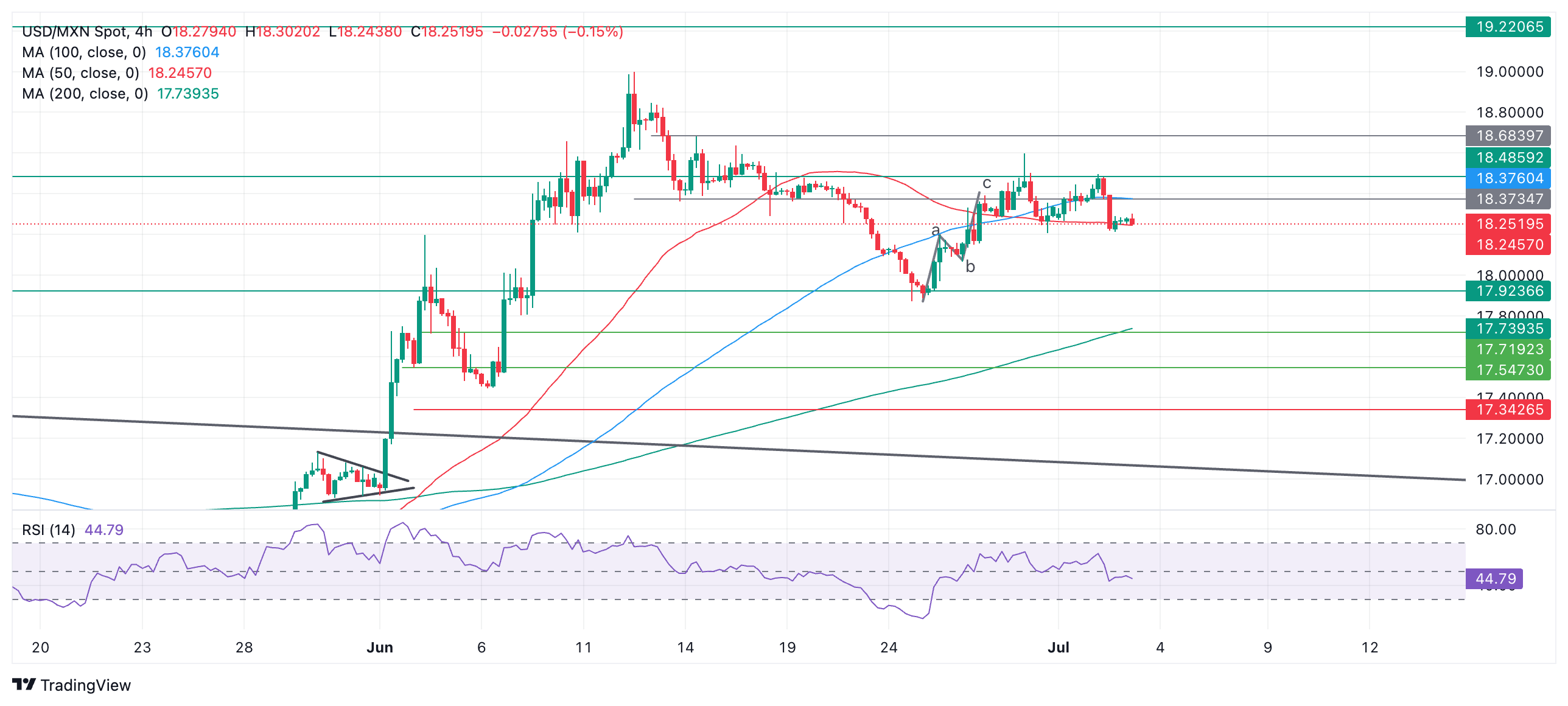
If USD/MXN rallies and breaks above 18.59 it will make a higher high and likely continue up to 18.68 (June 14 high), followed by 19.00 (June 12 high). A break above 19.00 would provide strong confirmation of a resumption of the short-and-intermediate term uptrends.
A move below 18.06 (June 26 low), however, would suggest the short-term downtrend was resuming and probably see a continuation down to 17.87 (June 24 low).
The direction of the long-term trend remains in doubt.
Mexican Peso FAQs
The Mexican Peso (MXN) is the most traded currency among its Latin American peers. Its value is broadly determined by the performance of the Mexican economy, the country’s central bank’s policy, the amount of foreign investment in the country and even the levels of remittances sent by Mexicans who live abroad, particularly in the United States. Geopolitical trends can also move MXN: for example, the process of nearshoring – or the decision by some firms to relocate manufacturing capacity and supply chains closer to their home countries – is also seen as a catalyst for the Mexican currency as the country is considered a key manufacturing hub in the American continent. Another catalyst for MXN is Oil prices as Mexico is a key exporter of the commodity.
The main objective of Mexico’s central bank, also known as Banxico, is to maintain inflation at low and stable levels (at or close to its target of 3%, the midpoint in a tolerance band of between 2% and 4%). To this end, the bank sets an appropriate level of interest rates. When inflation is too high, Banxico will attempt to tame it by raising interest rates, making it more expensive for households and businesses to borrow money, thus cooling demand and the overall economy. Higher interest rates are generally positive for the Mexican Peso (MXN) as they lead to higher yields, making the country a more attractive place for investors. On the contrary, lower interest rates tend to weaken MXN.
Macroeconomic data releases are key to assess the state of the economy and can have an impact on the Mexican Peso (MXN) valuation. A strong Mexican economy, based on high economic growth, low unemployment and high confidence is good for MXN. Not only does it attract more foreign investment but it may encourage the Bank of Mexico (Banxico) to increase interest rates, particularly if this strength comes together with elevated inflation. However, if economic data is weak, MXN is likely to depreciate.
As an emerging-market currency, the Mexican Peso (MXN) tends to strive during risk-on periods, or when investors perceive that broader market risks are low and thus are eager to engage with investments that carry a higher risk. Conversely, MXN tends to weaken at times of market turbulence or economic uncertainty as investors tend to sell higher-risk assets and flee to the more-stable safe havens.
Author

Joaquin Monfort
FXStreet
Joaquin Monfort is a financial writer and analyst with over 10 years experience writing about financial markets and alt data. He holds a degree in Anthropology from London University and a Diploma in Technical analysis.