|

Mayhem as Turkey’s President Recep Tayyip Erdogan fires central bank governor

  • Turkish central bank governor sacked in the wee hours of the night and replaced immediately.
  • The lira is likely to lose traction against USD come Monday; projected down leg eyes the 100 SMA and the 50 SMA.

Turkey’s central bank Governor, Murat Uysal, has been fired by the country’s President, Recep Tayyip Erdogan. Uysal was shown the door on Friday night in what could be a typical move to avoid direct market reaction as well as scrutiny from the press.

A former foreign minister has already been chosen to replace the outgoing governor. The decision to have Uysal out of his job barely 16 months after appointment comes amid a record slump in the Turkish lira which has elevated the danger of a currency crisis.

TRY likely to lose ground against USD

USD/TRY closed the trading on Friday at 8.5227 after hitting a wall at 8.6000. Since early November, the TRY has consolidated between 8.4000 and 8.6000. However, with the news regarding the sacking of the governor hitting the market on Monday, a leg down under the 50 Simple Moving Average could be seen. If sell orders increase, the pair could crumble to the 100 SMA in the 4-hour time frame.
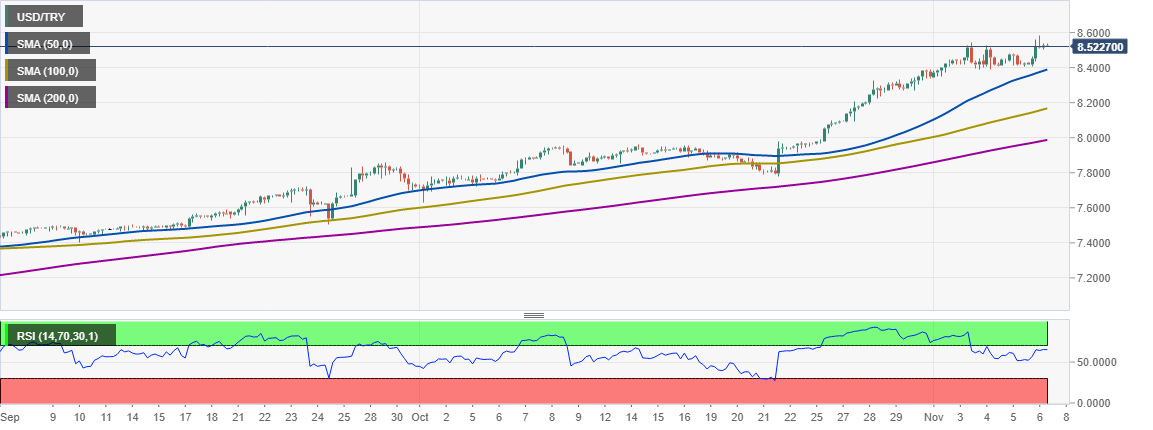
USD/TRY price chart

USD/TRY 4-hour chart

On the other hand, robust support is expected at 8.4000 which might see a rebound by the lira. It is worth noting that the bearish outlook will be invalidated if TRY gains ground against USD and breaks above the range resistance at 8.6000.

Author

John Isige

John Isige

FXStreet

John Isige is a seasoned cryptocurrency journalist and markets analyst committed to delivering high-quality, actionable insights tailored to traders, investors, and crypto enthusiasts. He enjoys deep dives into emerging Web3 tren


More from John Isige
Share:

Editor's Picks

GBP/USD off highs, back to 1.3620

GBP/USD remains slightly on the defensive at the end of the week, receding to the low 1.3600s after hitting fresh tops past 1.3670 earlier in the day. Cable’s correction comes after two daily gains in a row and amid a tepid advance in the Greenback, while poor UK data also accompany the downside.

EUR/USD treads water below 1.1700

EUR/USD now trades with modest losses around 1.1670 following another unsuccessful atempt to advance past 1.1700 the figure in a convincing fashion. The pair’s decline follows a maginal rebound in the US Dollar as market participants continue to assess recent US data as well as developments from the US bond market.

Gold trims gains, recedes to the sub-$4,600 area

Gold rapidly leaves behind Thursday’s inconclusive price action and advances markedly on Friday, briefly surpassing the $4,600 mark per troy ounce to hit three-month peaks. Meanwhile, the precious metal’s solid performance comes despite marginal gains in the buck coupled with another day of rising US Treasury yields across the curve.

Week ahead: Fed’s Jackson Hole and Nvidia earnings to dictate markets
The new Fed chair, Kevin Warsh, has made few public appearances since taking the central bank helm in May, yet he’s found it difficult to steer off controversy. Question marks about his relations with the President, Donald Trump, continue to swirl, while markets are still trying to make sense of his approach to monetary policy.
CFTC Report: Oil positioning rebounds; VIX and Yen exposure turn more bearish
The week in one sentence: Speculative positioning turned more constructive in the week to August 18. WTI recorded the largest increase, followed by a sharp narrowing in CAD net shorts. VIX and JPY positioning moved the other way, while Gold remained the clearest crowded long despite a softer spot price.
$20 billion offered, $2 billion taken: Why Treasury doubled its buyback cap

The US Treasury moved off its own calendar on Wednesday, and that is the part worth sitting with. At 12:32 GMT, the department said it would at least double the size of liquidity support buyback operations in the 10-year to 20-year and 20-year to 30-year sectors, lifting the maximum from $2 billion per operation to at least $4 billion, effective September 9 and running to November 4.