Oil at a critical breakpoint: Will geopolitics trigger the next major move?


Slowing data, rising geopolitical risk
The week ahead blends two powerful forces: moderating economic momentum and increasing geopolitical tension. While US and Eurozone data suggest steady but unspectacular growth, rising friction between the US and Iran is injecting a fresh risk premium into energy markets.
Macro is softening — but geopolitics may dominate price action.
Weekly outlook
United States
ISM manufacturing and services (Mon/Wed)
January’s ISM readings were notably strong, signaling resilient activity at the start of the year. However, February’s regional Fed surveys tell a slightly different story, pointing to some cooling in momentum. We expect that moderation to appear in this week’s national ISM releases.
Input costs remain a watchpoint. Oil prices have climbed recently as tensions between the US and Iran have intensified. That rise is likely keeping the prices-paid components elevated, reinforcing the message that inflation pressures are not fading quickly.
Jobs report (Fri)
Underlying job growth appears modest — around 50,000 per month — but heavily concentrated in private education and healthcare. These sectors have driven the majority of employment gains in recent years, highlighting limited breadth across the labor market.
We expect the unemployment rate to tick back up to 4.4% after last month’s surprise decline. Even so, this does not materially alter the Federal Reserve’s trajectory. Rate cuts remain unlikely before mid-year in our view.
Eurozone
February inflation (Tue)
Inflation cooled to 1.7% in January, largely due to energy base effects, and core inflation is moving closer to the ECB’s target. February’s reading is unlikely to shift that narrative significantly, though rising energy prices could nudge the headline slightly higher.
The ECB appears to be in a relatively stable position for now.
January unemployment (Wed)
Despite ongoing debates about AI’s labor impact, eurozone unemployment remains near historic lows. Vacancy rates have normalized, but joblessness remains resilient. No major change is expected in the upcoming release.
US Oil: Testing the descending channel
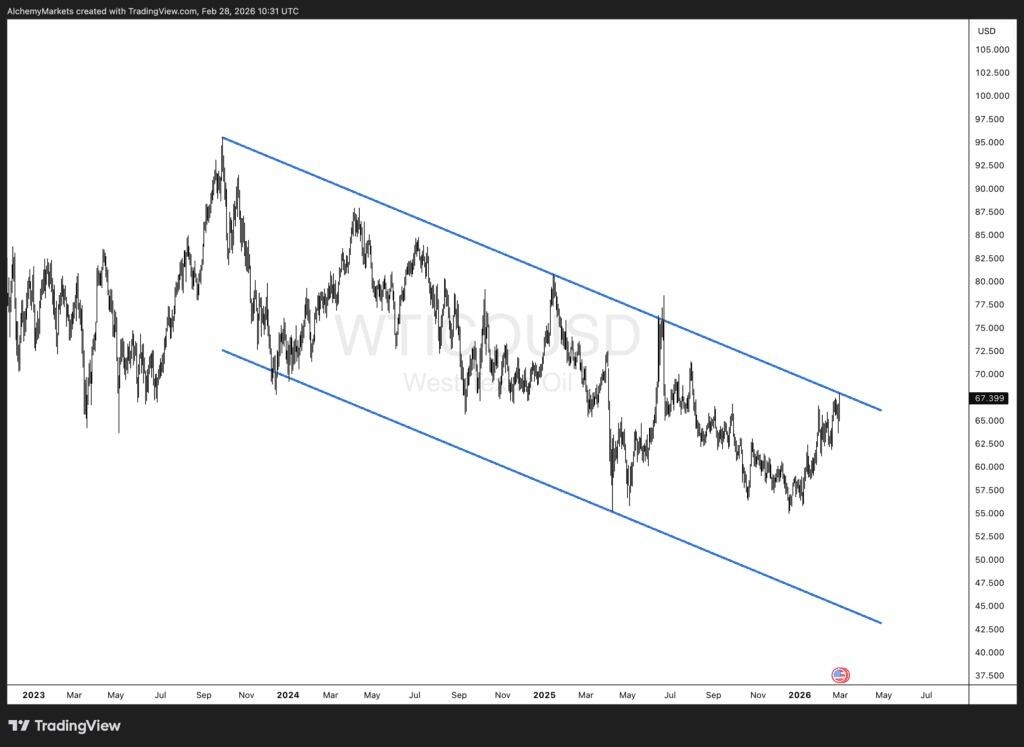
US Oil is sitting at a technically significant level. Price is pressing against the upper boundary of a well-defined descending channel that has guided the broader downtrend over the past two years.
This level is pivotal.
A clean break above the channel resistance would signal a potential trend shift and open room for a broader recovery toward the mid-$70s and possibly beyond. Momentum indicators are firming, suggesting buyers are probing for a breakout.
However, rejection at this trendline would reinforce the prevailing downtrend structure and could send prices back toward the lower channel boundary.
The geopolitical backdrop adds weight to this setup. Escalating US–Iran tensions increase the probability of supply disruptions in the Middle East — particularly around key transit routes such as the Strait of Hormuz. Any direct confrontation, sanctions escalation, or disruption to exports would likely tighten global supply expectations and push prices higher.
In short:
- Technicals say: Decision point.
- Geopolitics say: Upside risk is real.
- Macro data say: Demand growth may be moderating.
This combination suggests elevated volatility risk.
Author
Zorrays Junaid
Alchemy Markets
Zorrays Junaid has extensive combined experience in the financial markets as a portfolio manager and trading coach. More recently, he is an Analyst with Alchemy Markets, and has contributed to DailyFX and Elliott Wave Forecast in the past.