Japanese Yen pares modest intraday losses against mostly flat USD; US CPI awaited
- The Japanese Yen remains depressed amid mixed BoJ rate hike cues and a positive risk tone.
- However, the divergent BoJ-Fed policy expectations keep a lid on further gains for USD/JPY.
- Traders also seem reluctant and opt to wait for the release of the US consumer inflation data.

The Japanese Yen (JPY) recovers slightly from a one-week low touched against its American counterpart earlier this Tuesday, though the upside seems limited amid the mixed Bank of Japan (BoJ) rate hike cues. Investors now seem convinced that the prospects for further policy normalization by the BoJ could be delayed further on the back of domestic political uncertainty and the potential negative impact of higher US tariffs on the economy. Apart from this, the prevalent risk-on environment should contribute to capping the safe-haven JPY.
However, an upward revision in the forecast for inflation by the BoJ backs the case for an imminent interest rate hike by the end of this year. This marks a significant divergence in comparison to dovish Federal Reserve (Fed) expectations, which keeps the US Dollar (USD) bulls on the defensive and offers some support to the lower-yielding JPY. Traders also seem reluctant and opt to wait for the release of the latest US consumer inflation figures, which will drive the USD demand and provide some meaningful impetus to the USD/JPY pair.
Japanese Yen traders opt to wait for US CPI report before placing fresh directional bets
- Data released last week showed that inflation-adjusted real wages in Japan fell for the sixth straight month in June and fueled concerns about a consumption-led recovery. This comes on top of growing worries about Japan's fiscal health amid calls from the opposition to boost spending and cut taxes, especially after the ruling Liberal Democratic Party’s loss in the upper house election on July 20.
- Investors appeared to largely shrug off the latest tariff escalation, which is evident from the underlying bullish tone around the global equity markets. This further contributes to the safe-haven Japanese Yen's relative underperformance against the US Dollar for the third consecutive day on Tuesday and lifts the USD/JPY pair to a one-and-a-half-week high during the Asian session.
- The BoJ's Summary of Opinions released last Friday showed that policymakers debated the likelihood of resuming interest rate increases. Furthermore, the BoJ had revised up its inflation outlook in July, and reiterated that it will hike interest rates further if growth and inflation continue to advance in line with its estimates. This, in turn, might hold back the JPY bears from placing aggressive bets.
- Traders are overwhelmingly betting that the US Federal Reserve will resume its rate-cutting cycle in September and deliver at least two 25-basis-point rate cuts by the end of this year amid signs that the economy could be weakening. The expectations were lifted by the disappointing release of the US Nonfarm Payrolls report, which showed that employers hit the brakes on hiring in July.
- This, in turn, fails to assist the US Dollar to capitalize on its gains registered over the past two days and acts as a headwind for the USD/JPY pair. Traders also seem reluctant and keenly await the release of the latest US consumer inflation figures, due later during the North American session. The crucial data would influence Fed rate-cut expectations and, in turn, drive the USD demand.
- Investors will further take cues from speeches by influential FOMC members, which should provide some meaningful impetus to the USD/JPY pair. This week's economic docket also features the release of the US Producer Price Index on Thursday and the Preliminary Q2 GDP print from Japan on Friday. This could further infuse volatility around the USD/JPY pair during the latter part of the week.
USD/JPY could appreciate further while above the 147.75-14780 resistance breakpoint
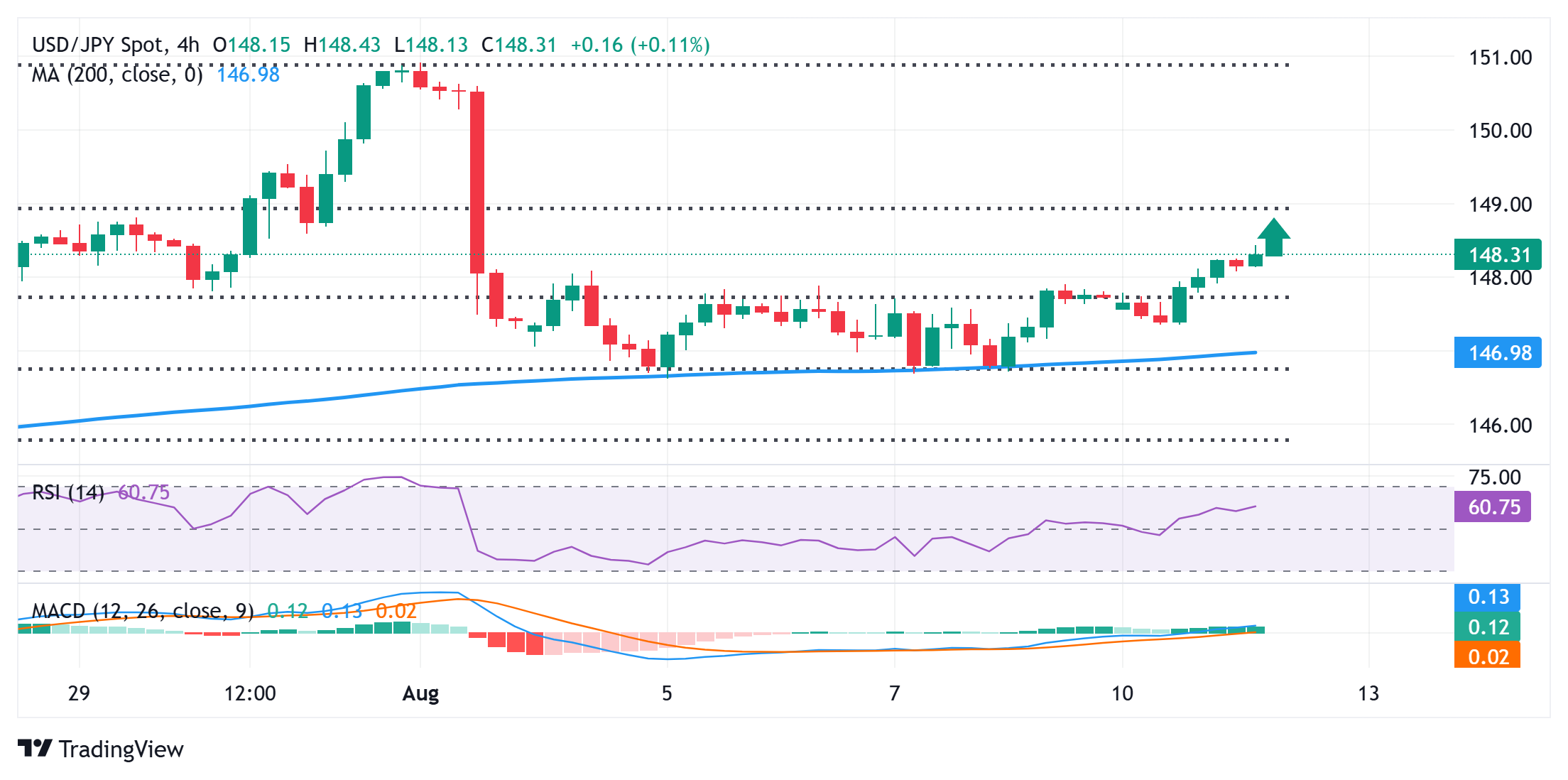
The overnight breakout through the 147.75-147.80 hurdle (38.2% Fibonacci retracement level of the July upswing) and a close above the 148.00 round figure could be seen as a key trigger for the USD/JPY pair. Moreover, slightly positive oscillators on the daily chart suggest that the path of least resistance for spot prices is to the upside. Some follow-through buying beyond the 148.45-148.50 region will reaffirm the constructive outlook and lift the pair towards the 149.00 neighborhood, or the 23.6% Fibo. retracement level.
On the flip side, the 148.00 mark, followed by the 147.80-147.75 region, could offer immediate support to the USD/JPY pair. Any further decline could be seen as a buying opportunity near the 147.00 round figure and remain limited near the 146.80 confluence – comprising the 200-period Simple Moving Average (SMA) on the 4-hour and the 50% Fibo. retracement level. A convincing break below the latter, however, might prompt some technical selling and drag spot prices to sub-146.00 levels, or the 61.8% Fibo. retracement level. The downward trajectory could extend further and eventually drag the pair to the 145.00 psychological mark.
Economic Indicator
Consumer Price Index (YoY)
Inflationary or deflationary tendencies are measured by periodically summing the prices of a basket of representative goods and services and presenting the data as The Consumer Price Index (CPI). CPI data is compiled on a monthly basis and released by the US Department of Labor Statistics. The YoY reading compares the prices of goods in the reference month to the same month a year earlier.The CPI is a key indicator to measure inflation and changes in purchasing trends. Generally speaking, a high reading is seen as bullish for the US Dollar (USD), while a low reading is seen as bearish.
Read more.Next release: Tue Aug 12, 2025 12:30
Frequency: Monthly
Consensus: 2.8%
Previous: 2.7%
Source: US Bureau of Labor Statistics
The US Federal Reserve (Fed) has a dual mandate of maintaining price stability and maximum employment. According to such mandate, inflation should be at around 2% YoY and has become the weakest pillar of the central bank’s directive ever since the world suffered a pandemic, which extends to these days. Price pressures keep rising amid supply-chain issues and bottlenecks, with the Consumer Price Index (CPI) hanging at multi-decade highs. The Fed has already taken measures to tame inflation and is expected to maintain an aggressive stance in the foreseeable future.
Author

Haresh Menghani
FXStreet
Haresh Menghani is a detail-oriented professional with 10+ years of extensive experience in analysing the global financial markets.