UPDATE: Honeywell recovers somewhat after Fed announces 50 bps cut
- Honeywell stock was sinking ahead of the FOMC decision on interest rates.
- Market was split between 25 and 50 bps camps.
- Samsung E&A announced its partnership with Honeywell on carbon capture technology.
- HON stock starts to recover from morning sell-off after rate cut announcement.

UPDATE: Honewell rose more than 1% off its Wednesday morning low after the Fed announced it was cutting interest rates by 50 basis points. HON stock immediately shot up from $201.60 to as high as $203.75 before moderating. The fed funds rate will decline from the 5.25%-5.50% range that it has been at for more than a year to the 4.75%-5.00% range. Additionally, the US central bank lowered its one-year Dot Plot projection from 4.1% to 3.4%.
Honeywell (HON) stock is sinking on Wednesday in the leadup to the Federal Reserve announcing its interest rate decision. The market is somewhat anxious about the result though they are unanimous in expecting a cut.
The sticking point is whether the cut will be 50 basis points (bps) or 25. Analysts largely project a 25 bps cut, while traders have broken since last Friday toward the 50 bps side of the bet. The CME Group’s FedWatch Tool shows 53% of bets favor the 50 bps option, while 47% favor 25 bps.
The market is selling off in anticipation, but the Dow Jones Industrial Average (DJIA), of which Honeywell is a constituent, is faring better. The DJIA lags over 0.2%, while the NASDAQ Composite veers closer to 0.4% at lunchtime in New York. The DJIA just hit a new all-time high on Tuesday.
A faster interest rate cutting cycle would be good for large industrials like Honeywell, as well as most other non-financial stocks, as it would lower financing costs.
Honeywell stock news
On Tuesday, Honeywell announced a new partnership with Samsung E&A that should see higher sales of its advanced solvent carbon capture (ASCC) technology to fossil fuel-burning power plants. The technology captures carbon from flue gas before it gets released into the atmosphere at power plants that burn coal, oil or natural gas.
"Deploying Honeywell's carbon capture technologies allows Samsung E&A to offer viable, more sustainable solutions for global clients during this energy transition,” said Hong Namkoong, president and CEO of the Korean engineering & construction company.
Honeywell’s ASCC technology is part of its suite of carbon-fighting offerings. Honeywell has named the global energy transition from fossil fuels to renewable energy as one of its primary business focuses.
In addition to chemical solvent offerings like ASCC, Honeywell offers physical solvents, adsorbents, membranes and cryogenics. Honeywell estimates that its entire suite of carbon capture, utilization, and storage solutions will mitigate as much as 320 million metric tons of carbon dioxide between 2023 and 2030.
Honeywell stock chart
Honeywell stock is trading inside a rising channel on the daily chart that begins in the summer of 2023, about 15 months ago. HON shares are trading at $201, while the lower trendline sits near $199. This makes the current price level ideal for an entry.
However, if Honeywell stock breaks below the trendline and closes there, then it might be time to sell. Typically, a trendline break like that is a foreshadowing of more weakness.
A break above the 50-day Simple Moving Average (SMA) near $205 will calm the market and likely engender traders to buy in.
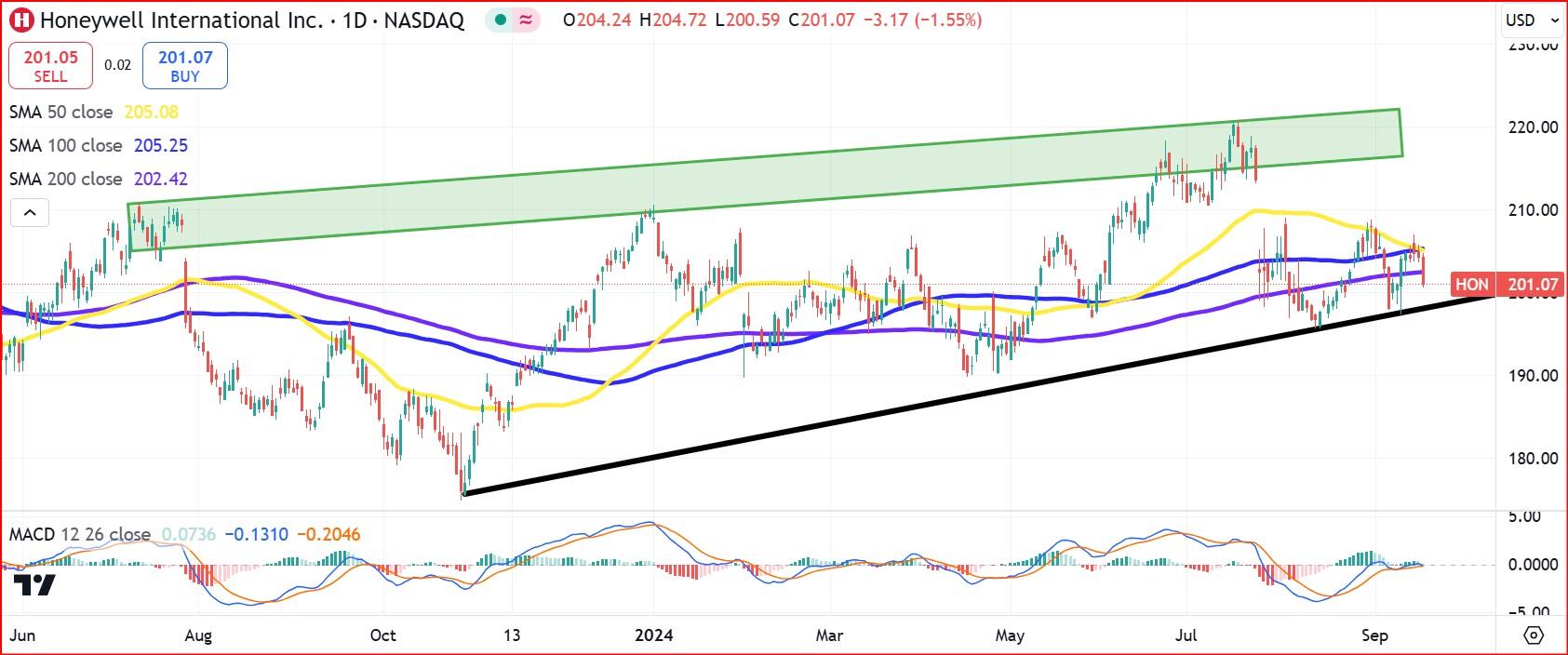
HON daily stock chart
Author

Clay Webster
FXStreet
Clay Webster grew up in the US outside Buffalo, New York and Lancaster, Pennsylvania. He began investing after college following the 2008 financial crisis.