Goldman Sachs advances on heat from Powell’s speech in Jackson Hole
- Fed Chair Powell signaled at Jackson Hole that an interest rate cut is imminent.
- Most of the market expects a 25bps cut, but a third still says Powell will begin with 50 bps.
- Powell says that labor market no longer a source of inflation.
- Goldman nears all-time high at $517.26, but entry points are aplenty.

Goldman Sachs (GS) gained alongside US indices on Friday after the market took Federal Reserve (Fed) Chair Jerome Powell’s words to heart regarding interest rate cuts at the September 18 meeting.
Shares of the esteemed investment bank added nearly 3% to reach an intraday high of $512.44 just before lunchtime.
The Dow Jones Industrial Average, of which Goldman is an outsized member, advanced by half a percentage point, and the NASDAQ and S&P 500 gained a similar amount.
Dow Jones jumps after Fed gives a nod to rate cuts
Jackson Hole, Powell presser lifts market
Firm news plays second fiddle on days like Friday, when the market unearthed more certainty that an interest rate would arrive in less than a month. The expectation was already there, but Powell’s straight talk solidified the existing sentiment.
The CME Group’s FedWatch Tool puts the odds of a 25 bps cut at 66% for the September meeting and a 50 bps cut at 34%.
“The time has come for policy to adjust," Powell told the packed audience at the Jackson Hole Economic Symposium in Wyoming. "The direction of travel is clear, and the timing and pace of rate cuts will depend on incoming data, the evolving outlook, and the balance of risks.”
Charlie Ripley of Allianz focused on Powell’s insight that the labor market was unlikely to be a source of medium-term inflation.
"While the pace and magnitude [of the cuts] has yet to be determined,” Ripley wrote in a client note, “it has been made very clear that the shift in focus has moved toward the labor market and the broader trajectory of the US economy."
Little has happened in the headlines for Goldman this week other than the light embarrassment over Ken Griffin’s Citadel hedge fund hiring away the bank’s chief technology officer. Atte Lahtiranta has been with Goldman since 2019 and will now become the principal officer in charge of Citadel’s trading and risk algorithms.
Dow Jones FAQs
The Dow Jones Industrial Average, one of the oldest stock market indices in the world, is compiled of the 30 most traded stocks in the US. The index is price-weighted rather than weighted by capitalization. It is calculated by summing the prices of the constituent stocks and dividing them by a factor, currently 0.152. The index was founded by Charles Dow, who also founded the Wall Street Journal. In later years it has been criticized for not being broadly representative enough because it only tracks 30 conglomerates, unlike broader indices such as the S&P 500.
Many different factors drive the Dow Jones Industrial Average (DJIA). The aggregate performance of the component companies revealed in quarterly company earnings reports is the main one. US and global macroeconomic data also contributes as it impacts on investor sentiment. The level of interest rates, set by the Federal Reserve (Fed), also influences the DJIA as it affects the cost of credit, on which many corporations are heavily reliant. Therefore, inflation can be a major driver as well as other metrics which impact the Fed decisions.
Dow Theory is a method for identifying the primary trend of the stock market developed by Charles Dow. A key step is to compare the direction of the Dow Jones Industrial Average (DJIA) and the Dow Jones Transportation Average (DJTA) and only follow trends where both are moving in the same direction. Volume is a confirmatory criteria. The theory uses elements of peak and trough analysis. Dow’s theory posits three trend phases: accumulation, when smart money starts buying or selling; public participation, when the wider public joins in; and distribution, when the smart money exits.
There are a number of ways to trade the DJIA. One is to use ETFs which allow investors to trade the DJIA as a single security, rather than having to buy shares in all 30 constituent companies. A leading example is the SPDR Dow Jones Industrial Average ETF (DIA). DJIA futures contracts enable traders to speculate on the future value of the index and Options provide the right, but not the obligation, to buy or sell the index at a predetermined price in the future. Mutual funds enable investors to buy a share of a diversified portfolio of DJIA stocks thus providing exposure to the overall index.
Goldman Sachs stock chart
Goldman's share price has risen some 31% already this year, so most traders will want to wait for a pullback before entering on the long side. Of course if GS stock overtakes $517.26, the high from July 31, then they will have missed their chance.
The primary points of interest for bulls are the 50-day Simple Moving Average (SMA), which is gliding near $480. Below there is the $471 prior resistance from May and the summer support level of $440 that stood tall in both June and early August.
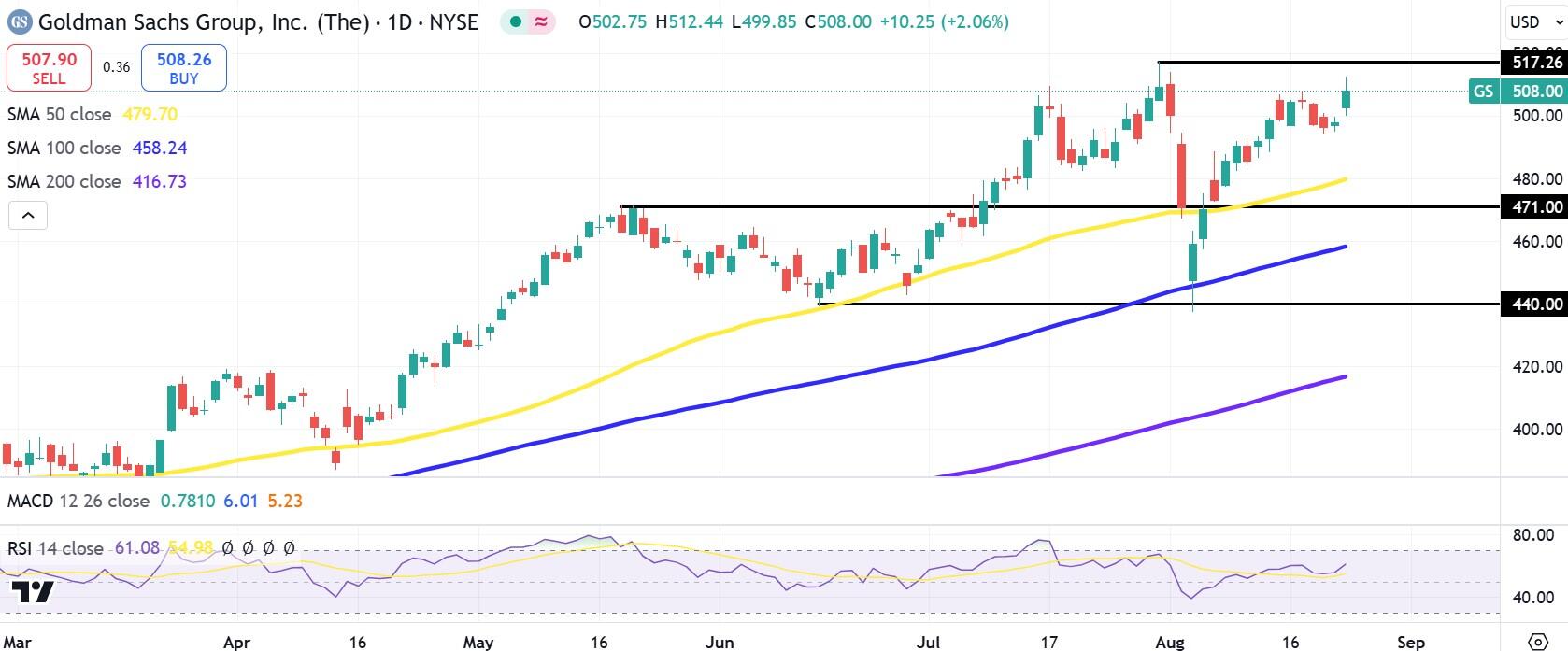
Goldman Sachs daily stock chart
Author

Clay Webster
FXStreet
Clay Webster grew up in the US outside Buffalo, New York and Lancaster, Pennsylvania. He began investing after college following the 2008 financial crisis.