Gold plunges from record highs as profit-taking and a firmer US Dollar weigh
- Gold plunges from record highs as extreme volatility triggers forced liquidation and heavy profit-taking.
- Markets reassess the Fed outlook after US President Donald Trump nominates Kevin Warsh as Fed Chair.
- Technically, XAU/USD shows a near-term bearish bias on the 4-hour chart as momentum fades, with $5,000 acting as the key downside level.

Gold (XAU/USD) comes under intense selling pressure on Friday, giving back all the gains registered earlier this week as extreme volatility triggers broad-based liquidation of leveraged positions. Meanwhile, traders also lock in profits at elevated price levels. At the time of writing, XAU/USD is trading around $4,980, snapping a nine-day winning streak.
The metal is down more than 7.0% on the day after hitting a fresh all-time high near $5,600 on Thursday. The sell-off gathered pace as markets price in a less dovish Federal Reserve (Fed) after reports that former Fed Governor Kevin Warsh is emerging as a leading candidate to succeed Chair Jerome Powell, whose term is set to end in May.
Investors view Warsh as a more hawkish and market-friendly choice than other potential candidates. This has eased fears of aggressive rate cuts under Trump’s pick for the role, despite his repeated calls for lower interest rates.
This, in turn, lifted the US Dollar (USD) and Treasury yields, reinforcing the downside pressure on Bullion. Even so, Gold remains on track for its strongest monthly gain since 1980, up nearly 15%, supported by safe-haven demand amid persistent geopolitical tensions and broader economic uncertainties.
Market movers: Gold tumbles as liquidation accelerates and the US Dollar rebounds
- US President Donald Trump said on Friday he is nominating Kevin Warsh to be Chairman of the Board of Governors of the Federal Reserve System.
- US Producer Price Index (PPI) data came in hotter than expected. Headline PPI rose 0.5%MoM in December, up from 0.2% in November and above market expectations. On a yearly basis, producer prices increased by 3.0%, compared with forecasts of 2.7%, and matched the previous reading of 3.0%.
- Core PPI rose 0.7%MoM in December, above the 0.2% forecast and the prior 0.0% reading. On a yearly basis, core PPI increased to 3.3% from 3.0%, also above expectations of 2.9%.
- The US Dollar Index (DXY), which tracks the Greenback’s value against a basket of six major currencies, is trading around 96.64, rebounding after hitting a four-year low near 95.56 earlier this week.
- On the geopolitical front, US-Iran tensions are rising after US President Donald Trump issued fresh warnings of potential military action over Iran’s nuclear programme, saying in a Truth Social post on Wednesday that a “massive armada” is heading toward Iran, while reports also said that Iran issued a warning to ships at sea about a planned drill involving live fire in the Strait of Hormuz.
- On the monetary policy front, the Fed left interest rates unchanged at 3.50%-3.75% at its January 27-28 meeting, and struck a cautious, data-dependent tone, stressing that the Committee is well positioned to adjust policy if risks emerge that could threaten progress toward its dual mandate. Markets continue to expect two interest-rate cuts this year.
Technical analysis: XAU/USD faces near-term downside risks after a sharp pullback
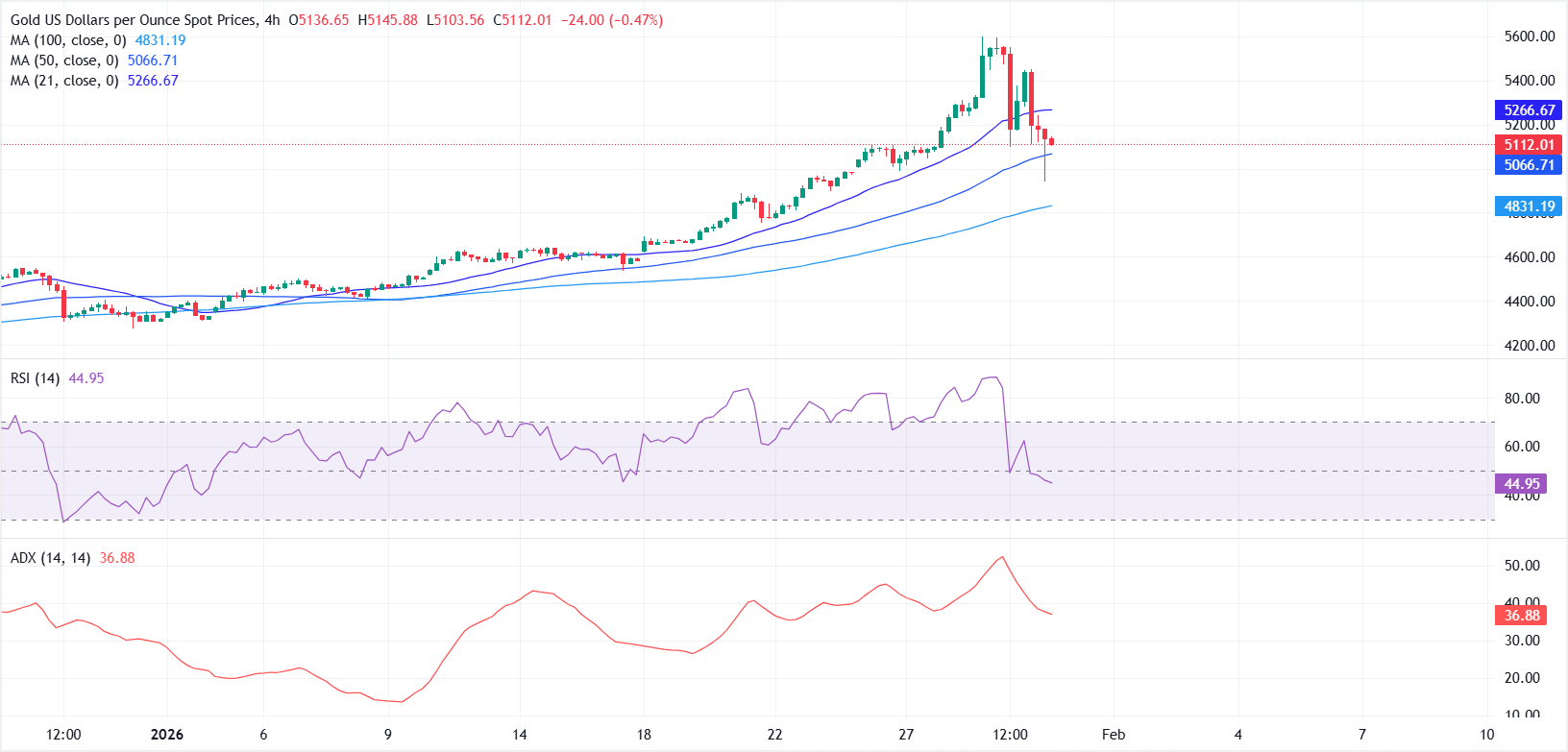
On the 4-hour chart, Gold tilts bearish in the near term after the sharp pullback from record highs, with prices now slipping below the 21-period Simple Moving Average (SMA), signalling that the overbought conditions seen earlier in the week are unwinding.
The Relative Strength Index (RSI) stands at 45.67 and is easing, reflecting a clear loss of upside momentum after the recent surge. The broader trend remains constructive, with the 21-period SMA still holding above the 50- and 100-period SMAs.
However, the 21-SMA near $5,267 now acts as the first upside hurdle, while the 50-period SMA around $5,066 offers immediate support. A sustained reclaim of the 21-period SMA would be needed to stabilise the short-term outlook.
On the downside, a decisive break below the $5,000 psychological level would expose the 100-period SMA support near $4,831.
Gold FAQs
Gold has played a key role in human’s history as it has been widely used as a store of value and medium of exchange. Currently, apart from its shine and usage for jewelry, the precious metal is widely seen as a safe-haven asset, meaning that it is considered a good investment during turbulent times. Gold is also widely seen as a hedge against inflation and against depreciating currencies as it doesn’t rely on any specific issuer or government.
Central banks are the biggest Gold holders. In their aim to support their currencies in turbulent times, central banks tend to diversify their reserves and buy Gold to improve the perceived strength of the economy and the currency. High Gold reserves can be a source of trust for a country’s solvency. Central banks added 1,136 tonnes of Gold worth around $70 billion to their reserves in 2022, according to data from the World Gold Council. This is the highest yearly purchase since records began. Central banks from emerging economies such as China, India and Turkey are quickly increasing their Gold reserves.
Gold has an inverse correlation with the US Dollar and US Treasuries, which are both major reserve and safe-haven assets. When the Dollar depreciates, Gold tends to rise, enabling investors and central banks to diversify their assets in turbulent times. Gold is also inversely correlated with risk assets. A rally in the stock market tends to weaken Gold price, while sell-offs in riskier markets tend to favor the precious metal.
The price can move due to a wide range of factors. Geopolitical instability or fears of a deep recession can quickly make Gold price escalate due to its safe-haven status. As a yield-less asset, Gold tends to rise with lower interest rates, while higher cost of money usually weighs down on the yellow metal. Still, most moves depend on how the US Dollar (USD) behaves as the asset is priced in dollars (XAU/USD). A strong Dollar tends to keep the price of Gold controlled, whereas a weaker Dollar is likely to push Gold prices up.
Author

Vishal Chaturvedi
FXStreet
I am a macro-focused research analyst with over four years of experience covering forex and commodities market. I enjoy breaking down complex economic trends and turning them into clear, actionable insights that help traders stay ahead of the curve.