Fed's Powell: Economy has once again surprised us with its strength

At the post-meeting press conference, Fed Chair Jerome Powell explained why policymakers decided to keep interest rates unchanged following the January meeting and took questions from reporters on the decision.
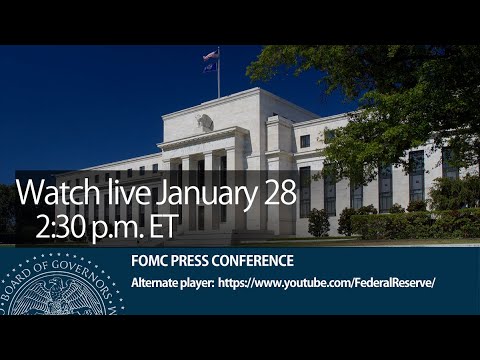
Powell's press conference highlights
The US economy is on firm footing.
Current stance of the policy is appropriate.
Current policy promotes progress toward two goals.
Activity in the housing sector is weak.
Government shutdown effects should be reversed this quarter.
Labour market may be stabilising.
Slowing job growth reflects a decline in the labour force, though labour demand has clearly softened as well.
Inflation remains somewhat elevated relative to the goal.
Total core PCE inflation in December probably rose 3%.
Disinflation appears to be continuing in the services sector.
Disinflation appears to be continuing in the services sector.
Policy rate within range of plausible estimates of neutral.
Well positioned to determine the extent and timing of additional rate adjustments.
Policy not on preset course.
Decisions are made on a meeting-by-meeting basis.
At the higher end of the range of neutral.
I think it's hard to look at incoming data and say policy is significantly restrictive and may be loosely neutral, or somewhat restrictive.
Hard to say policy is significantly restrictive from data.
Committee was pretty broadly for holding today.
Risks to both sides of the mandate have diminished a bit.
Most of the overrun in inflation is from tariffs, not demand.
Core PCE ex-effects of tariffs on goods is running just a bit above 2%, and that's a healthy development in inflation.
Expect to see the tariff effect on goods peaking and then coming down this year.
Upside risks to inflation and downside risks to employment have diminished.
Hard to say if mandate risks are fully in balance.
Short-term inflation expectations have fully retraced; that’s very comforting.
Longer-term inflation expectations reflect confidence in a return to 2% inflation.
We will always act to address when the economy moves away from goals.
A weakening labour market calls for cutting; a strong labour market for not.
No one’s base case is a rate hike for the next move.
Job availability read from Conference Board is an indication of softening.
Labour market has softened.
If labour supply and demand are even but no jobs are being created, it’s hard to say if that’s really full employment.
Economy has once again surprised us with its strength.
Consumer spending is uneven across income levels, but overall it’s good.
Most of the inflation overshoot was in goods, related to tariffs, and was one-time.
There is an expectation that the middle quarters of the year will see tariff inflation topping out.
Estimate goods inflation peaking in the middle of the year.
So far, the economy has pulled through well despite big changes in trade policy.
This section below was published at 19:00 GMT to cover the Federal Reserve's policy decisions and the immediate market reaction.
At its January meeting, the Federal Reserve (Fed) kept its Fed Funds Target Range (FFTR) unchanged at 3.50%–3.75%, right in line with what markets were expecting.
Highlights from the FOMC statement
Inflation remains somewhat elevated.
Federal Reserve leaves key overnight interest rate unchanged in 3.50–3.75% range, no longer judges downside risks to employment as rising.
Unemployment rate has shown some signs of stabilisation, job gains have remained low.
Uncertainty about the economic outlook remains elevated.
Upgrades assessment of economic activity, says it has been expanding at a “solid” pace.
Attentive to risks to both sides of dual mandate.
Reaffirms statement on longer-run goals, monetary policy strategy.
Vote in favour of policy was 10–2, with Governors Miran and Waller dissenting in favour of a 25-basis-point cut.
Market reaction to Fed policy announcements
The US Dollar keeps pushing higher on Wednesday, extending its U-turn from Tuesday’s multi-year lows near 95.50 when tracked by the US Dollar Index (DXY). The move higher in the buck appears propped up by a marked bounce in US Treasury yields across the curve as investors assess the Fed’s interest rate decision.
US Dollar Price Today
The table below shows the percentage change of US Dollar (USD) against listed major currencies today. US Dollar was the strongest against the Swiss Franc.
| USD | EUR | GBP | JPY | CAD | AUD | NZD | CHF | |
|---|---|---|---|---|---|---|---|---|
| USD | 0.98% | 0.53% | 0.97% | 0.12% | 0.28% | 0.34% | 1.23% | |
| EUR | -0.98% | -0.47% | 0.02% | -0.87% | -0.71% | -0.64% | 0.24% | |
| GBP | -0.53% | 0.47% | 0.49% | -0.40% | -0.24% | -0.17% | 0.71% | |
| JPY | -0.97% | -0.02% | -0.49% | -0.89% | -0.73% | -0.65% | 0.21% | |
| CAD | -0.12% | 0.87% | 0.40% | 0.89% | 0.17% | 0.23% | 1.12% | |
| AUD | -0.28% | 0.71% | 0.24% | 0.73% | -0.17% | 0.07% | 0.93% | |
| NZD | -0.34% | 0.64% | 0.17% | 0.65% | -0.23% | -0.07% | 0.88% | |
| CHF | -1.23% | -0.24% | -0.71% | -0.21% | -1.12% | -0.93% | -0.88% |
The heat map shows percentage changes of major currencies against each other. The base currency is picked from the left column, while the quote currency is picked from the top row. For example, if you pick the US Dollar from the left column and move along the horizontal line to the Japanese Yen, the percentage change displayed in the box will represent USD (base)/JPY (quote).
This section below was published at 10:00 GMT as a preview of the Federal Reserve's policy announcements.
- The US Federal Reserve is expected to leave the policy rate unchanged after the first meeting of 2026.
- Fed Chair Powell’s comments on the policy outlook will be watched closely by investors.
- The US Dollar struggles to stay resilient against its rivals following a bullish start to the year.
The United States (US) Federal Reserve (Fed) announces its interest rate decision on Wednesday. Markets widely expect the US central bank to keep the policy rate unchanged in the range of 3.5%-3.75%. As this decision is nearly fully priced in, Fed Chair Jerome Powell’s comments in the post-meeting press conference could impact the US Dollar’s (USD) performance.

The CME FedWatch Tool shows that investors see about a 98% probability of a policy hold in January, and price in a 15% chance of a 25-basis-point (bps) rate cut in March.
According to a recently conducted Reuters poll, all 100 economists surveyed expect the Fed to hold the federal funds rate unchanged in January. Moreover, 58% of respondents forecast no rate changes during the first quarter, compared with December’s poll, when at least one cut by March was anticipated.
TD Securities analysts agree that the Fed will keep rates on hold at the 3.50%-3.75% range, arguing that risk-management cuts are now over and the policy is closer to neutral.
"While Powell is likely to sound noncommittal around near term rate cuts, we expect him to remind market participants that the median Fed official still looks for easing this year," they add. "Overall, we expect a relatively neutral reaction from the FOMC meeting. While we continue to look for rates to move lower later this year amid a combination of less prohibitive supply dynamics, strong demand, and further Fed rate cuts, the risk in the near-term is a Fed on hold for longer."
When will the Fed announce its interest rate decision and how could it affect EUR/USD?
The Fed is scheduled to announce its interest rate decision and publish the monetary policy statement at 19:00 GMT. This will be followed by Fed Chair Jerome Powell's press conference starting at 19:30 GMT.
The rate decision itself is unlikely to trigger a significant market reaction, but Powell’s tone could influence the USD valuation and drive EUR/USD price action.
In case Powell adopts an optimistic tone on the inflation outlook and emphasizes the need to support the labor market amid worsening conditions, investors could see this as a dovish sign. In this scenario, the USD could come under renewed selling pressure and allow EUR/USD to gather bullish momentum. Conversely, the pair could turn south if Powell notes that the central bank is not as concerned about the labor market as it was at the end of 2025 and that there are still upside risks to inflation. Investors could remain convinced of another monetary policy hold in March as a result, and the market positioning suggests that there is some room for USD gains.
Market participants will also pay close attention to headlines over the nomination of the next Fed chair. US President Donald Trump could take the opportunity to criticize Powell and announce his nomination just before or after the Fed event, ramping up the market volatility and clouding the market reaction.
US Treasury Secretary Scott Bessent said recently that Trump could reach a decision by the end of the month. The US president also told CNBC that he would prefer to keep White House economic adviser Kevin Hassett in his current position.
BlackRock's chief bond investment manager, Rick Rieder, Fed Governor Christopher Waller and former Fed Governor Kevin Warsh are the last three candidates in the race. Powell’s term as head of the Fed ends in May, but his term on the central bank runs through 2028. During the press conference, he is likely to be asked whether he intends to finish out his term. If Powell hints that his retirement will be sooner rather than later, and Trump names either Waller or Warsh as the next Fed chair, markets could lean toward a more dovish policy outlook, hurting the USD and boosting EUR/USD.
On the other hand, Rieder is widely seen as someone who would be less influenced by politics and who would assess economic conditions to make the right policy decisions. Although that doesn’t necessarily mean he wouldn’t embrace a dovish stance, he is a market person after all, and his nomination could at least ease market concerns over the Fed losing its independence.
In a post published on X in response to the inflation data, “we think the Fed is likely to become increasingly concerned about genuine labor market weakness and will respond with modest reductions in the policy interest rate,” said Rieder and added:
“However, given the noisiness of recent data, including this report, the Fed will probably choose to wait a meeting, or so, to begin cutting rates again. 2026 is likely to bring much greater dispersion across monetary policy paths, economic growth trends, and credit markets.”
Eren Sengezer, European Session Lead Analyst at FXStreet, provides a short-term technical outlook for EUR/USD:
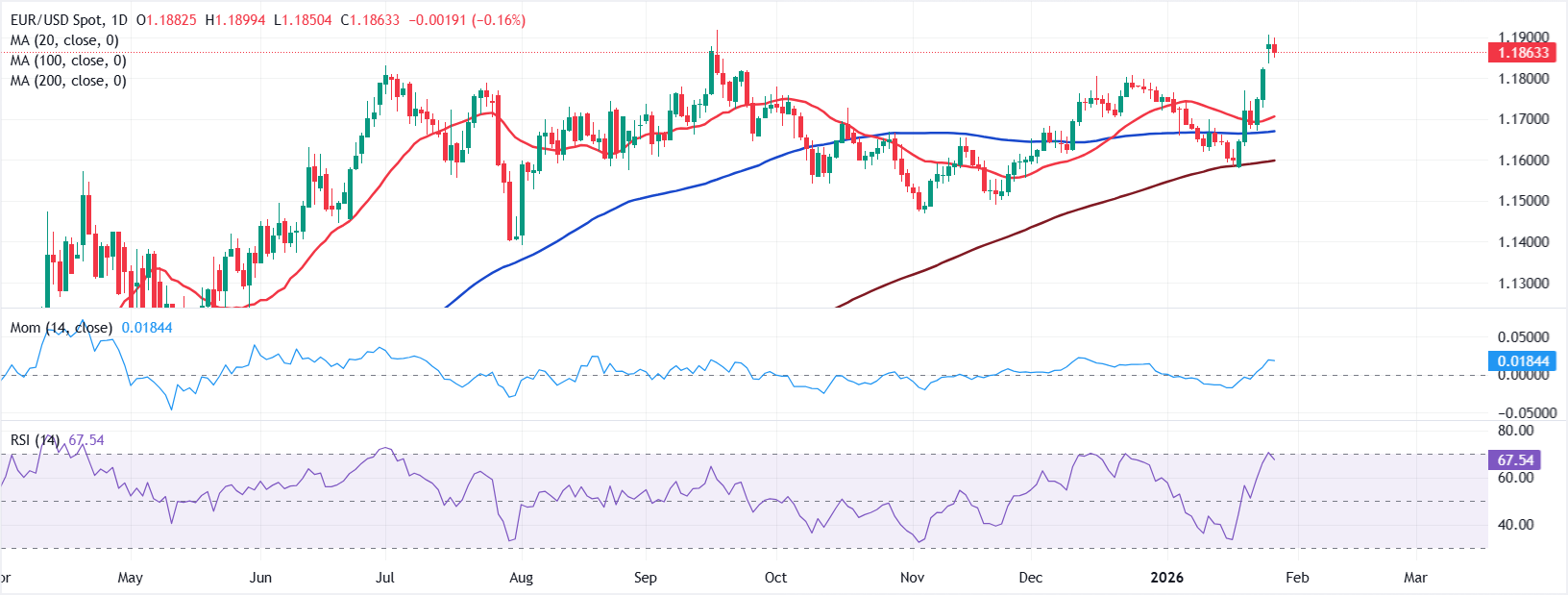
“The Relative Strength Index (RSI) indicator keeps near overbought conditions on the daily chart, and EUR/USD holds firm above its 20-day and 100-day Simple Moving Averages (SMA), highlighting a bullish tilt in the short-term technical outlook. On the upside, 1.1918 (September high) aligns as the immediate resistance level ahead of 1.2000 (round level). On the flip side, 1.1821 (Friday’s close) could be seen as the first support level before 1.1760 (static level), followed by 1.1710 (20-day SMA). A daily close below the latter could open the door for a steeper slide toward the 1.1600 mark.”
Inflation FAQs
Inflation measures the rise in the price of a representative basket of goods and services. Headline inflation is usually expressed as a percentage change on a month-on-month (MoM) and year-on-year (YoY) basis. Core inflation excludes more volatile elements such as food and fuel which can fluctuate because of geopolitical and seasonal factors. Core inflation is the figure economists focus on and is the level targeted by central banks, which are mandated to keep inflation at a manageable level, usually around 2%.
The Consumer Price Index (CPI) measures the change in prices of a basket of goods and services over a period of time. It is usually expressed as a percentage change on a month-on-month (MoM) and year-on-year (YoY) basis. Core CPI is the figure targeted by central banks as it excludes volatile food and fuel inputs. When Core CPI rises above 2% it usually results in higher interest rates and vice versa when it falls below 2%. Since higher interest rates are positive for a currency, higher inflation usually results in a stronger currency. The opposite is true when inflation falls.
Although it may seem counter-intuitive, high inflation in a country pushes up the value of its currency and vice versa for lower inflation. This is because the central bank will normally raise interest rates to combat the higher inflation, which attract more global capital inflows from investors looking for a lucrative place to park their money.
Formerly, Gold was the asset investors turned to in times of high inflation because it preserved its value, and whilst investors will often still buy Gold for its safe-haven properties in times of extreme market turmoil, this is not the case most of the time. This is because when inflation is high, central banks will put up interest rates to combat it. Higher interest rates are negative for Gold because they increase the opportunity-cost of holding Gold vis-a-vis an interest-bearing asset or placing the money in a cash deposit account. On the flipside, lower inflation tends to be positive for Gold as it brings interest rates down, making the bright metal a more viable investment alternative.
Interest rates FAQs
Interest rates are charged by financial institutions on loans to borrowers and are paid as interest to savers and depositors. They are influenced by base lending rates, which are set by central banks in response to changes in the economy. Central banks normally have a mandate to ensure price stability, which in most cases means targeting a core inflation rate of around 2%. If inflation falls below target the central bank may cut base lending rates, with a view to stimulating lending and boosting the economy. If inflation rises substantially above 2% it normally results in the central bank raising base lending rates in an attempt to lower inflation.
Higher interest rates generally help strengthen a country’s currency as they make it a more attractive place for global investors to park their money.
Higher interest rates overall weigh on the price of Gold because they increase the opportunity cost of holding Gold instead of investing in an interest-bearing asset or placing cash in the bank. If interest rates are high that usually pushes up the price of the US Dollar (USD), and since Gold is priced in Dollars, this has the effect of lowering the price of Gold.
The Fed funds rate is the overnight rate at which US banks lend to each other. It is the oft-quoted headline rate set by the Federal Reserve at its FOMC meetings. It is set as a range, for example 4.75%-5.00%, though the upper limit (in that case 5.00%) is the quoted figure. Market expectations for future Fed funds rate are tracked by the CME FedWatch tool, which shapes how many financial markets behave in anticipation of future Federal Reserve monetary policy decisions.
Author

FXStreet Team
FXStreet
Composed of a group of economic journalists and FX experts, the FXStreet content team produces and oversees all content published on FXStreet. It provides a purely journalistic approach to the Forex market.