Gold steadies ahead of Fed decision as traders position for dovish outcome
- Gold recovers to $3,998 after touching a three-week low of $3,886 on Tuesday as investors await Fed’s policy decision.
- With US data flow disrupted by the government shutdown, markets focus on Powell’s tone for guidance.
- Dovish commentary could reignite XAU/USD’s uptrend toward the 20-day SMA at $4,075; a hawkish shift risks a retest of weekly lows.

Gold price recovers some ground on Wednesday after hitting a three-week low of $3,886 the previous day as traders await the Federal Reserve (Fed) decision later in the day. XAU/USD trades at $3,998, snapping three consecutive days of losses.
XAU/USD snaps three-day losing streak, holds around $4,000 amid Fed rate-cut bets
The US government shutdown has left traders and the Fed without crucial data ahead of the decision. The latest Consumer Price Index (CPI) report in the US came at around familiar levels at 3% headline and core, but showed that prices had stabilized and would not prevent the Fed from reducing borrowing costs.
Additionally, weakness in the labor market cemented the case for a 25-basis-point rate cut, followed by an additional one in the December meeting, according to Prime Market Terminal interest rate probability tool.
Therefore, the uptrend may resume following the Fed’s decision, though traders will be keen to Fed Chair Jerome Powell's words. If he leans hawkish, Gold prices might tumble and challenge the current week's low. Otherwise, XAU/USD could recover the $4,000 print and could be poised to test the 20-day SMA at $4,075.
Regarding trade news, US President Donald Trump announced a deal with South Korea, and remains optimistic of achieving an agreement with Chinese President Xi Jinping.
Daily market movers: Fed and trade talks to dictate Gold’s direction
- The US Dollar Index (DXY), which tracks the performance of the buck versus six currencies, stays flat at around 98.72
- The US 10-year Treasury note yield rises almost two basis points to 3.997%. US real yields — which correlate inversely to Gold prices — climb two basis points to 1.717%.
- Reuters reported that China's COFCO purchased three cargoes totaling 180k tonnes of US soybeans ahead of the Trump-Xi meeting.
- Amid the ongoing government shutdown, Automatic Data Processing (ADP) revealed that it will begin releasing a preliminary weekly employment estimate every Tuesday. In its first release, ADP estimated that US private employers added roughly 14,250 jobs per week over the four weeks ending October 11.
- Gold could also resume its uptrend once central banks resume their purchases. South Korea's central bank is considering adding Gold reserves in the medium-to-long term, according to the Head of Reserve Investment at the Bank of Korea, Heung-Soon Jung, at a precious metals conference on Tuesday.
- The South Korean central bank has had 104 metric tons of Gold reserves since 2013.
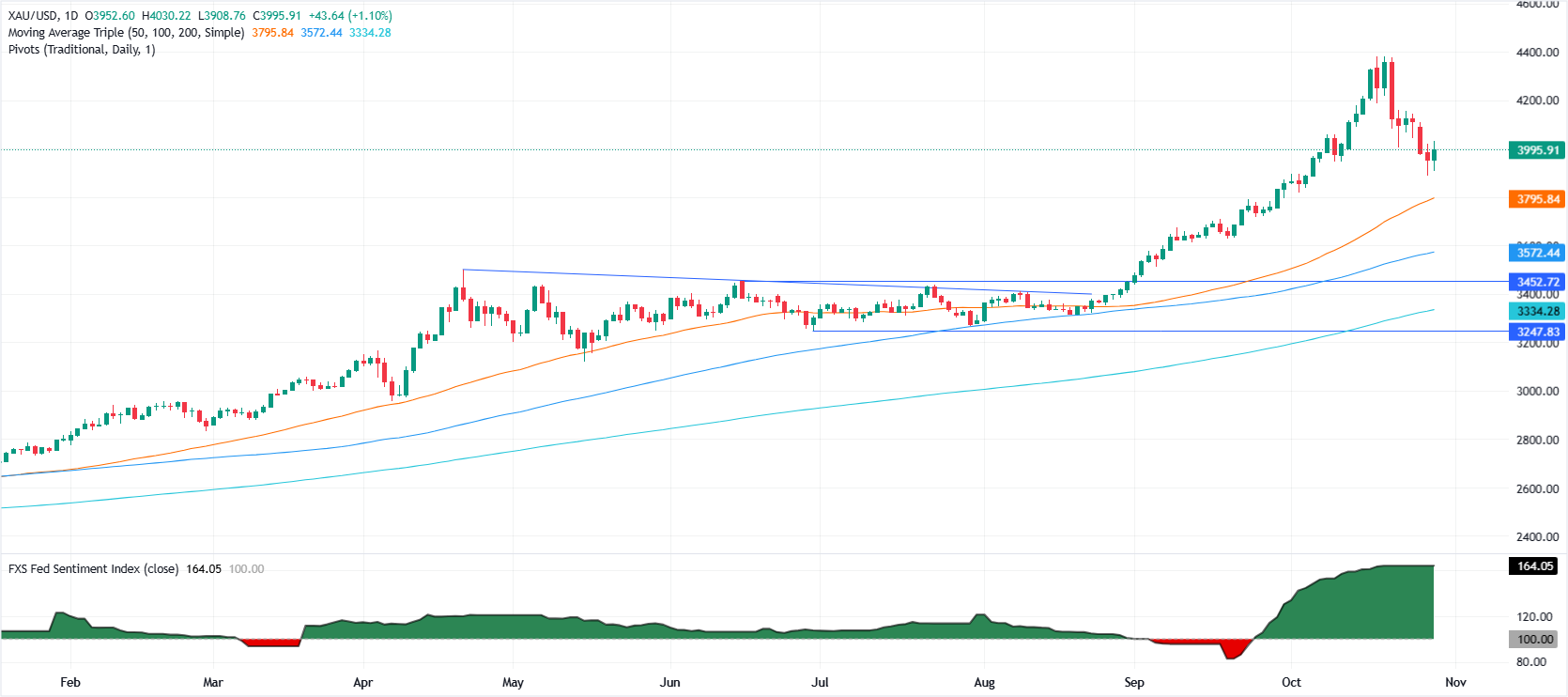
Technical outlook: Gold price rises and hovers around $4,000
Gold’s technical picture shows the uptrend remains intact, but buyers must achieve a daily close above $4,000 so they can remain hopeful of testing the 20-day Simple Moving Average (SMA) at $4,075.
Momentum as measured by the Relative Strength Index (RSI) reveals that buyers are gathering some steam. Therefore, further upside is expected in the short term.
Once XAU/USD climbs above the 20-day SMA, the next resistance would be $4,100, followed by the October 22 peak at $4,161. Conversely, a daily close below $4,000 would expose Gold to lower prices, with sellers eyeing October’s 28 low of $3,886, followed by the 50-day Simple Moving Average (SMA) near $3,779.
Gold FAQs
Gold has played a key role in human’s history as it has been widely used as a store of value and medium of exchange. Currently, apart from its shine and usage for jewelry, the precious metal is widely seen as a safe-haven asset, meaning that it is considered a good investment during turbulent times. Gold is also widely seen as a hedge against inflation and against depreciating currencies as it doesn’t rely on any specific issuer or government.
Central banks are the biggest Gold holders. In their aim to support their currencies in turbulent times, central banks tend to diversify their reserves and buy Gold to improve the perceived strength of the economy and the currency. High Gold reserves can be a source of trust for a country’s solvency. Central banks added 1,136 tonnes of Gold worth around $70 billion to their reserves in 2022, according to data from the World Gold Council. This is the highest yearly purchase since records began. Central banks from emerging economies such as China, India and Turkey are quickly increasing their Gold reserves.
Gold has an inverse correlation with the US Dollar and US Treasuries, which are both major reserve and safe-haven assets. When the Dollar depreciates, Gold tends to rise, enabling investors and central banks to diversify their assets in turbulent times. Gold is also inversely correlated with risk assets. A rally in the stock market tends to weaken Gold price, while sell-offs in riskier markets tend to favor the precious metal.
The price can move due to a wide range of factors. Geopolitical instability or fears of a deep recession can quickly make Gold price escalate due to its safe-haven status. As a yield-less asset, Gold tends to rise with lower interest rates, while higher cost of money usually weighs down on the yellow metal. Still, most moves depend on how the US Dollar (USD) behaves as the asset is priced in dollars (XAU/USD). A strong Dollar tends to keep the price of Gold controlled, whereas a weaker Dollar is likely to push Gold prices up.
Author

Christian Borjon Valencia
FXStreet
Markets analyst, news editor, and trading instructor with over 14 years of experience across FX, commodities, US equity indices, and global macro markets.














