Gold strengthens on rising trade tensions, Fed uncertainty and a weaker Dollar
- Gold extends gains above $3,400 as Trump ramps up criticism over Fed Chair Powell.
- Dollar weakness, rising safe-haven demand, and escalating trade tensions continue to support bullion.
- XAU/USD trades near $3,430 at the time of writing, with the $3,452 June high in focus.

Gold (XAU/USD) is experiencing a fresh bout of optimism on Tuesday as trade tensions and concerns about the Federal Reserve’s (Fed) independence continue to lend support through safe-haven demand.
The precious metal is hovering trading above the $3,400 level, with gains nearing 1% at the time of writing as bullish momentum builds.
Trade talks and Fed independence remain in focus, supporting Gold's gains
The likelihood of a trade deal between the EU and the US before the August 1 deadline is fading, and investors are growing increasingly wary.
This uncertainty, along with broader trade tensions involving key US partners, remains a major theme supporting Gold's appeal as a safe-haven asset.
Adding to market unease are renewed concerns about the Fed’s independence. US Treasury Secretary Scott Bessent spoke with CNBC on Monday and commented on the matter.
He suggested that it may be time to “examine the entire institution and whether they’ve been successful.” He has also proposed a review of the Fed’s non-monetary functions, citing issues like “mission creep” and cost overruns in building renovations.
The Fed’s independence from political influence is a key pillar of the central bank's credibility. When that independence is called into question, investors fear that monetary policy could become motivated by factors other than data-driven considerations, weakening confidence in the US Dollar.
Meanwhile, US President Trump continued to criticise Fed Chair Jerome Powell. In a meeting with Philippine President Ferdinand Marcos held at the White House on Tuesday, Trump stated that he thinks Powell has "done a bad job, but he's going to be out pretty soon."
While Gold traditionally benefits from economic uncertainty and risk aversion, recent developments have limited its upside.
Rising institutional interest in Bitcoin, amid improving regulatory clarity, has drawn some safe-haven flows away from the precious metal.
At the same time, US equities, particularly tech stocks, remain attractive to investors anticipating Fed interest rate cuts.
These competing inflows into alternative assets are acting as a headwind for bullion, even as uncertainty remains elevated.
Daily digest market movers: US-EU trade talks near deadline as tariff threats persist
- Talks between the United States and the European Union have dragged on in recent weeks, with little sign of real progress. US President Donald Trump has floated the idea of imposing a sweeping 30% tariff on most EU imports as part of his push to narrow the trade deficit. The US imports more goods from the EU than it exports, though when it comes to services, the opposite holds true.
- Trade negotiations are currently underway in Brussels and Washington as officials work to finalize proposals and fallback strategies in a final effort to prevent a sharp escalation in transatlantic tensions. The talks bring together senior representatives from the European Commission’s trade team, led by Trade Commissioner Maroš Šefčovič and US counterparts including Commerce Secretary Howard Lutnick and Trade Representative Jamieson Greer.
- The European Union is preparing a package of retaliatory tariffs, in case negotiations don't succeed, targeting key American exports, including digital services, aerospace products, and bourbon. Even if a deal is reached, the US plans to keep baseline tariffs of 15–20% on EU goods, along with sector-specific levies on steel, copper and auto parts. Trump has also indicated that tariffs on pharmaceuticals and semiconductors may be implemented soon. The economic uncertainty could support Gold demand as a safe-haven asset.
- Over the weekend, Howard Lutnick struck a more optimistic tone regarding US-EU talks during an interview with CBS News. “These are the two biggest trading partners in the world, talking to each other. We’ll get a deal done. I am confident we’ll get a deal done,” he said. Still, Lutnick made it clear that there’s no room for delays. “That’s a hard deadline—so on August 1, the new tariff rates will come in.”
- The Fed is currently in a blackout period prior to the July 30 interest rate decision, and no further comments on monetary policy are expected to be provided by Fed officials until then. However, despite ongoing criticism from the US president, who has called for the resignation of Fed Chair Jerome Powell, the majority of the central bank's members have remained reluctant to cut rates until the clear inflation pressures from tariffs are evident.
Gold breaks out above $3,400 as bullish momentum builds
Gold (XAU/USD) has broken out above the $3,400 resistance level, confirming a move beyond the symmetrical triangle pattern that had been forming over recent weeks.
This breakout is supported by bullish momentum, as reflected in both price action and a rising Relative Strength Index (RSI), currently near 63, suggesting room for further upside before reaching overbought conditions.
The price is now comfortably above the 23.6% Fibonacci retracement level of the April low-high move at $3,372, with the next resistance levels seen at the June 16 swing high of $3,452, followed by the April record high at $3,500.
On the downside, immediate support lies at the breakout point near $3,400, followed by the 50-day moving average at $3,331. A break below this level could bring the 38.2% Fibonacci retracement at $3,292 back into focus.
Overall, the breakout signals renewed bullish interest, with confirmation needed via a daily close above $3,400 to sustain upward momentum.
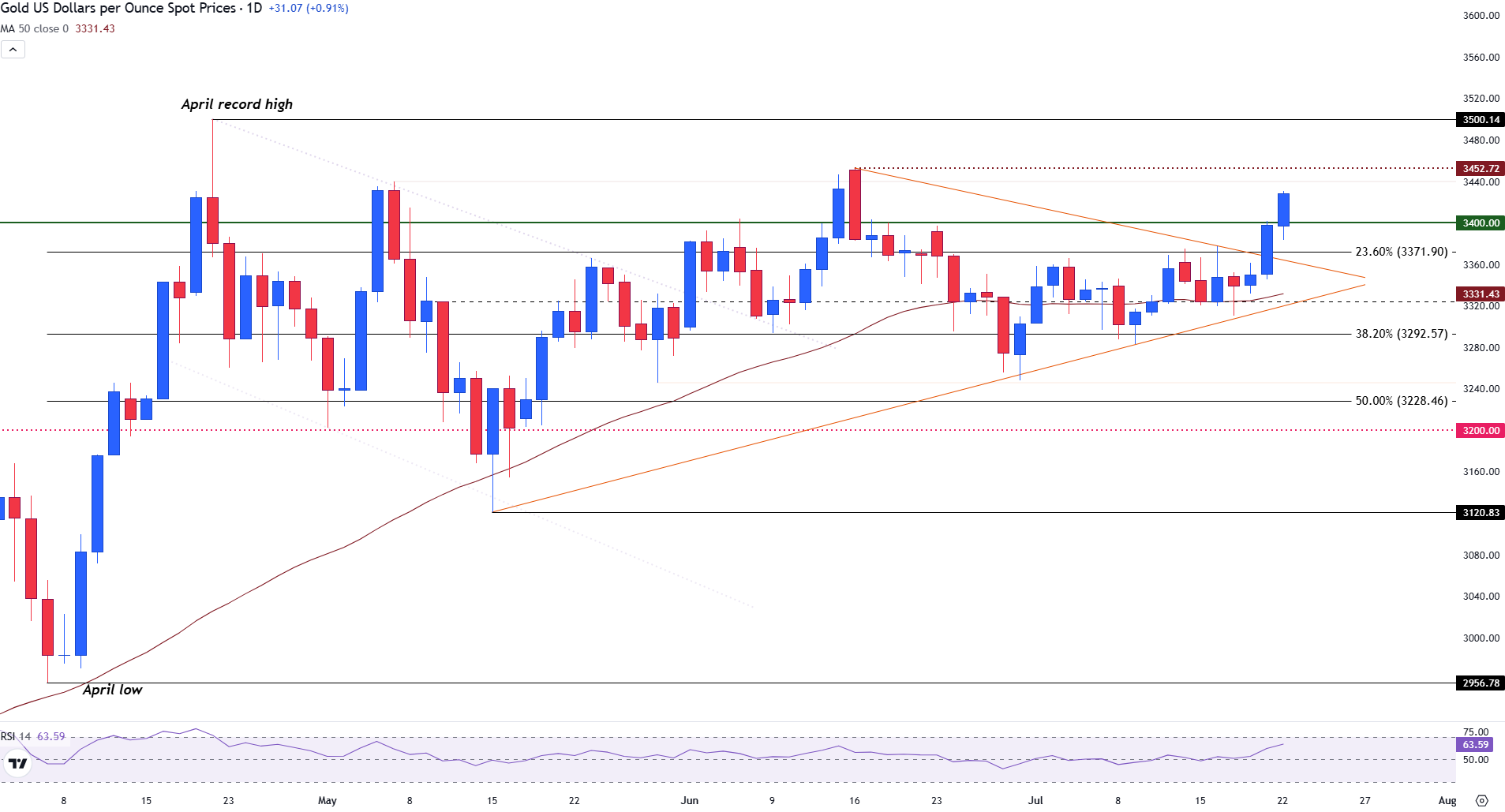
Gold daily chart
Fed FAQs
Monetary policy in the US is shaped by the Federal Reserve (Fed). The Fed has two mandates: to achieve price stability and foster full employment. Its primary tool to achieve these goals is by adjusting interest rates. When prices are rising too quickly and inflation is above the Fed’s 2% target, it raises interest rates, increasing borrowing costs throughout the economy. This results in a stronger US Dollar (USD) as it makes the US a more attractive place for international investors to park their money. When inflation falls below 2% or the Unemployment Rate is too high, the Fed may lower interest rates to encourage borrowing, which weighs on the Greenback.
The Federal Reserve (Fed) holds eight policy meetings a year, where the Federal Open Market Committee (FOMC) assesses economic conditions and makes monetary policy decisions. The FOMC is attended by twelve Fed officials – the seven members of the Board of Governors, the president of the Federal Reserve Bank of New York, and four of the remaining eleven regional Reserve Bank presidents, who serve one-year terms on a rotating basis.
In extreme situations, the Federal Reserve may resort to a policy named Quantitative Easing (QE). QE is the process by which the Fed substantially increases the flow of credit in a stuck financial system. It is a non-standard policy measure used during crises or when inflation is extremely low. It was the Fed’s weapon of choice during the Great Financial Crisis in 2008. It involves the Fed printing more Dollars and using them to buy high grade bonds from financial institutions. QE usually weakens the US Dollar.
Quantitative tightening (QT) is the reverse process of QE, whereby the Federal Reserve stops buying bonds from financial institutions and does not reinvest the principal from the bonds it holds maturing, to purchase new bonds. It is usually positive for the value of the US Dollar.
Author

Tammy Da Costa, CFTe®
FXStreet
Tammy is an economist and market analyst with a deep passion for financial markets, particularly commodities and geopolitics.