Gold price slips to two-day low amid caution ahead of US core PCE inflation
- Gold price tumbles to $2,340 as investors worry that Fed rates will remain higher for longer.
- The US Dollar and bond yields rise as traders pare Fed rate-cut bets for September.
- Investors shift focus to the US core PCE price index data for fresh guidance on Friday.

Gold price (XAU/USD) falls sharply to near $2,340 in Wednesday’s New York session. The precious metal weakens after the recovery move to near $2,360 stalled. The yellow metal falls back as Federal Reserve (Fed) policymakers emphasize keeping interest rates higher for longer.
Meanwhile, investors turn cautious as the focus shifts to the United States (US) core Personal Consumption Expenditure Price Index (PCE) data for April, which will be published on Friday. The Fed’s preferred inflation measure is forecasted to have grown steadily on both monthly and annual basis at 0.3% and 2.8%, respectively.
The expected growth in the underlying inflation data would prompt the likelihood of interest rates remaining at higher levels. This scenario bodes poorly for the Gold price given that the opportunity cost of holding investments in non-yielding assets, such as Gold, rises. The condition would be favorable for yields on interest-bearing assets and US Dollar.
At the time of writing, the US Dollar rises to near 105.00 and the 10-year US Treasury yields post fresh three-week high around 4.60% on cautious market sentiment.
Daily digest market movers: Gold price remains on backfoot as Fed rate-cut hopes wane
- Gold price resumes its downside journey after a short-lived pullback move to near $2,360. The precious metal comes under pressure as traders redeem significant bets favouring the Fed to begin lowering interest rates from the September meeting. The confidence of traders towards the Fed reducing borrowing rates from September has been shaken by the Fed’s hawkish guidance on interest rates.
- The CME FedWatch tool shows that traders see a 46% chance that the central bank will reduce interest rates from their current levels in September. The odds have come down from 57.5% recorded a week ago.
- Fed officials want to be patient with the current interest rate framework as they lack evidence that inflation will sustainably return to the desired rate of 2%. Despite a decline in inflationary pressures in April after remaining hot for the entire first quarter, policymakers want interest rates to remain elevated. Policymakers worry that the slowdown won’t be long-lasting given the strength in the labor market.
- Meanwhile, Fed policymakers are also open to tightening policy further if progress in the disinflation process stalls or price pressures revamp again. On Tuesday, Minneapolis Fed Bank President Neel Kashkari said in an interview with CNBC broadcast, “I think the odds of us raising rates are quite low, but I don’t want to take anything off the table.”
- When asked about what conditions will boost the confidence of the Fed for rate cuts this year, Kaskari said: "Many more months of positive inflation data, I think, to give me confidence that it’s appropriate to dial back," Reuters reported.
Technical Analysis: Gold price sees more downside as inverted flag breaks down
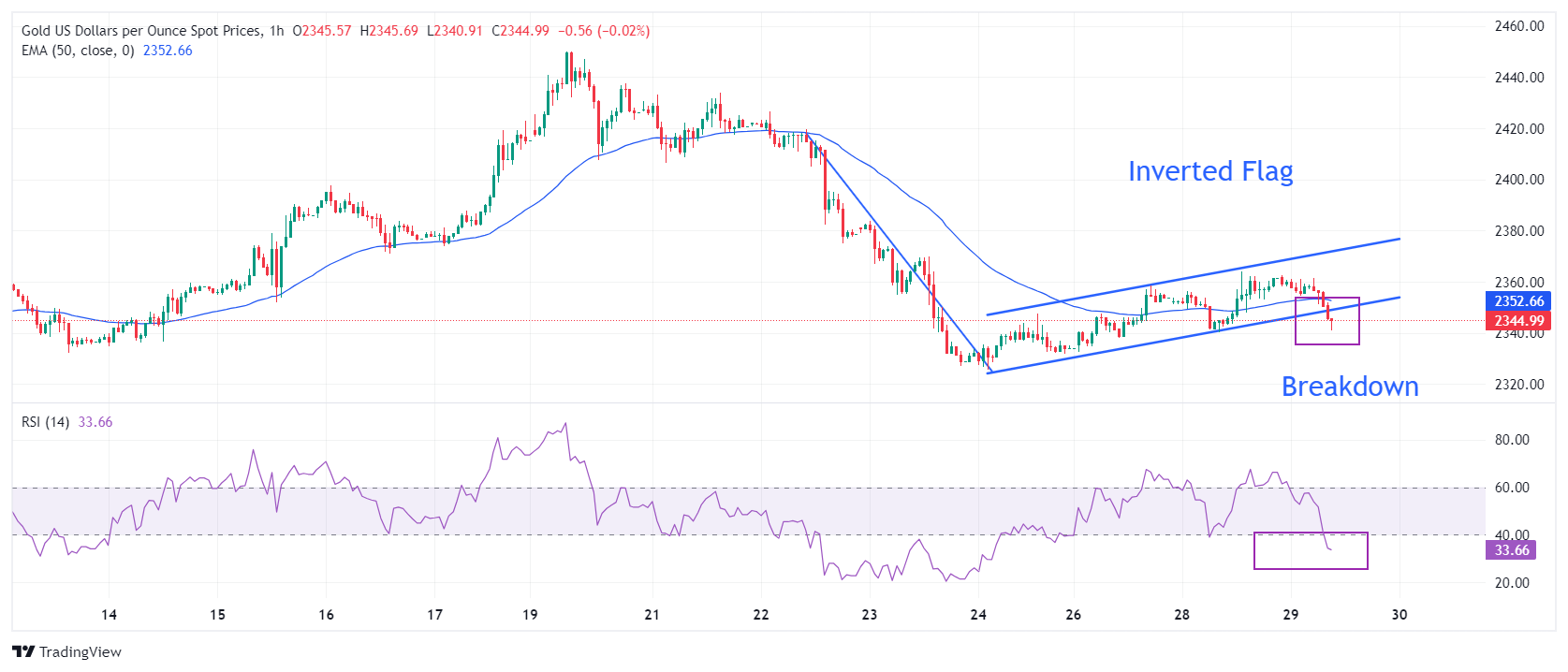
Gold price weakens after the breakdown of an Inverted Flag chart formation on an hourly timeframe. A breakdown of the above-mentioned chart pattern suggests that the downside trend has resumed after the entry of fresh sellers. The near-term outlook is uncertain as the Gold price has slipped below the 50-period Exponential Moving Average (EMA), which trades around $2,350.
The 14-period Relative Strength Index (RSI) has shifted into the bearish range of 20.00-40.00, suggesting that a bearish momentum has been established.
If the Gold price breaks below the May 24 low of around $2,320, more downside will appear. However, a recovery move above the May 28 high of around $2,365 would put bulls in the driving seat.
Inflation FAQs
Inflation measures the rise in the price of a representative basket of goods and services. Headline inflation is usually expressed as a percentage change on a month-on-month (MoM) and year-on-year (YoY) basis. Core inflation excludes more volatile elements such as food and fuel which can fluctuate because of geopolitical and seasonal factors. Core inflation is the figure economists focus on and is the level targeted by central banks, which are mandated to keep inflation at a manageable level, usually around 2%.
The Consumer Price Index (CPI) measures the change in prices of a basket of goods and services over a period of time. It is usually expressed as a percentage change on a month-on-month (MoM) and year-on-year (YoY) basis. Core CPI is the figure targeted by central banks as it excludes volatile food and fuel inputs. When Core CPI rises above 2% it usually results in higher interest rates and vice versa when it falls below 2%. Since higher interest rates are positive for a currency, higher inflation usually results in a stronger currency. The opposite is true when inflation falls.
Although it may seem counter-intuitive, high inflation in a country pushes up the value of its currency and vice versa for lower inflation. This is because the central bank will normally raise interest rates to combat the higher inflation, which attract more global capital inflows from investors looking for a lucrative place to park their money.
Formerly, Gold was the asset investors turned to in times of high inflation because it preserved its value, and whilst investors will often still buy Gold for its safe-haven properties in times of extreme market turmoil, this is not the case most of the time. This is because when inflation is high, central banks will put up interest rates to combat it. Higher interest rates are negative for Gold because they increase the opportunity-cost of holding Gold vis-a-vis an interest-bearing asset or placing the money in a cash deposit account. On the flipside, lower inflation tends to be positive for Gold as it brings interest rates down, making the bright metal a more viable investment alternative.
Author
Sagar Dua
FXStreet
Sagar Dua is associated with the financial markets from his college days. Along with pursuing post-graduation in Commerce in 2014, he started his markets training with chart analysis.