Gold price rebounds on weaker US Dollar, investors await US key data
Most recent article: Gold price stays strong yet hovers at around $2,350
- Gold price gains momentum in Tuesday’s Asian session.
- The weaker USD and ongoing Middle East geopolitical tensions support the precious metal.
- Traders will monitor the US CB Consumer Confidence and the speeches from the Fed’s Kashkari, Daly and Cook on Tuesday.
Gold price (XAU/USD) edges higher on Tuesday after bouncing off two-week lows of $2,325. The uptick of yellow metal is bolstered by the softer US Dollar (USD) and safe-haven flows amid the ongoing geopolitical tensions in the Middle East. On the other hand, higher short-term Treasury yields following hawkish Fed minutes and stronger US economic data are likely to support the Greenback in the near term. Traders might prefer to wait on the sidelines ahead of the key US inflation data this week.
The US Conference Board’s Consumer Confidence is due on Tuesday, along with the Fed’s Neel Kashkari, Mary Daly, and Lisa Cook speeches. The US Core Personal Consumption Expenditures Price Index (Core PCE) will take center stage on Friday. With more hawkish comments from Fed officials and any signs of sticky inflation, traders might shift the prospects of the first Fed rate cut back. This, in turn, is likely to boost the USD and exert some selling pressure on the USD-denominated gold price.
Daily digest market movers: Gold price remains strong amid Fed’s hawkish comments and stronger US data
- An Israeli airstrike triggered a fire that killed 45 people in a tent camp in the Gazan city of Rafah, officials said on Monday. Global leaders called for the implementation of a World Court order to halt Israel's attacks, per Reuters.
- According to the recent Fed meeting minutes, the central bank would take longer than anticipated to gain greater confidence in inflation moving to the 2% target.
- Traders have reduced their bets on interest rate reduction by the US Federal Reserve (Fed) to 49% odds in September, down from 63% a week earlier, according to the CME FedWatch tool.
- The preliminary US Gross Domestic Product (GDP) Annualized is estimated to grow 1.4% in Q1 from 1.6% in the previous reading.
- The US Core Personal Consumption Expenditures Price Index (Core PCE), the Fed’s preferred inflation gauge, is expected to show an increase of 0.3% MoM and 2.8% YoY in April.
- UBS analysts raised their gold price projection to $2,600 by the end of 2024. Citi experts forecast that gold will reach $3,000 per ounce during the next six to eighteen months.
Technical analysis: Gold price maintains a positive stance in the long term
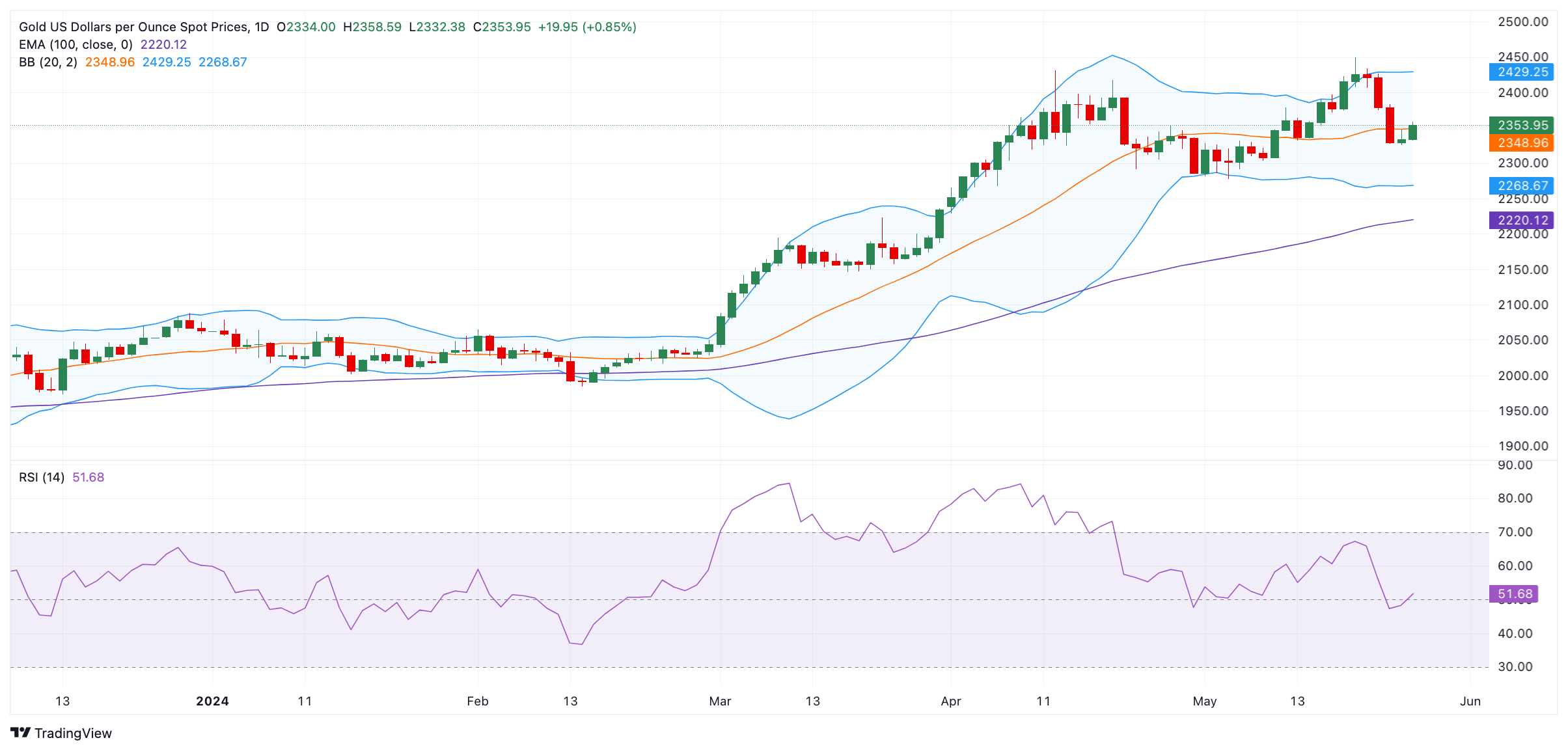
The gold price trades on a positive note on the day. According to the 1-hour chart, the precious metal keeps the bullish vibe unchanged as it holds above the key 100-day Exponential Moving Average (EMA). Nonetheless, the 14-day Relative Strength Index (RSI) hovers around the 50-midline, indicating a neutral level or balance between bullish and bearish positions, which means consolidation or directionlessness cannot be ruled out.
The upper boundary of the Bollinger Band at $2,430 acts as an immediate resistance level for XAU/USD. Any follow-through buying above the mentioned level will attract some buyers to the all-time high of $2,450 and then the $2,500 psychological barrier.
In the bearish environment, the first downside target will emerge near the $2,300 round mark. A breach of this level could drag the yellow metal lower to $2,268, followed by the 100-day EMA of $2,220.
US Dollar price today
The table below shows the percentage change of US Dollar (USD) against listed major currencies today. US Dollar was the weakest against the Australian Dollar.
| USD | EUR | GBP | CAD | AUD | JPY | NZD | CHF | |
| USD | -0.15% | -0.06% | -0.06% | -0.23% | -0.12% | -0.14% | -0.18% | |
| EUR | 0.15% | 0.08% | 0.08% | -0.07% | 0.04% | 0.00% | -0.01% | |
| GBP | 0.07% | -0.08% | -0.01% | -0.16% | -0.05% | -0.08% | -0.10% | |
| CAD | 0.07% | -0.08% | 0.01% | -0.15% | -0.04% | -0.07% | -0.09% | |
| AUD | 0.22% | 0.07% | 0.16% | 0.15% | 0.11% | 0.08% | 0.07% | |
| JPY | 0.11% | -0.02% | 0.05% | 0.03% | -0.11% | -0.03% | -0.05% | |
| NZD | 0.14% | -0.01% | 0.07% | 0.07% | -0.08% | 0.03% | -0.01% | |
| CHF | 0.14% | -0.01% | 0.08% | 0.08% | -0.05% | 0.03% | 0.00% |
The heat map shows percentage changes of major currencies against each other. The base currency is picked from the left column, while the quote currency is picked from the top row. For example, if you pick the Euro from the left column and move along the horizontal line to the Japanese Yen, the percentage change displayed in the box will represent EUR (base)/JPY (quote).
Gold FAQs
Gold has played a key role in human’s history as it has been widely used as a store of value and medium of exchange. Currently, apart from its shine and usage for jewelry, the precious metal is widely seen as a safe-haven asset, meaning that it is considered a good investment during turbulent times. Gold is also widely seen as a hedge against inflation and against depreciating currencies as it doesn’t rely on any specific issuer or government.
Central banks are the biggest Gold holders. In their aim to support their currencies in turbulent times, central banks tend to diversify their reserves and buy Gold to improve the perceived strength of the economy and the currency. High Gold reserves can be a source of trust for a country’s solvency. Central banks added 1,136 tonnes of Gold worth around $70 billion to their reserves in 2022, according to data from the World Gold Council. This is the highest yearly purchase since records began. Central banks from emerging economies such as China, India and Turkey are quickly increasing their Gold reserves.
Gold has an inverse correlation with the US Dollar and US Treasuries, which are both major reserve and safe-haven assets. When the Dollar depreciates, Gold tends to rise, enabling investors and central banks to diversify their assets in turbulent times. Gold is also inversely correlated with risk assets. A rally in the stock market tends to weaken Gold price, while sell-offs in riskier markets tend to favor the precious metal.
The price can move due to a wide range of factors. Geopolitical instability or fears of a deep recession can quickly make Gold price escalate due to its safe-haven status. As a yield-less asset, Gold tends to rise with lower interest rates, while higher cost of money usually weighs down on the yellow metal. Still, most moves depend on how the US Dollar (USD) behaves as the asset is priced in dollars (XAU/USD). A strong Dollar tends to keep the price of Gold controlled, whereas a weaker Dollar is likely to push Gold prices up.
Author

Lallalit Srijandorn
FXStreet
Lallalit Srijandorn is a Parisian at heart. She has lived in France since 2019 and now becomes a digital entrepreneur based in Paris and Bangkok.

















