Gold price stays strong yet hovers at around $2,350
- Gold price rises close to 1% after bouncing off two-week low of $2,325.
- Strong US economic data dampens hopes for Fed easing, pressured Gold prices last week.
- Fed officials indicate longer timeline to achieve 2% inflation target, impacting Gold's appeal.
- Upcoming US PCE Price Index anticipated to report a core increase of 2.8% YoY and headline growth of 0.3% MoM.

Gold price is up on Monday amid thin trading due to holidays across both sides of the Atlantic, particularly the UK and the US. The yellow metal bounced off two-week lows of $2,325, as US Treasury yields finished the last week down, while the Greenback weakened across the board.
The XAU/USD trades at $2,354 on Monday, gaining close to 1% at the time of writing. Solid economic data from the United States (US) hurts market participants' hopes that the Federal Reserve (Fed) will ease monetary policy this year. Consequently, this undermined the non-yielding metal, which tumbled by more than 3% last week.
Fedspeak weighed on Gold prices as officials acknowledged it would take longer than previously thought to curb stickier inflation to the Fed’s 2% core inflation goal. Although the golden metal is considered a hedge against inflation, higher US Treasury yields sponsored the last leg down of XAU/USD.
UBS analysts chimed in, “We expect gold prices to stay volatile and price setbacks to be shallow, targeting Gold prices to test new record highs later this year.”
A scarce macroeconomic calendar during the week is expected to reveal April’s Personal Consumption Expenditures (PCE) Price Index, the Fed’s favorite inflation gauge. Estimates suggest the core reading will print at 2.8% YoY, while headline PCE is foreseen edging higher to 0.3% MoM.
Daily digest market movers: Gold price rises amid weak US Dollar
- Gold prices are boosted by the decline in US Treasury yields and a softer US Dollar.
- US 10-year Treasury note is yielding 4.461% and loses one-and-a-half basis points, undermining the Greenback. The US Dollar Index (DXY), which tracks the buck’s performance against a basket of peers, trades at 104.58, down 0.15%.
- US economy continues to fare well, as evidenced by last week's S&P Global PMIs, which highlighted increased business activity. However, investor uncertainty about the economic outlook persists due to a worse-than-expected US Durable Goods Orders report released on Friday.
- FOMC Minutes showed that Fed officials remained uncertain about the degree of policy restrictiveness. They added that “it would take longer than previously anticipated to gain greater confidence in inflation moving sustainably to 2%.”
- BBH analysts commented that since the latest Beige Book released on April 17, the US inflation has remained sticky despite some signs of softening in the labor market. They added, “We expect a balanced tone in this report that will allow the Fed to take a wait and see approach with regards to easing.”
- Fed funds rate futures estimate just 25 basis points of interest rate cuts in 2024, according to data provided by the Chicago Board of Trade (CBOT).
Technical analysis: Gold price clings to gains above $2,330
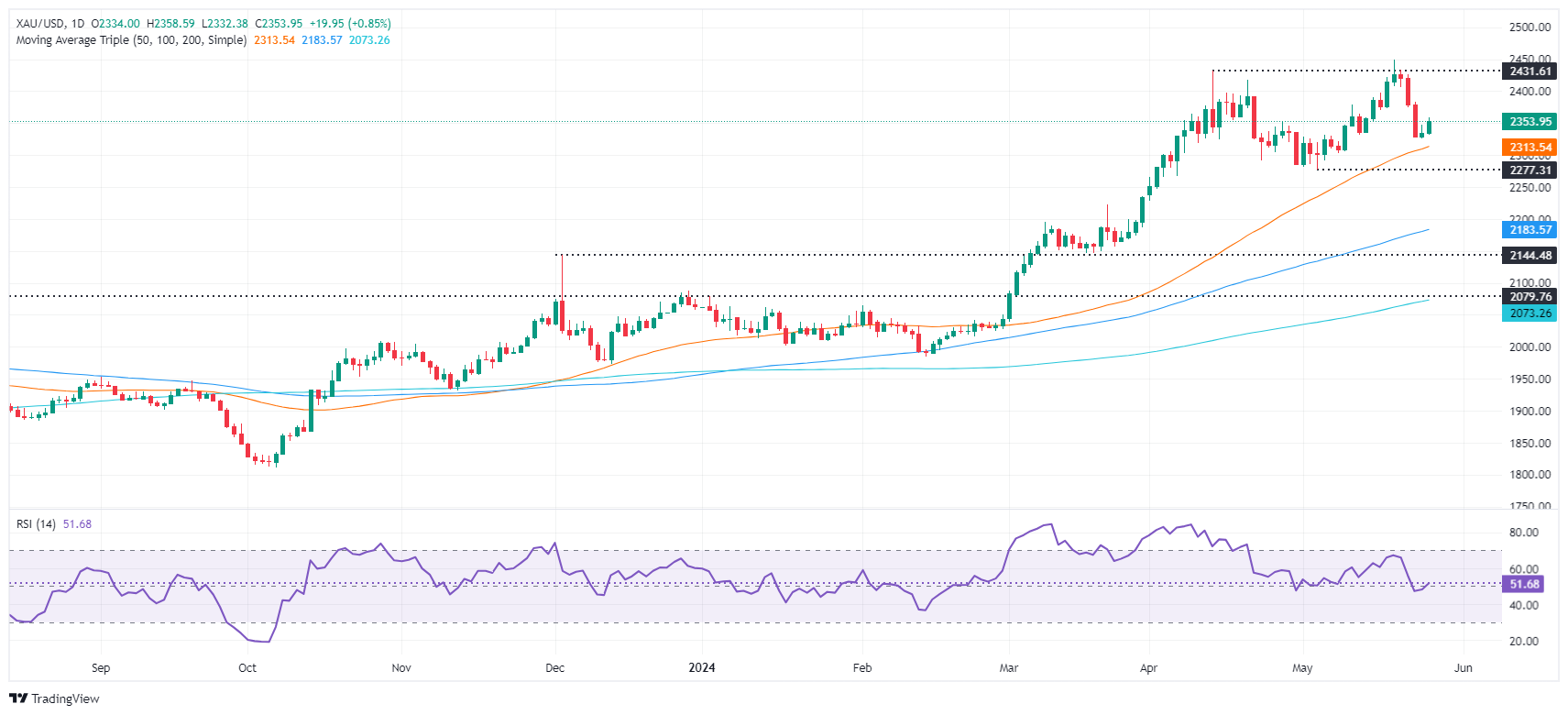
Gold price uptrend remains intact despite retreating below the $2,400 figure. Buyers are gathering traction as depicted in the Relative Strength Index (RSI) indicator, which has turned bullish, hinting that higher prices lie ahead.
If XAU/USD clears $2,350, that would expose the $2,400 mark. Further gains lie overhead as buyers target the year-to-date high of $2,450, followed by the $2,500 mark.
On the other hand, if bears keep the XAU/USD price below $2,350, they need to push prices below the May 8 low of $2,303. Once surpassed, the May 3 cycle low of $2,277 would follow.
Gold FAQs
Gold has played a key role in human’s history as it has been widely used as a store of value and medium of exchange. Currently, apart from its shine and usage for jewelry, the precious metal is widely seen as a safe-haven asset, meaning that it is considered a good investment during turbulent times. Gold is also widely seen as a hedge against inflation and against depreciating currencies as it doesn’t rely on any specific issuer or government.
Central banks are the biggest Gold holders. In their aim to support their currencies in turbulent times, central banks tend to diversify their reserves and buy Gold to improve the perceived strength of the economy and the currency. High Gold reserves can be a source of trust for a country’s solvency. Central banks added 1,136 tonnes of Gold worth around $70 billion to their reserves in 2022, according to data from the World Gold Council. This is the highest yearly purchase since records began. Central banks from emerging economies such as China, India and Turkey are quickly increasing their Gold reserves.
Gold has an inverse correlation with the US Dollar and US Treasuries, which are both major reserve and safe-haven assets. When the Dollar depreciates, Gold tends to rise, enabling investors and central banks to diversify their assets in turbulent times. Gold is also inversely correlated with risk assets. A rally in the stock market tends to weaken Gold price, while sell-offs in riskier markets tend to favor the precious metal.
The price can move due to a wide range of factors. Geopolitical instability or fears of a deep recession can quickly make Gold price escalate due to its safe-haven status. As a yield-less asset, Gold tends to rise with lower interest rates, while higher cost of money usually weighs down on the yellow metal. Still, most moves depend on how the US Dollar (USD) behaves as the asset is priced in dollars (XAU/USD). A strong Dollar tends to keep the price of Gold controlled, whereas a weaker Dollar is likely to push Gold prices up.
Author

Christian Borjon Valencia
FXStreet
Markets analyst, news editor, and trading instructor with over 14 years of experience across FX, commodities, US equity indices, and global macro markets.

















