Gold price drifts higher as traders brace for US NFP data
- Gold price trades in positive territory in Friday’s early European session.
- US election uncertainty and geopolitical risks underpin the Gold price, but renewed USD might cap its upside.
- The US October Nonfarm Payrolls data will take center stage on Friday.

The Gold price (XAU/USD) recovers some lost ground on Friday. The uncertainties surrounding the US presidential election and the ongoing geopolitical tensions in the Middle East provide some support to the precious metal, a traditional safe-haven asset.
Nonetheless, the rising US treasury bond yields and a stronger US Dollar (USD) might weigh on the yellow metal. Traders will closely watch the US October employment report on Friday for fresh impetus, including the Nonfarm Payrolls (NFP), Unemployment Rate and Average Hourly Earnings. The stronger outcome could prompt bets for less aggressive policy easing by the Federal Reserve (Fed), exerting some selling pressure on the non-yielding yellow metal.
Daily Digest Market Movers: Gold price rebounds ahead of highly-anticipated US NFP data
- “Gold should retain its upward bias and may even flirt with $2,800 in the days ahead, as long as US election risks continue weighing on market sentiment, while Fed rate cut expectations remain intact,” said Han Tan, chief market analyst at Exinity Group.
- Authorities say two separate Hezbollah rocket attacks killed seven people in northern Israel, making it the worst day of such strikes in months, per the BBC.
- "Investors are still in the mindset of buying the dips and that strategy is still going to hold through the (U.S.) election, and maybe after that because there is going to be a lot of turmoil," noted Marex analyst Edward Meir.
- Democratic Vice President Kamala Harris held a marginal 46% to 43% lead over Republican former President Donald Trump, with a glum electorate saying the country is on the wrong track, according to Reuters/Ipsos poll.
- The US Personal Consumption Expenditures (PCE) Price Index, rose 2.1% on a yearly basis in September, compared to 2.2% in August. This figure came in line with market expectations. On a monthly basis, the PCE increased 0.2%, as expected.
- The core PCE Price Index, which excludes volatile food and energy prices, jumped 2.7% in the same period, matching August's rise and above the market estimation of 2.6%. The core PCE Price Index rose 0.3% on a monthly basis, in line with the consensus.
- US Initial Jobless Claims for the week ending October 26 fell from 228K to 216K, coming in below the forecast of 230K.
- Markets are currently pricing in almost 100% odds for a 25-basis points (bps) rate cut by the Fed in the November meeting.
Technical Analysis: Gold price remains strong in the longer term
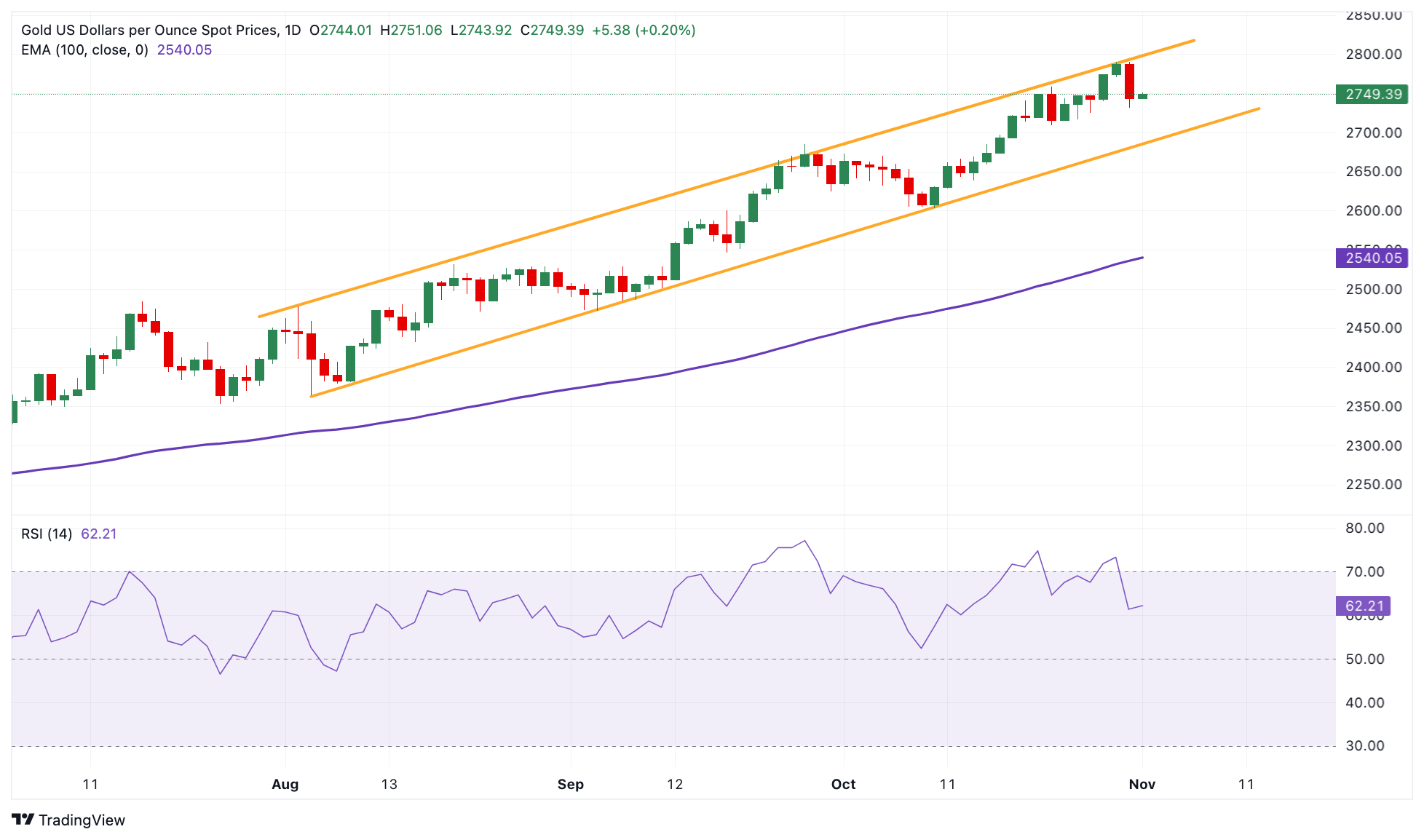
The all-time high and psychological mark in the $2,790-$2,800 zone appears to be a tough nut to crack for Gold bulls. A decisive break above this level could result in a rally to $2,850.
On the downside, the initial support level for the yellow metal emerges at $2,715, the low of October 24. The additional downside filter to watch is $2,624, the low of September 30. The next contention level is located at $2,600 before $2,500, the low of September 9 and round figure.
Gold FAQs
Gold has played a key role in human’s history as it has been widely used as a store of value and medium of exchange. Currently, apart from its shine and usage for jewelry, the precious metal is widely seen as a safe-haven asset, meaning that it is considered a good investment during turbulent times. Gold is also widely seen as a hedge against inflation and against depreciating currencies as it doesn’t rely on any specific issuer or government.
Central banks are the biggest Gold holders. In their aim to support their currencies in turbulent times, central banks tend to diversify their reserves and buy Gold to improve the perceived strength of the economy and the currency. High Gold reserves can be a source of trust for a country’s solvency. Central banks added 1,136 tonnes of Gold worth around $70 billion to their reserves in 2022, according to data from the World Gold Council. This is the highest yearly purchase since records began. Central banks from emerging economies such as China, India and Turkey are quickly increasing their Gold reserves.
Gold has an inverse correlation with the US Dollar and US Treasuries, which are both major reserve and safe-haven assets. When the Dollar depreciates, Gold tends to rise, enabling investors and central banks to diversify their assets in turbulent times. Gold is also inversely correlated with risk assets. A rally in the stock market tends to weaken Gold price, while sell-offs in riskier markets tend to favor the precious metal.
The price can move due to a wide range of factors. Geopolitical instability or fears of a deep recession can quickly make Gold price escalate due to its safe-haven status. As a yield-less asset, Gold tends to rise with lower interest rates, while higher cost of money usually weighs down on the yellow metal. Still, most moves depend on how the US Dollar (USD) behaves as the asset is priced in dollars (XAU/USD). A strong Dollar tends to keep the price of Gold controlled, whereas a weaker Dollar is likely to push Gold prices up.
Author

Lallalit Srijandorn
FXStreet
Lallalit Srijandorn is a Parisian at heart. She has lived in France since 2019 and now becomes a digital entrepreneur based in Paris and Bangkok.