Gold Price Forecast: XAU/USD holds $1,970 amid three-week uptrend, central banks eyed – Confluence Detector
- Gold Price seesaws around weekly top, braces for the third consecutive weekly gains.
- Overall mixed sentiment joins China’s efforts to nurture economic optimism to propel XAU/USD price.
- Risk catalysts will be the key to track amid a light calendar, cautious mood ahead of Fed monetary policy meeting.
- Gold Price run-up past $1,970 confluence appears bumpier than the south-run.

Gold Price (XAU/USD) steadies after refreshing the highest levels in two months as it braces for the third consecutive weekly gain ahead of the key central bank announcements from the US, Europe and Japan. Apart from the pre-announcement anxiety, a light calendar and mixed catalysts, as well as the market’s consolidation of the recent moves, also prod the XAU/USD traders.
That said, upbeat US employment clues joined disappointment from the US energy and technology shares to propel US Treasury bond yields, as well as the US Dollar, the previous day. Adding to this, pessimism surrounding China’s economic growth also challenged the Gold buyers on Thursday. However, a slew of measures to defend the world’s second-largest economy by the policymakers joined the US Dollar’s positioning for the next week’s Fed meeting to trigger a corrective bounce in the XAU/USD price while snapping a two-day losing streak.
It’s worth noting that apart from the US employment clues, the majority of the US statistics haven’t been impressive to support the Fed in announcing more rate hikes past July in the next week, which in turn pushed back the market bears and keep the Gold buyers hopeful. However, it all depends upon how well the US central bank can defend the hawkish bias and the US Dollar.
Also read: Gold Price Forecast: Will XAU/USD attempt another run toward $2,000?
Gold Price: Key levels to watch
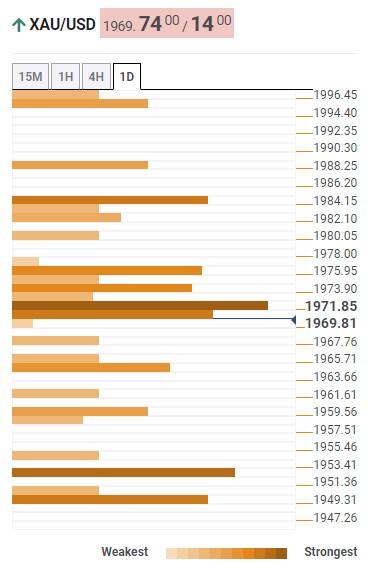
As per our Technical Confluence indicator, Gold Price seesaws around the $1,970 support-turned-resistance confluence comprising the Pivot Point one-month R1, Fibonacci 23.6% on one-day and the middle band of the Bollinger on the four-hour (4H) play.
In a case where the Gold Price successfully crosses the $1,970 hurdle, the previous monthly high of around $1,985 will gain the buyer’s attention.
Following that, the upper band of the Bollinger on 4H and Pivot Point one-week R2 can challenge the XAU/USD bulls near $1,989 and $1,995 respectively before directing them to the $2,000 round figure.
On the flip side, a convergence of the previous daily low and weekly high, as well as the middle band of the Bollinger on the hourly chart, restricts the immediate downside of the Gold Price near $1,965.
In a case where the XAU/USD slides beneath the $1,965 support, the Fibonacci 23.6% on one-week and Pivot Point one-day S2, around $1,953, will precede the 50-DMA support of around $1,950 to act as the final defenses of the Gold buyers.
Overall, the Gold Price remains on the front foot unless breaking $1,950 but the road towards the north appears long.
Here is how it looks on the tool
About Technical Confluences Detector
The TCD (Technical Confluences Detector) is a tool to locate and point out those price levels where there is a congestion of indicators, moving averages, Fibonacci levels, Pivot Points, etc. If you are a short-term trader, you will find entry points for counter-trend strategies and hunt a few points at a time. If you are a medium-to-long-term trader, this tool will allow you to know in advance the price levels where a medium-to-long-term trend may stop and rest, where to unwind positions, or where to increase your position size
Author

Anil Panchal
FXStreet
Anil Panchal has nearly 15 years of experience in tracking financial markets. With a keen interest in macroeconomics, Anil aptly tracks global news/updates and stays well-informed about the global financial moves and their implications.