Gold Price Forecast: XAU/USD eases on Friday as investors look elsewhere
- Gold bids cooled back below $2,650, crimping the week’s gains at the tail end.
- Market risk appetite recovered on Friday after US ISM data improved.
- Fedspeak further cooled investors concerns, Fed’s Barkin soothes market concerns.

XAU/USD dipped on Friday, with Gold prices falling roughly two-thirds of a percent and dipping back below $2,650 per ounce as market sentiment recovers from the early week’s risk-off appetite. It’s been a wobbly start to global markets during the first week of the 2025 trading season, but investors are still looking for reasons to firm up their stance heading into the new year.
Federal Reserve (Fed) Bank of Richmond President Tom Barkin spoke to a bankers association in Maryland on Friday, highlighting that the Fed has already reduced interest rates by a full percentage point during 2024, bringing the fed funds rate down to the 4.25%-4.5% range. The US unemployment rate is also holding at historically low levels, while inflation appears to be drifting back toward the Fed’s target of 2% annually. Fed’s Barkin also downplayed the potential negative effects of incoming President Donald Trump’s plans to enact sweeping tariff proposals on his first day in office that would see the US functionally enter into simultaneous trade wars with all of the US’ closest allies and trading partners unilaterally. According to Fed policymaker Barkin, markets shouldn’t be too worried about a potential 10%-20% fee on all imported goods into the US, because the “pass-through from tariffs to prices is not straightforward, it depends on multiple factors including business supply chains, and the price elasticity of consumers.”
Coming up next week, American markets and institutions will be taking Thursday off in observation of the passing of former President Jimmy Carter, who died on December 29th at the age of 100. Friday will follow up with the first US Nonfarm Payrolls (NFP) print of 2025.
Gold price forecast
Gold prices have been caught in a rough cyclical churn through the last quarter of 2024, with XAU/USD bids routinely spinning around the $2,650 handle. Gold’s sideways grind is best highlighted by the 50-day Exponential Moving Average (EMA), which has been moving sideways since early November and is acting like a trap for bids, keeping price action constrained.
Bulls have failed repeatedly to muscle prices back above $2,720, while selling pressure remains bolstered by a near-term technical floor at the $2,600 handle.
XAU/USD daily chart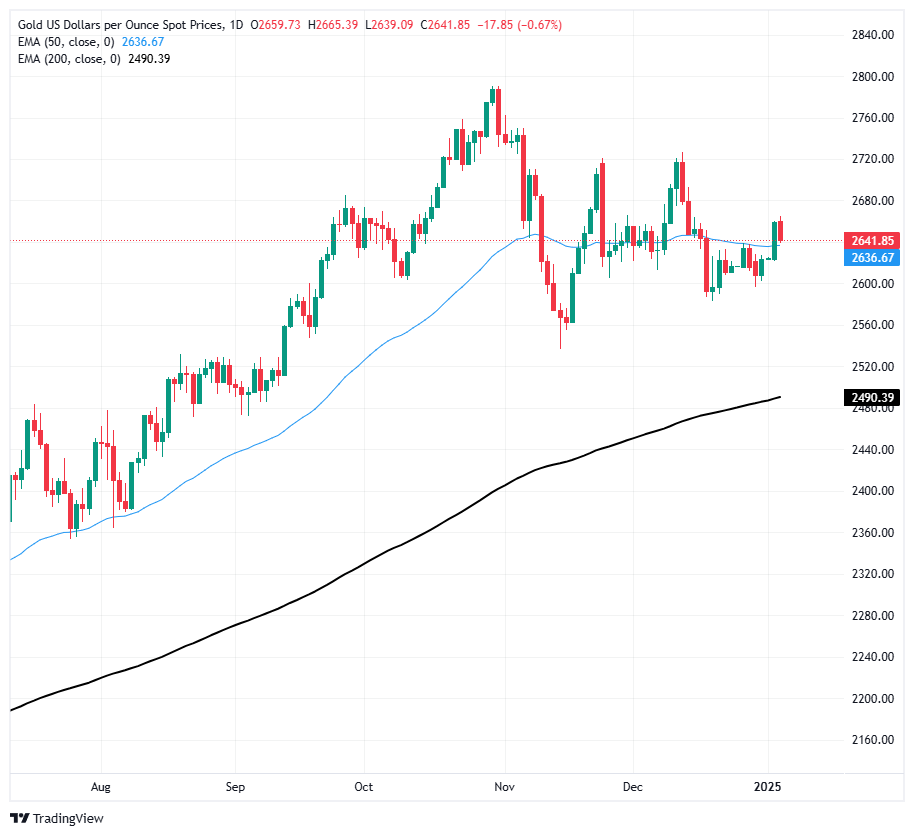
Gold FAQs
Gold has played a key role in human’s history as it has been widely used as a store of value and medium of exchange. Currently, apart from its shine and usage for jewelry, the precious metal is widely seen as a safe-haven asset, meaning that it is considered a good investment during turbulent times. Gold is also widely seen as a hedge against inflation and against depreciating currencies as it doesn’t rely on any specific issuer or government.
Central banks are the biggest Gold holders. In their aim to support their currencies in turbulent times, central banks tend to diversify their reserves and buy Gold to improve the perceived strength of the economy and the currency. High Gold reserves can be a source of trust for a country’s solvency. Central banks added 1,136 tonnes of Gold worth around $70 billion to their reserves in 2022, according to data from the World Gold Council. This is the highest yearly purchase since records began. Central banks from emerging economies such as China, India and Turkey are quickly increasing their Gold reserves.
Gold has an inverse correlation with the US Dollar and US Treasuries, which are both major reserve and safe-haven assets. When the Dollar depreciates, Gold tends to rise, enabling investors and central banks to diversify their assets in turbulent times. Gold is also inversely correlated with risk assets. A rally in the stock market tends to weaken Gold price, while sell-offs in riskier markets tend to favor the precious metal.
The price can move due to a wide range of factors. Geopolitical instability or fears of a deep recession can quickly make Gold price escalate due to its safe-haven status. As a yield-less asset, Gold tends to rise with lower interest rates, while higher cost of money usually weighs down on the yellow metal. Still, most moves depend on how the US Dollar (USD) behaves as the asset is priced in dollars (XAU/USD). A strong Dollar tends to keep the price of Gold controlled, whereas a weaker Dollar is likely to push Gold prices up.
Author

Joshua Gibson
FXStreet
Joshua joins the FXStreet team as an Economics and Finance double major from Vancouver Island University with twelve years' experience as an independent trader focusing on technical analysis.
















