Gold Price Forecast: XAU/USD dribbles within $30 range as Fed Minutes loom
- Gold price seesaws inside one-week-old trading range between 50-day EMA and 100-day EMA.
- Cautious mood ahead of FOMC Minutes, geopolitical fears surrounding Russia, China keeps XAU/USD bears hopeful.
- Fed Minutes should push back policy pivot talks to please Gold sellers.

Gold price (XAU/USD) probes a two-day downtrend as it treads water around $1,835 during early Wednesday. In doing so, the bright metal remains inside the one-week-old trading range of around $30.00 as traders await the Federal Open Market Committee’s (FOMC) Monetary Policy Meeting Minutes. It’s worth noting that the geopolitical fears and the US Dollar’s lackluster moves around the multi-day top seem to add filters to the XAU/USD traders.
That said, firmer prints of the preliminary US S&P Global PMIs for February joined the hawkish Fed bets to underpin the US Dollar Index’s first daily positive in three the previous day, down 0.07% intraday near 104.11 at the latest.
However, the US Treasury bond yields’ lackluster moves around the three-month high, marked the previous day, seem to restrict the XAU/USD momentum of late.
Also likely to probe the Gold traders could be the hawkish bias surrounding the US Federal Reserve (Fed) and looming policy pivot chatters.
Furthermore, comments from US Secretary of State Antony Blinken and Russian President Vladimir Putin weigh on the market sentiment and the Gold price as both suggest further tension between Moscow and Kyiv, which also includes indirect participation of the West and China of late. Though, an absence of major updates in Asia seemed to have paused the risk-off mood.
Amid these plays, the US 10-year and two-year treasury bond yields seesaw around the three-month highs marked the previous day while S&P 500 Futures print mild gains despite Wall Street’s negative closing.
Looking ahead, mixed mood and caution ahead of the FOMC Minutes can keep XAU/USD on a dicey floor but the signals for Fed policy pivot will be enough to recall the Gold buyers.
Gold price technical analysis
Gold price remains inactive between the 100-day Exponential Moving Average (EMA) and 50-day EMA following its break of the three-month-old support line, now resistance. Adding strength to the downside bias are the bearish MACD signals and a two-week-old descending trend line.
It’s worth noting, however, that the nearly oversold conditions of RSI (14) highlight the importance of the 100-day EMA level of $1,821 as the key support.
On the contrary, a downward-sloping resistance line from February 09, close to $1,838 restricts the XAU/USD’s immediate upside ahead of the 50-day EMA, near $1,853 by the press time.
Hence, the Gold price stays on the bear’s radar unless breaking the support-turned-resistance line from late November, close to $1,916, but the room for metal appears limited.
Gold price: Daily chart
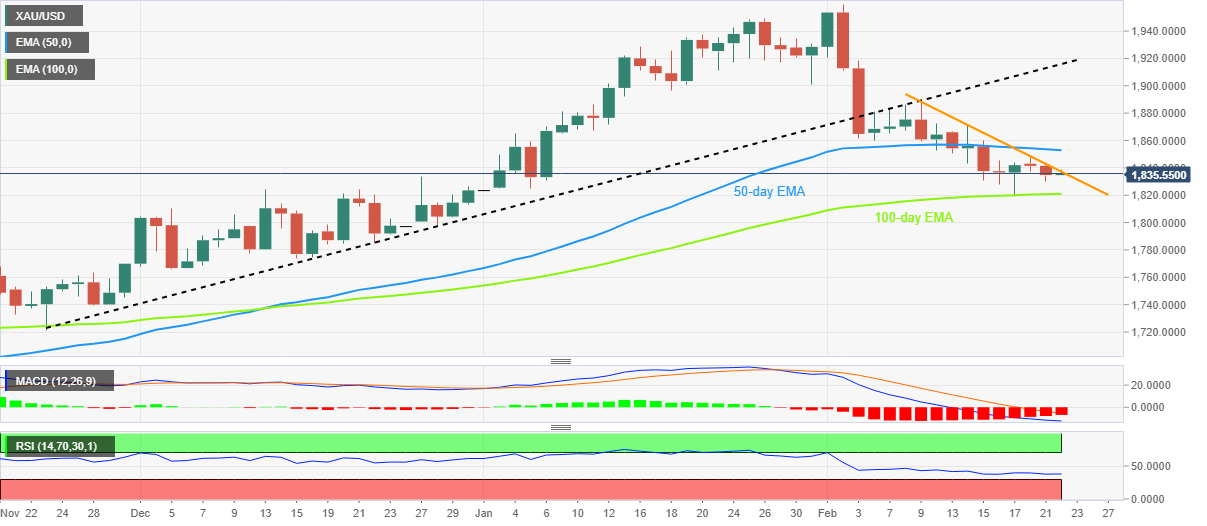
Trend: Further downside expected
Author

Anil Panchal
FXStreet
Anil Panchal has nearly 15 years of experience in tracking financial markets. With a keen interest in macroeconomics, Anil aptly tracks global news/updates and stays well-informed about the global financial moves and their implications.