Gold Price Forecast: Impending bull cross teases XAU/USD buyers near $1,670
- Gold price snaps four-day downtrend with mild gains around one-week low.
- Risk off mood, hawkish Fed bets keep XAU/USD bears hopeful ahead of the key US CPI, FOMC Minutes.
- Updates on Russia-Ukraine, Sino-American tussles also become important to watch for fresh impulse.

Gold price (XAU/USD) portrays a corrective bounce near $1,670 during Tuesday’s Asian session. In doing so, the yellow metal prints the first positive day in five as the US Dollar Index (DXY) fails to cheer the return of the full markets and the hawkish Fed bets.
That said, the DXY retreats from a one-week high to 113.00, down 0.15% intraday as traders brace for this week’s key events/data, namely Wednesday’s Fed Minutes and Thursday’s US Consumer Price Index (CPI) for September. The US dollar index pullback could also be linked to the recently mixed Fedspeak.
“US can lower inflation relatively quickly without recession or large increase in unemployment,” said Chicago Fed President Charles Evans on Monday. The policymaker also added that the Fed needs to "carefully and judiciously" navigate to a "reasonably restrictive" policy rate. It should be noted that Federal Reserve Vice Chair Lael Brainard made the case for cautious rate hikes for the future, per the Wall Street Journal (WSJ).
Even so, the CME’s FedWatch Tool signals a 78.4% chance of the Fed’s 75 bps rate hike in November, which in turn weigh on the mood.
On a different page, Russia’s intense shelling on Kyiv, in reaction to the Crimean bridge explosion, joins the fears that the US and China could again be at loggerheads amid looming concerns surrounding Taiwan and South Korea to weigh on the XAU/USD prices.
Amid these plays, the US 10-year Treasury yields remain sidelined at around 3.96% whereas the S&P 500 Futures struggle to extend the bounce off a one-week low after witnessing a downside in the last four consecutive days.
Looking forward, the qualitative catalysts like headlines surrounding Russia, China and Fedspeak may entertain the gold traders ahead of the Federal Open Market Committee (FOMC) Meeting Minutes and the US CPI. However, the bears are likely to keep reins as fears of economic slowdown keep the US dollar index on the bull’s radar.
Technical analysis
Gold price rebounds from a two-month-old previous resistance line, now support around $1,664. In doing so, the XAU/USD teases a golden cross moving average pattern that lures the buyers. It’s worth noting that the 50-SMA’s upside piercing to the 200-SMA could be considered a bull cross or golden cross.
The corrective bounce also gains support from the oversold RSI (14), which in turn suggests further recovery towards the aforementioned SMA confluence near $1,691-92.
However, the gold buyers remain cautious until the quote renews the monthly high near $1,730.
Alternatively, a downside break of the $1,664 resistance-turned-support could direct short-term sellers toward $1,655 and $1,640 levels to the south before highlighting the yearly low surrounding $1,615.
Gold: Four-hour chart
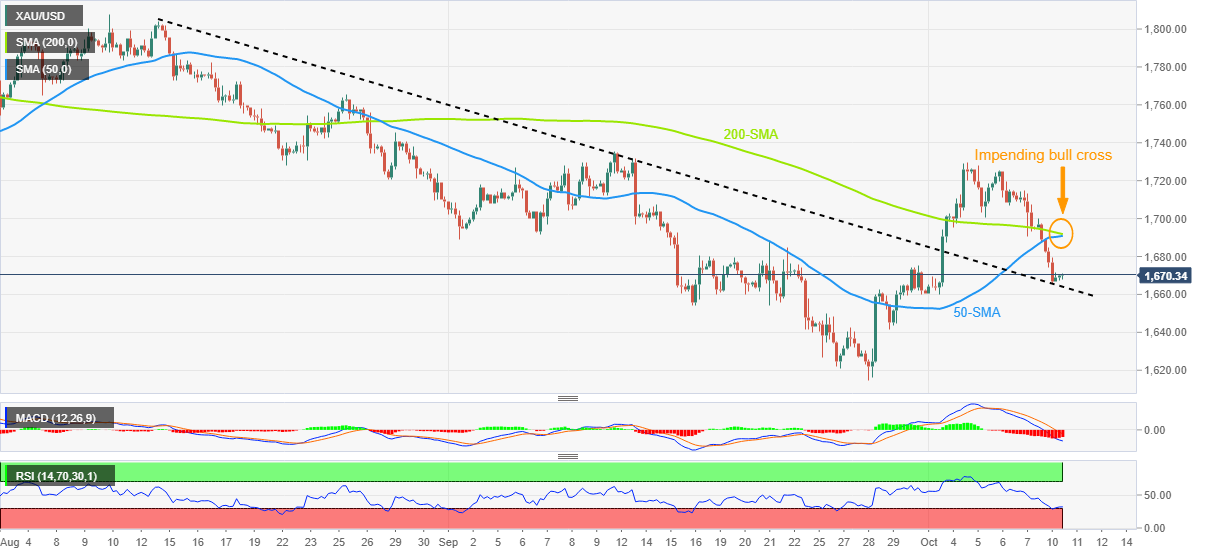
Trend: Corrective bounce expected
Author

Anil Panchal
FXStreet
Anil Panchal has nearly 15 years of experience in tracking financial markets. With a keen interest in macroeconomics, Anil aptly tracks global news/updates and stays well-informed about the global financial moves and their implications.
















