Gold Price Forecast: XAU/USD loses its shine but holds above 1,800
- Gold is fending the 38.2% Fibo with bulls looking for a charge to the $1,850s.
- Key central bank events are in focus which could turn the US dollar over again and support gold higher.

Update: Gold prices lock in some fresh gains but continue to face pressure near the $1,830-$1,835 range. A slight pullback in the US Dollar helped the precious metal to scale higher despite the rising US Treasury yields. The US 10-year benchmark Treasury yields trade higher at 1.33% with more than 1% gains, which capped the upside for gold prices. Higher US Treasury yields diminish the shine of the non-yielding asset. Furthermore, the imports in India rose almost double in August as prices dip ahead of the festival season. A combination of factors remained supportive for gold prices near the lower levels disappointing US jobs reports, persistent coronavirus threat and geopolitical concerns. Investors assessed weaker-than-expected NFP data as a signal of delay in Fed’s plan to reduce the asset purchase program.
Labour Day holidays witnessed a robust US dollar that pressured gold throughout the North American time zone on Monday.
The greenback, as measured in the DXY index, was over 0.12% higher by the start of early Asia a 92.2260.
At the time of writing, XAU/USD is trading at $1,822.72 and flat on the sessions so far.
Yesterday, the yellow metal fell from a high of $1,830.30 to a low of $1,821.50.
The index rallied from an overnight low on Monday of 92.035 to a high of 92.311 so far.
Gold will struggle if there is going to be a resurgence in the greenback amid concerns centred around the global growth recovery.
Last week's major miss in Nonfarm Payrolls in the world's largest economy was not only concerning for the US but as the nation sneezes, the rest of the world catches a cold, as the saying goes.
The highly contagious coronavirus variant is upsetting progress on this front and that is where the US dollar smile theory comes into play.
The US dollar can perform no matter the state of the US economy for it is expected that the markets will be buying the dollar for its safe-haven allure, especially during times of uncertainty.
There is a focus on China in this regard.
China and central bank risks
China is losing steam and data recently slowed more than expected in July as extreme weather and the highly contagious Delta variant of the coronavirus swept across the country.
Industry continued to come off the boil as supply chain bottlenecks worsened and demand softened,"
Monthly indicators of industrial, consumption, services and investment activity all showed growth retreating more quickly than expected—and decelerating from June’s yearly growth rates—according to data released by China’s National Bureau of Statistics.
For instance, the official non-manufacturing PMI in August was 47.5, well down from July's 53.3, data from the NBS showed.
The latest surveys suggest that China's economy contracted in August as virus disruptions weighed heavily on services activity.
The recovery was already plateauing more than a year after the pandemic first exploded.
However, on Tuesday, we will now see China's August trade data which might instil some confidence in the nation's recovery after all.
Analysts at Westpac expect the data to reflect export strength despite the impact of the Delta variant.
Nevertheless, the US dollar would be expected to remain robust until there are signs of decoupling in economic recoveries from around the world, leaving the US behind.
With that being said, central banks from around the world will be meeting this week, starting with the Reserve Bank of Australia on Tuesday.
There are mixed sentiments surrounding what the outcome will be. It is a toss of a coin as to whether the central bank will hold off from tapering or add more.
The US dollar stands to thrive if the Federal Reserve's peers converge in a cautionary manner; that is to say, refrain from tapering at the same time the Fed holds back.
In such a scenario, the price of gold and the commodities block, in general, would once again come under pressure.
Additionally, there are risks of Fed speakers speaking contrary to Friday's payrolls outcome.
markets might be reminded that while the NFP report missed by a mile, it is a blip in a series of very strong data and one data set alone may not be what it takes to knock the Fed off from its course of tapering later this year.
Gold technical analysis
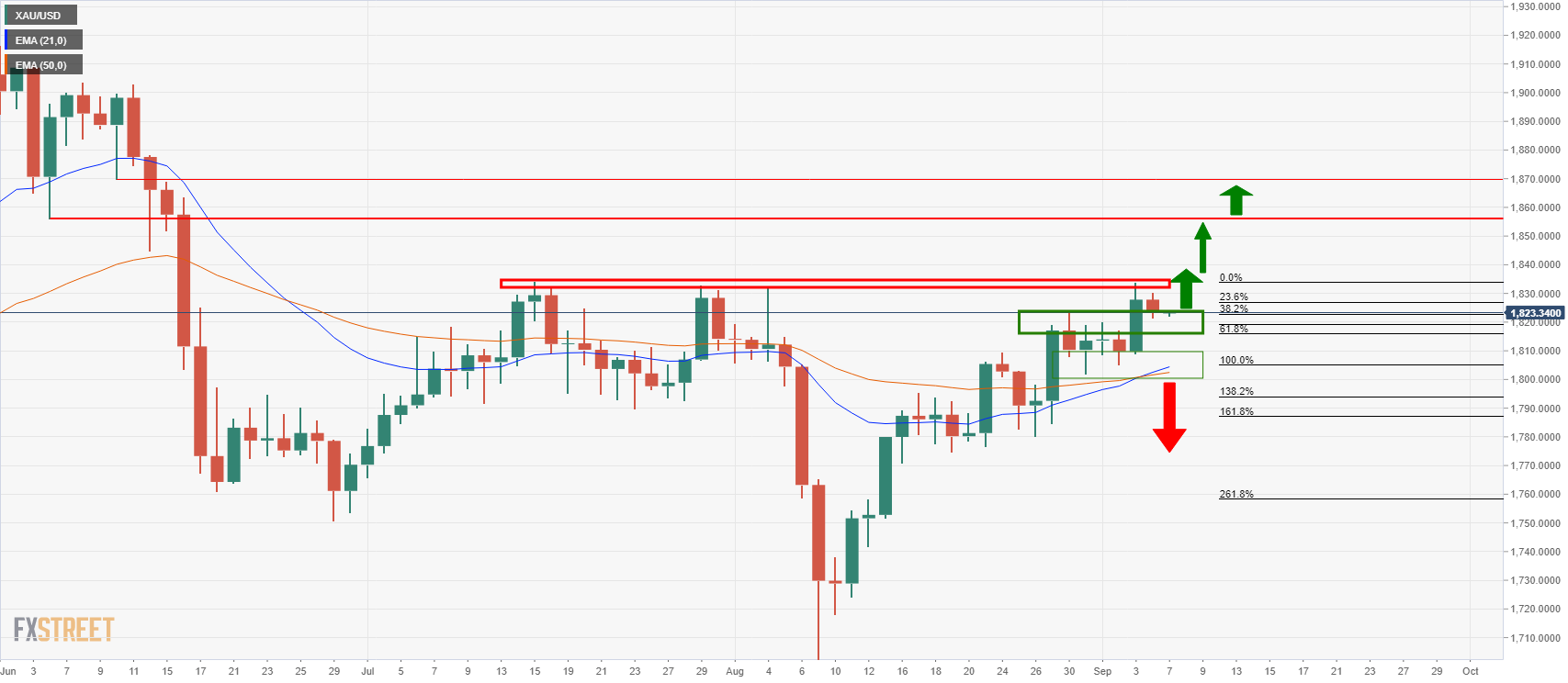
The price is poised to rally from the 38.2% Fibonacci retracement level with the 1,850s and 1,870s in the bull's sights.
However, on a break of support and below 1,800, the bears will be back in control, taking out the 50 and 21 EMAs.
Author

Ross J Burland
FXStreet
Ross J Burland, born in England, UK, is a sportsman at heart. He played Rugby and Judo for his county, Kent and the South East of England Rugby team.