Gold hits record above $4,900 as rally extends despite risk-on mood
- Gold tops $4,900 despite improved risk appetite after US–Europe tensions ease.
- Strong US GDP and steady inflation trim near-term Fed cut hopes, yet bullion remains bid.
- Markets still price 41 bps of Fed easing in 2026, underpinning Gold’s broader uptrend.
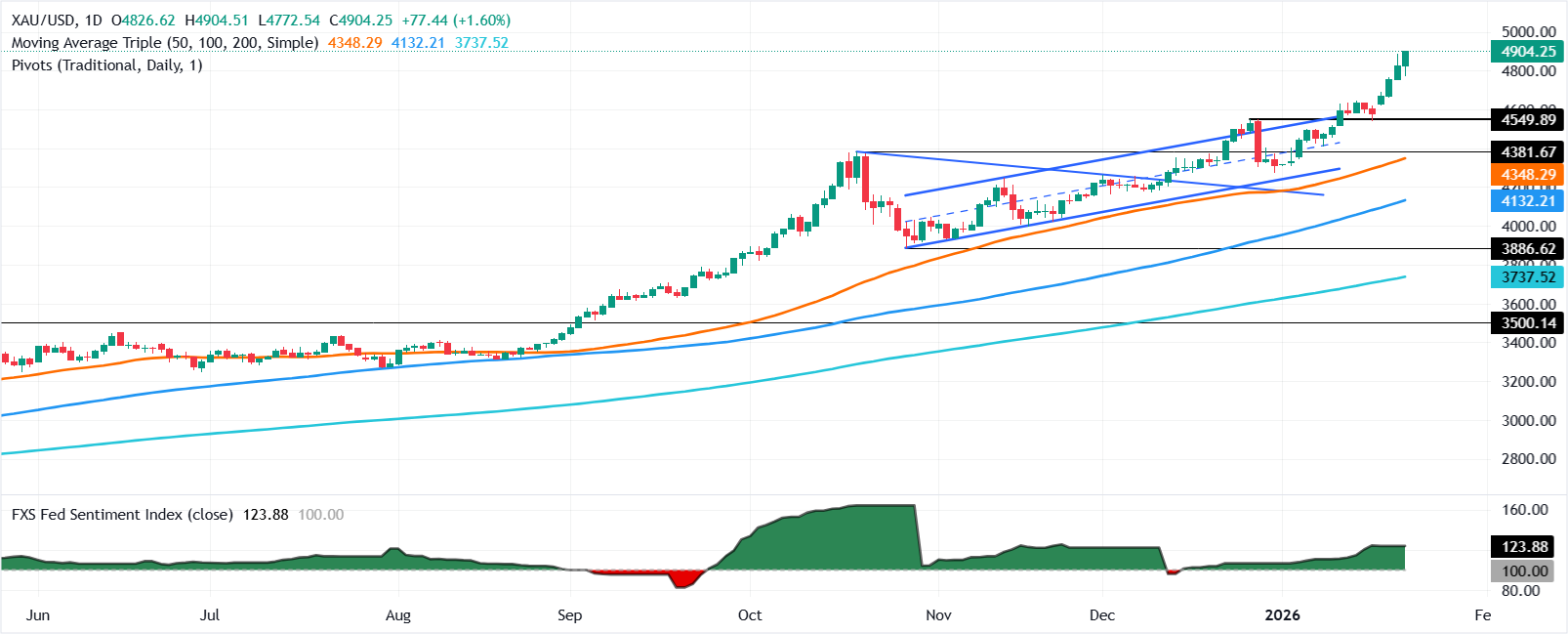
Gold (XAU/USD) surges for the fourth consecutive trading day on Thursday, hitting a fresh record high of $4,906, even as risk appetite improved and tensions between the US and Europe eased, following an agreement over Greenland. At the time of writing, XAU/USD trades at $4,903, up 1.60% in the day.
Gold climbs for a fourth straight day as lingering policy uncertainty and easing expectations support demand
Market mood is positive following conversations between US President Donald Trump and NATO Secretary General Mark Rutte in Switzerland. Following the meeting, Trump dropped the threats of tariffs imposed on eight European countries effective on February 1.
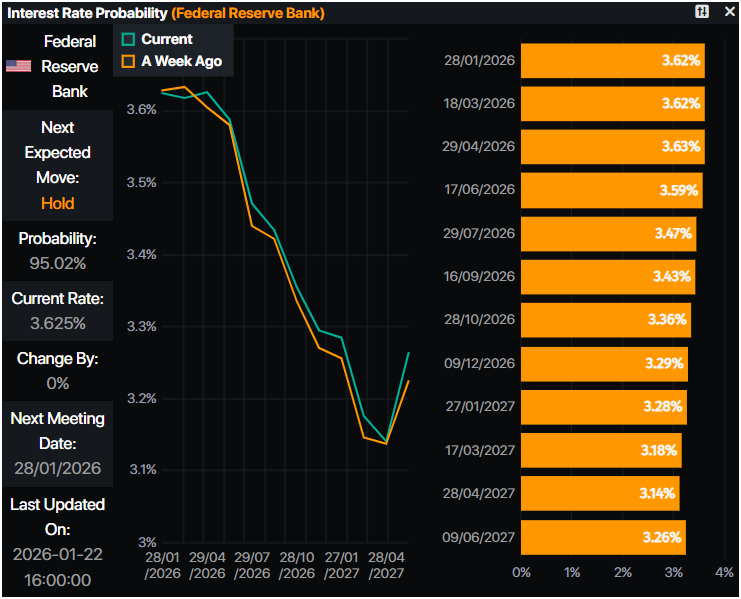
Aside from geopolitical tensions, US economic data showed that the economy fares better than expected. Gross Domestic Product for the third quarter exceeded estimates. At the same time, the labor market shows signs of stability rather than weakness, as pointed out by Federal Reserve (Fed) officials. Therefore, expectations for a rate cut in the January 27-28 meeting are already priced out.
Other data revealed that the Fed’s preferred inflation gauge steadied, yet it remains far from the Fed’s 2% goal.
All in all, money markets are still expecting 41 basis points of easing towards the end of the year, according to Prime Market Terminal data. As better-than-expected US economic data was released, traders continued to trim dovish Fed bets.
What’s on the US economic docket on January 23?
The schedule will feature S&P Global Flash PMIs and the University of Michigan Consumer Sentiment final reading for January.
Daily digest market movers: Gold traders ignore solid US data
- The US Department of Commerce revealed that the Fed’s favorite inflation gauge, the Core Personal Consumption Expenditures (PCE) Price Index, rose by 2.7% YoY in October, and by 2.8% in November, as expected.
- The US Bureau of Economic Analysis reported that Q3 2025 GDP expanded by 4.4% YoY, beating expectations of 4.3% and the Q2 reading of 3.8%. Growth was underpinned by stronger exports and a smaller drag from inventories.
- At the same time, figures from the US Department of Labor showed continued resilience. Initial Jobless Claims for the week ending January 17 rose to 200K, slightly above the upwardly revised 199K prior reading, but still below forecasts of 212K.
- A Reuters survey showed that most economists expect the Fed to pause its easing cycle in the January meeting. The poll revealed that most economists do not expect further easing as long as Fed Chair Jerome Powell leads the central bank.
- Regarding geopolitics, the Danish Prime Minister Mette Frederiksen said that regarding Greenland, “we can discuss our agreement on defense with the US.” Earlier, Greenland PM Jens-Frederik Nielsen said that Greenland continues to take the security in the Arctic seriously and choose the Greenland we know today, as part of the Kingdom of Denmark.
- When asked about the US Golden Dome, Nielsen said “I’m sure we can work out something that benefits all of us.”
- US Treasury yields remained steady, yet Gold has continued its rally. The US 10-year Treasury note is flat at 4.251%. At the same time, the US Dollar Index (DXY), which tracks the American currency's performance versus six peers, plummets 0.47% to 98.32.
Technical analysis: Gold price poised to challenge $5,000
The Gold price rally is set to continue as the Greenback gets battered. XAU/USD seems poised to extend its gains past $4,900, with traders eyeing the $5,000 mark as the next milestone. The Relative Strength Index (RSI) turned overbought and it seems poised to test its latest peak, which could exacerbate Bullion’s move higher.
Conversely, if Gold drops below $4,850, it could open the door for sellers to test lower prices. The next key demand zone would be the January 20 high at $4,766. Once surpassed, the next stop would be $4,700.
Gold FAQs
Gold has played a key role in human’s history as it has been widely used as a store of value and medium of exchange. Currently, apart from its shine and usage for jewelry, the precious metal is widely seen as a safe-haven asset, meaning that it is considered a good investment during turbulent times. Gold is also widely seen as a hedge against inflation and against depreciating currencies as it doesn’t rely on any specific issuer or government.
Central banks are the biggest Gold holders. In their aim to support their currencies in turbulent times, central banks tend to diversify their reserves and buy Gold to improve the perceived strength of the economy and the currency. High Gold reserves can be a source of trust for a country’s solvency. Central banks added 1,136 tonnes of Gold worth around $70 billion to their reserves in 2022, according to data from the World Gold Council. This is the highest yearly purchase since records began. Central banks from emerging economies such as China, India and Turkey are quickly increasing their Gold reserves.
Gold has an inverse correlation with the US Dollar and US Treasuries, which are both major reserve and safe-haven assets. When the Dollar depreciates, Gold tends to rise, enabling investors and central banks to diversify their assets in turbulent times. Gold is also inversely correlated with risk assets. A rally in the stock market tends to weaken Gold price, while sell-offs in riskier markets tend to favor the precious metal.
The price can move due to a wide range of factors. Geopolitical instability or fears of a deep recession can quickly make Gold price escalate due to its safe-haven status. As a yield-less asset, Gold tends to rise with lower interest rates, while higher cost of money usually weighs down on the yellow metal. Still, most moves depend on how the US Dollar (USD) behaves as the asset is priced in dollars (XAU/USD). A strong Dollar tends to keep the price of Gold controlled, whereas a weaker Dollar is likely to push Gold prices up.
Author

Christian Borjon Valencia
FXStreet
Markets analyst, news editor, and trading instructor with over 14 years of experience across FX, commodities, US equity indices, and global macro markets.
















