USD/JPY bounces back as weak Japanese GDP and BoJ rate hike bets collide
- Yen gives back gains after Q4 GDP miss, but BoJ April hike expectations and Thursday's CPI data cap the upside.
- Japan's Q4 GDP grew just 0.1% QoQ, missing the 0.4% consensus and narrowly avoiding a technical recession, while the International Monetary Fund (IMF) called on the BoJ to continue raising rates.
- Thursday's Japanese January national CPI is the key event, with core inflation (ex-fresh food) expected near 2.0%; US initial jobless claims, the Philadelphia Fed Survey, and speeches from Fed officials round out a heavy calendar.

USD/JPY bounced on Wednesday after the Japanese Yen's (JPY) recent rally finally ran out of steam, which has been its best weekly performance since November 2024. Despite a growth miss in Japanese Gross Domestic Product (GDP) figures earlier this week, Bank of Japan (BoJ) rate hike expectations remain firmly in place; former board member Adachi said an April move is likely, and the International Monetary Fund (IMF) reiterated that Japan should continue normalizing policy. Thursday's Japanese National Consumer Price Index (CPI) inflation data is critical: a firm core reading would reinforce the case for BoJ tightening and could push the Yen stronger again, while a soft print would give the pair room to extend Wednesday's bounce.
Bounce off oversold zone meets resistance at the 50-day EMA
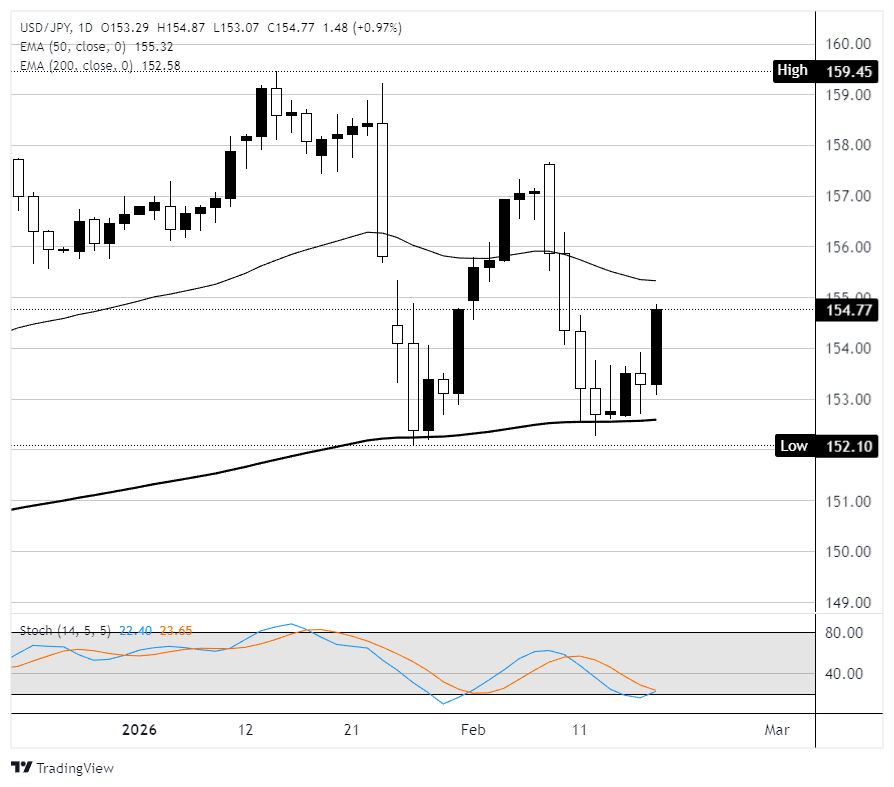
On the daily chart, USD/JPY opened Wednesday near the 153.00 handle before rising around 1%. The bounce produced a solid bullish candle, but price has stalled just below the 50-day EMA at 155.30, which is acting as immediate resistance. The 200-day EMA sits lower near 152.60, and price is trading between the two averages, suggesting the pair is in a transitional phase after the sharp sell-off from the January high near 159.45. The Stochastic Oscillator is turning higher from the oversold zone, suggesting downward momentum is fading, and a near-term relief rally could develop. A break above the 50-day EMA at 155.30 would target 156.00 and the mid-January consolidation area. Failure to clear it would leave the pair vulnerable to a retest of the 153.00 support and the 152.10 year-to-date low.
USD/JPY daily chart
Japanese Yen FAQs
The Japanese Yen (JPY) is one of the world’s most traded currencies. Its value is broadly determined by the performance of the Japanese economy, but more specifically by the Bank of Japan’s policy, the differential between Japanese and US bond yields, or risk sentiment among traders, among other factors.
One of the Bank of Japan’s mandates is currency control, so its moves are key for the Yen. The BoJ has directly intervened in currency markets sometimes, generally to lower the value of the Yen, although it refrains from doing it often due to political concerns of its main trading partners. The BoJ ultra-loose monetary policy between 2013 and 2024 caused the Yen to depreciate against its main currency peers due to an increasing policy divergence between the Bank of Japan and other main central banks. More recently, the gradually unwinding of this ultra-loose policy has given some support to the Yen.
Over the last decade, the BoJ’s stance of sticking to ultra-loose monetary policy has led to a widening policy divergence with other central banks, particularly with the US Federal Reserve. This supported a widening of the differential between the 10-year US and Japanese bonds, which favored the US Dollar against the Japanese Yen. The BoJ decision in 2024 to gradually abandon the ultra-loose policy, coupled with interest-rate cuts in other major central banks, is narrowing this differential.
The Japanese Yen is often seen as a safe-haven investment. This means that in times of market stress, investors are more likely to put their money in the Japanese currency due to its supposed reliability and stability. Turbulent times are likely to strengthen the Yen’s value against other currencies seen as more risky to invest in.
Author

Joshua Gibson
FXStreet
Joshua joins the FXStreet team as an Economics and Finance double major from Vancouver Island University with twelve years' experience as an independent trader focusing on technical analysis.


![How Wall Street rigs the game [Video]](https://editorial.fxsstatic.com/images/i/market-chaos-01.jpg)