Gold price falls as US NFP surprises to the upside, US Dollar recovers
- Gold price falls after US NFP report highlights a resilient labour market, with the unemployment falling to 4.1% in June, and Fed rate cut expectations ease
- US employment data showed 147K were added to the US economy in June, above the 110K forecast, resulting in a rebound in yields, pushing bullion lower.
- XAU/USD plunges as US economic resilience limits demand for the Dollar.

Gold (XAU/USD) is edging lower in the European session on Thursday, as markets look ahead to the US Nonfarm Payrolls (NFP) data release for June.
At the time of writing, Gold is trading near $3,350, with US economic data driving volatility and price action ahead of Friday’s Independence Day holiday in the US.
Markets had anticipated that the Nonfarm Payrolls report would show a gain of 110K jobs in June, following an increase of 144K the previous month. However, the actual headline figure came in stronger than expected at 147K. At the same time, the unemployment rate declined to 4.1% from 4.2%.
Weekly Jobless Claims also edged lower, helping to ease concerns about the strength of the US labor market and diminishing the likelihood of a rate cut in July.
This employment report is a key indicator of labor market conditions in the US, although it does not include sectors such as agriculture.
Before the release of the June data, the CME FedWatch Tool indicated that markets assigned a 25.3% probability to a 25-basis-point rate cut in July. That probability has now fallen sharply to just 4.7%. Expectations of sustained higher interest rates have increased the appeal of US yields, boosting demand for the dollar.
Gold daily digest market movers: Can Thursday's data sway the Fed and drive bullion?
- The ADP Employment Change report released on Wednesday showed that the employment situation in the private sector has continued to weaken. Analysts had expected 95K jobs to be added in June. Instead, the actual figures revealed 33K jobs lost.
- President Trump continues to pressure Fed Chair Jerome Powell to reduce interest rates. On Wednesday, he called for the “immediate resignation” of Fed Powell on a Truth Social post.
- With the Fed’s independence coming under question, Gold could continue to find support from political uncertainty in the US, which has been weakening demand for the Greenback.
- Speaking at the European Central Bank (ECB) forum on Tuesday, Powell stated that "It's going to depend on the data, and we are going meeting by meeting. I wouldn't take any meeting off the table or put it directly on the table. It's going to depend on how the data evolves.” When questioned about interest rates, he said, “In effect, we went on hold when we saw the size of the tariffs, and essentially all inflation forecasts for the United States went up materially as a consequence of the tariffs. We didn’t overreact; in fact, we didn’t react at all. We’re simply taking some time.”
Gold technical analysis: XAU/USD falls below $3,350 as US yields rebound
Gold is currently trading below the 20-day Simple Moving Average (SMA), providing resistance at $3,350. The 78.6% Fibonacci retracement of the April low-high move serves as an additional price ceiling at $3,372.
Gold (XAU/USD) daily price chart:
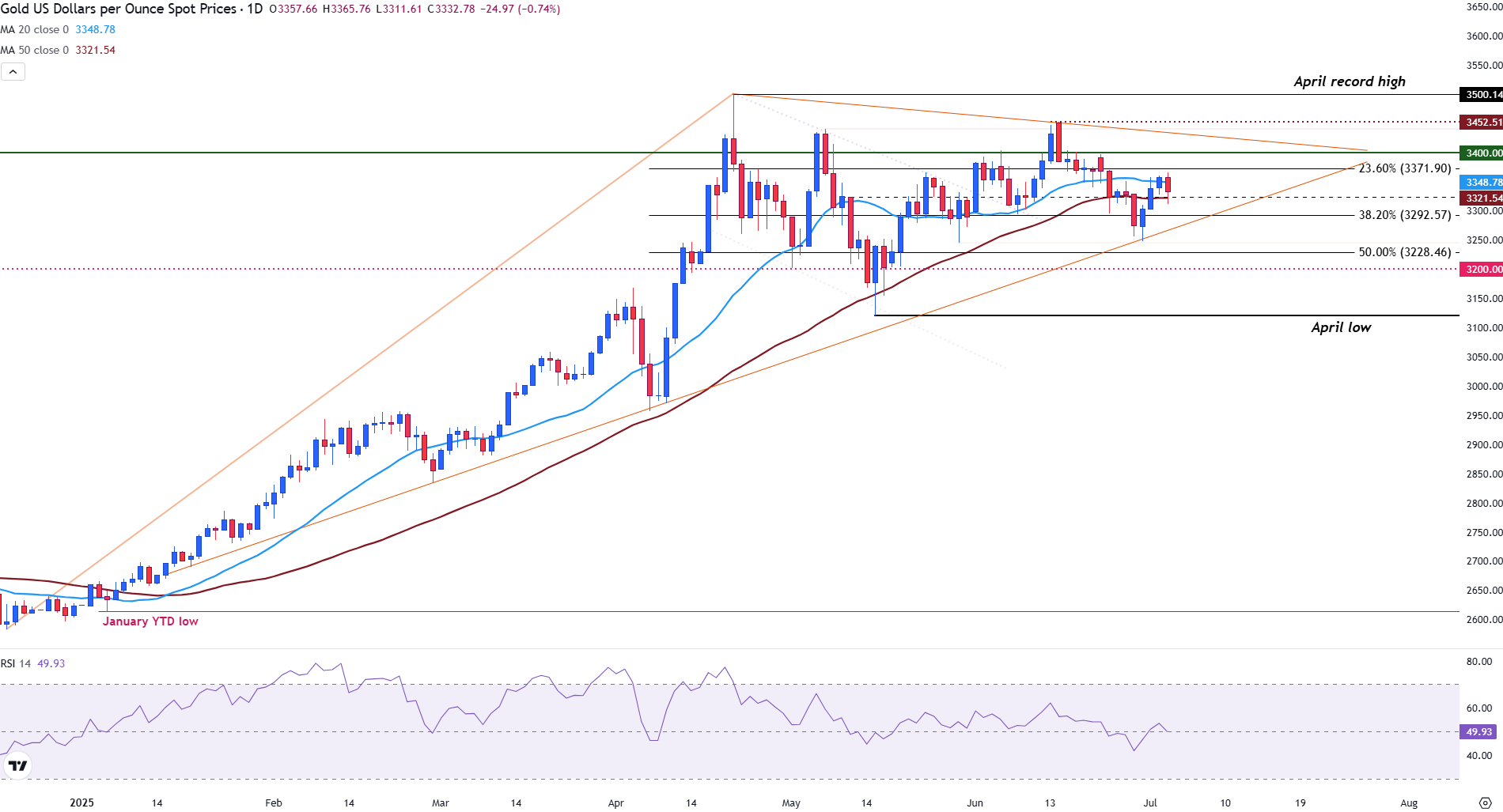
The Relative Strength Index (RSI) is flattening near 50, representing the neutral zone. This reflects indecision among investors right ahead of the key fundamental catalysts.
If Gold falls below the 50-day SMA at $3,322, the next psychological level of $3,300 and the midpoint of the April move at $3,328 could provide near-term support for XAU/USD.
(This story was corrected on July 3 at 14:19 GMT to say that the NFP employment data showed a 147K increase and not a 149K increase, while the Unemployment Rate fell from 4.2%, not 4.3%.)
Gold FAQs
Gold has played a key role in human’s history as it has been widely used as a store of value and medium of exchange. Currently, apart from its shine and usage for jewelry, the precious metal is widely seen as a safe-haven asset, meaning that it is considered a good investment during turbulent times. Gold is also widely seen as a hedge against inflation and against depreciating currencies as it doesn’t rely on any specific issuer or government.
Central banks are the biggest Gold holders. In their aim to support their currencies in turbulent times, central banks tend to diversify their reserves and buy Gold to improve the perceived strength of the economy and the currency. High Gold reserves can be a source of trust for a country’s solvency. Central banks added 1,136 tonnes of Gold worth around $70 billion to their reserves in 2022, according to data from the World Gold Council. This is the highest yearly purchase since records began. Central banks from emerging economies such as China, India and Turkey are quickly increasing their Gold reserves.
Gold has an inverse correlation with the US Dollar and US Treasuries, which are both major reserve and safe-haven assets. When the Dollar depreciates, Gold tends to rise, enabling investors and central banks to diversify their assets in turbulent times. Gold is also inversely correlated with risk assets. A rally in the stock market tends to weaken Gold price, while sell-offs in riskier markets tend to favor the precious metal.
The price can move due to a wide range of factors. Geopolitical instability or fears of a deep recession can quickly make Gold price escalate due to its safe-haven status. As a yield-less asset, Gold tends to rise with lower interest rates, while higher cost of money usually weighs down on the yellow metal. Still, most moves depend on how the US Dollar (USD) behaves as the asset is priced in dollars (XAU/USD). A strong Dollar tends to keep the price of Gold controlled, whereas a weaker Dollar is likely to push Gold prices up.
Author

Tammy Da Costa, CFTe®
FXStreet
Tammy is an economist and market analyst with a deep passion for financial markets, particularly commodities and geopolitics.