Gold slides 2% lower with peace talks in Turkey going ahead
- Gold price slides lower with Russia-Ukraine talks in Turkey after all still taking place.
- Meanwhile, questions arise about the stability and trustworthiness of the US Dollar.
- After a volatile week, Gold faces headwinds in holding $3,200 on Friday.

Gold (XAU/USD) price trades on the backfoot, trading at $3,178 at the time of writing on Friday while multiple questions and concerns arise in markets and amongst traders. First and foremost, the Ukraine-Russia talks looked to be dead and buried even before Ukrainian President Volodymyr Zelenskyy shook hands with Turkish President Recep Tayyip Erdoğan on the tarmac at Ankara. Russian President Vladimir Putin didn’t attend himself and only sent some low-level diplomats, who were rather seen as Russia taunting and pestering Ukraine.
This spurred several world leaders to lash out at Russia, threatening with more severe sanctions to force President Putin to the negotiation table. Markets are bracing for comments from United States (US) President Donald Trump, who appears to be not amused with the scenery, according to Reuters. Meanwhile news came out, which triggered another leg lower in Gold, that both the Russian and Ukraine delegation will continue with talks in Istanbul.
Meanwhile, the US Dollar (USD) is being challenged by markets, which would be a tailwind for XAU/USD. Volatility “in US risk assets and the dollar will lead more international investors to consider hedging more of their dollar exposure and globally diversifying their asset allocations,” Mark Haefele, chief investment officer for the Swiss bank’s wealth management unit, said this week. “Gold remains an important diversifier,” Bloomberg reports.
Daily digest market movers: A week to forget
- Progress on trade negotiations between the US and China has also sapped appetite for haven demand, adding to bearish headwinds for Gold as the standoff between the world’s two largest economies led to a sharp rebound in risk assets this week, Reuters reports.
- Investors need to diversify and hedge “to increase certainty about the value of their assets, especially when they have non-dollar liabilities coming due,” Mark Haefele, chief investment officer for the Swiss bank’s wealth management unit, said. “There doesn’t need to be a seismic shift in US exceptionalism for these trends to manifest themselves.”, Bloomberg reports.
- Precious metals sector consolidations are facing some headwinds. A major Chinese Gold producer is scouting for acquisition opportunities worldwide, although the recent price volatility driven by global trade turmoil means it’s not rushing to secure deals, Bloomberg reports.
Gold Price Technical Analysis: Rally not over yet, but looking fragile
Headwinds and tailwinds, too many to sum up for Gold, are currently pushing the precious metal all over the place. It is no longer an easy picture, at least for now, and Gold is not one-directional as it was at the start of the year. Ultimately, the ‘last wind standing” will decide which direction Gold will head. Though for now, investors should keep looking at the $3,160 area to assess whether the Gold rally is still viable and intact.
On the upside, the pivotal technical level at $3,245 (April 1 high) is acting as resistance and could be difficult to reclaim. Once through there, the R1 resistance at $3,280 and the R2 resistance at $3,320 are the following levels to watch, though a major catalyst would be needed to get it there.
On the other side, the daily Pivot Point stands at $3,199, in line with the $3,200 big figure. In case that level does not hold on Friday, expect a move lower to test the support area around $3,160, with the April 3 high at $3,167 and the intraday S1 support at $ 3,160, before the 55-day Simple Moving Average (SMA) at $3,138.
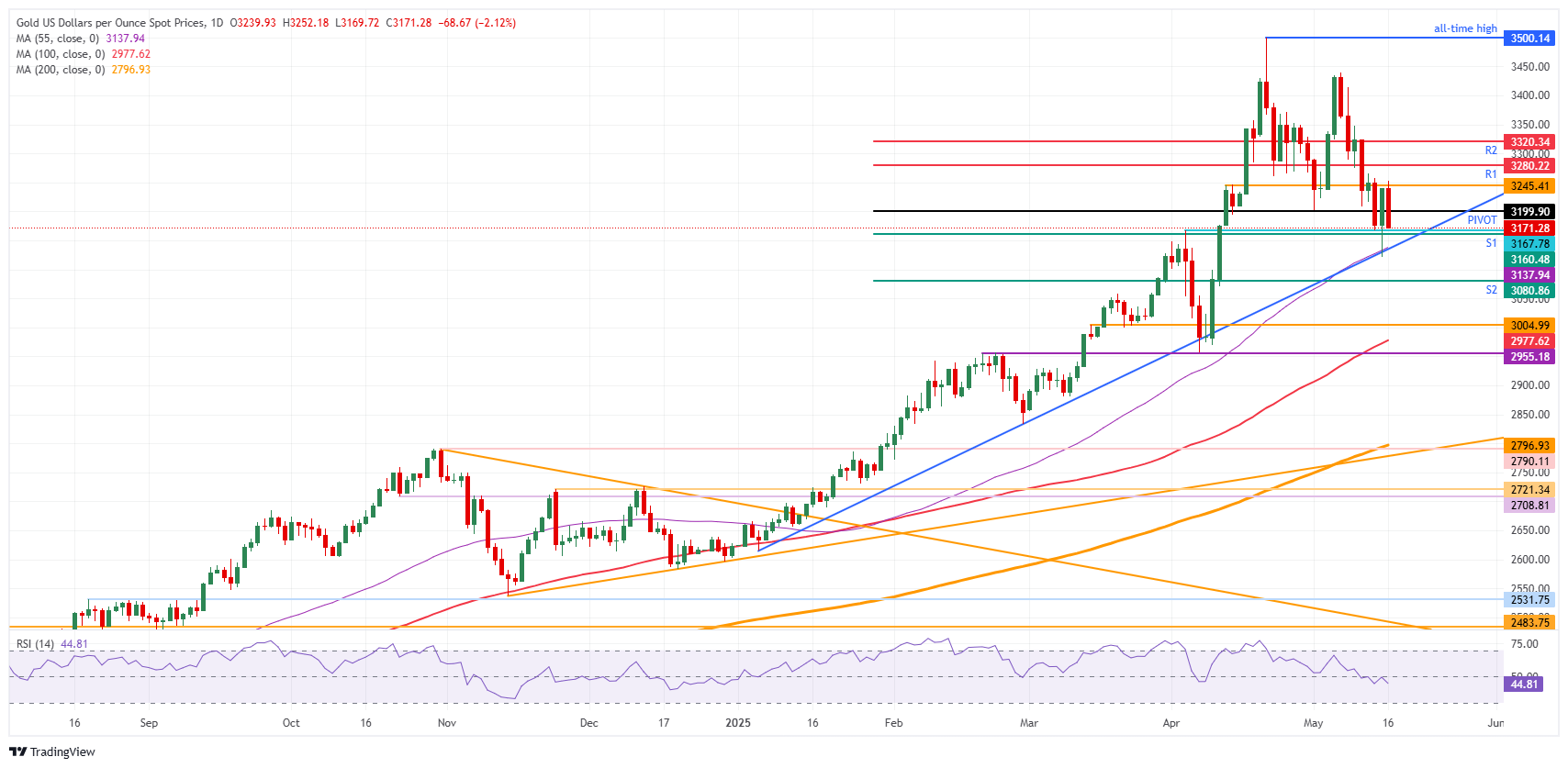
XAU/USD: Daily Chart
Interest rates FAQs
Interest rates are charged by financial institutions on loans to borrowers and are paid as interest to savers and depositors. They are influenced by base lending rates, which are set by central banks in response to changes in the economy. Central banks normally have a mandate to ensure price stability, which in most cases means targeting a core inflation rate of around 2%. If inflation falls below target the central bank may cut base lending rates, with a view to stimulating lending and boosting the economy. If inflation rises substantially above 2% it normally results in the central bank raising base lending rates in an attempt to lower inflation.
Higher interest rates generally help strengthen a country’s currency as they make it a more attractive place for global investors to park their money.
Higher interest rates overall weigh on the price of Gold because they increase the opportunity cost of holding Gold instead of investing in an interest-bearing asset or placing cash in the bank. If interest rates are high that usually pushes up the price of the US Dollar (USD), and since Gold is priced in Dollars, this has the effect of lowering the price of Gold.
The Fed funds rate is the overnight rate at which US banks lend to each other. It is the oft-quoted headline rate set by the Federal Reserve at its FOMC meetings. It is set as a range, for example 4.75%-5.00%, though the upper limit (in that case 5.00%) is the quoted figure. Market expectations for future Fed funds rate are tracked by the CME FedWatch tool, which shapes how many financial markets behave in anticipation of future Federal Reserve monetary policy decisions.
Author

Filip Lagaart
FXStreet
Filip Lagaart is a former sales/trader with over 15 years of financial markets expertise under its belt.