|

GBP/USD path of least resistance is down ahead of critical data – Confluence Detector

GBP/USD is looking for a new direction after the UK clashed with China over Huawei and ahead of all-important inflation, jobs, and retail sales figures from the UK.  How is the currency pair positioned? 

The Technical Confluences Indicator is showing that cable faces a wall of resistance at 1.2589, which is a dense cluster including the Bollinger Band 15min-Upper, the Pivot Point one-day Resistance 1, the BB 4h-Middle, the Simple Moving Average 4-one-day, the Fibonacci 38.2% one-week, the BB 1h-Upper, the Fibonacci 38.2% one-month, and more. 

Further above, the next cap is at 1.2673, which is the convergence of the PP one-day R3 and the previous weekly high. 

Support awaits at 1.2535, which is the confluence of the SMA 10-one-day and the Fibonacci 61.8% one-week.

Further down, the next cushion is at 1.2490, which is the meeting point of the BB one-day Middle and the SMA 100-4h. 

This is how it looks on the tool:
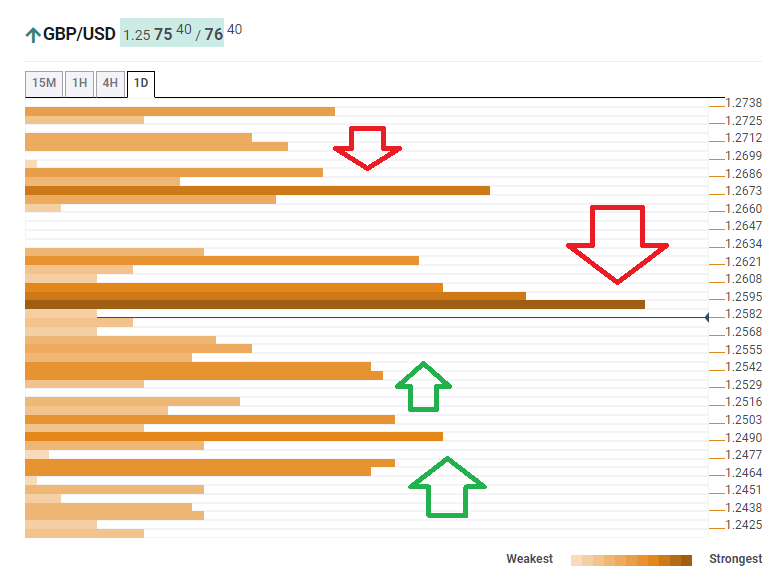
Confluence Detector

The Confluence Detector finds exciting opportunities using Technical Confluences. The TC is a tool to locate and point out those price levels where there is a congestion of indicators, moving averages, Fibonacci levels, Pivot Points, etc. Knowing where these congestion points are located is very useful for the trader, and can be used as a basis for different strategies.

This tool assigns a certain amount of “weight” to each indicator, and this “weight” can influence adjacents price levels. This means that one price level without any indicator or moving average but under the influence of two “strongly weighted” levels accumulate more resistance than their neighbors. In these cases, the tool signals resistance in apparently empty areas.

Learn more about Technical Confluence

Author

Yohay Elam

Yohay Elam

FXStreet

Yohay is in Forex since 2008 when he founded Forex Crunch, a blog crafted in his free time that turned into a fully-fledged currency website later sold to Finixio.


More from Yohay Elam
Share:

Editor's Picks

AUD/USD sits at three-week highs above 0.7000 on hawkish RBA-speak

AUD/USD holds a positive bias for the fourth straight day, trading above 0.7000 in the Asian session on Wednesday and at three-week highs. RBA Deputy Governor Andrew Hauser's hawkish remarks and inflation concerns underpin the pair. However, the upside appears capped as the US Dollar attracts some buyers amid looming US-Iran uncertainty.

USD/JPY remains confined in a familiar range below 158.50

USD/JPY sees some dip-buying in the Asian session on Wednesday, though it remains confined within a multi-week range near 158.50 as the uncertainty over the timing of the next BoJ rate hike keeps Japanese Yen bulls on the defensive. Meanwhile, hawkish Fed expectations, bolstered by inflation risks stemming from volatile oil prices, underpin the US Dollar. However, looming intervention fears could limit JPY losses and cap the currency pair.

Gold advances modestly; targets $4,150

Gold prices manage to reverse three consecutive daily declines, trading just below the $4,150 mark per troy ounce on Wednesday. The precious metal’s recovery comes amid a slight drop in the US Dollar, mixed US Treasury yields across the board and a widespread cautious tone from the US-Iran front.

Bitcoin eyes a break above $85,000 as institutional demand returns

Bitcoin edges higher above $83,000, extending its rebound from the 50-day EMA near $80,786. US-listed BTC spot ETFs recorded over $23 million in net inflows on Tuesday, following Monday's $526 million, signaling a return of institutional demand.

What November 3 means for the Fed's rate path and the US Dollar

The USD faces a decisive period ahead of the November 3 midterm elections. While markets anticipate another interest rate increase from the Fed in December, the battle for control of Congress could reshape fiscal policy expectations and, indirectly, the path of US monetary policy in 2027.

The US Dollar fell. Gold didn't rally. That tells you everything
Gold (XAU/USD) is struggling to capitalize on a weaker US Dollar (USD), after repeatedly failing to establish itself above the $4,200 level. The precious metal remains confined to a relatively narrow trading range despite a combination of developments that would normally support higher prices.