GBP/USD jumps as China treasury rumors hit USD, UK politics cap gains
- GBP/USD rallies after reports that China is cutting exposure to US Treasuries.
- The US Dollar slides sharply as markets reassess US asset demand ahead of delayed NFP and CPI.
- Sterling gains are capped by UK political turmoil around Starmer and persistent fiscal uncertainty.

The Pound Sterling (GBP) posts solid gains versus the US Dollar (USD) on Monday as rumors emerged that China is asking to reduce exposure to US Treasuries, which weighed on the Greenback. Nevertheless, the pair remains capped by political turmoil in the United Kingdom (UK). At the time of writing, GBP/USD trades at 1.3659, up 0.41%.
Sterling advances toward 1.3660 as reports of reduced Chinese Treasury exposure sink the Dollar despite UK political headwinds
Risk appetite is mixed as investors await the release of crucial economic data in the US. Last week’s short US government shutdown pushed the release of the January Nonfarm Payrolls and inflation figures to Wednesday and Friday, respectively.
Bloomberg reported that Chinese authorities advised institutions to limit purchases and reduce their overall exposure to US Treasuries amid fears of volatility in the fixed income markets. This increased the US Dollar’s selloff as depicted by the US Dollar Index (DXY).
The DXY, which measures the performance value of the American currency against six others, is down 0.77%, tumbling below the 97.00 figure for the first time since January 30.
Political turmoil in the UK witnessed the resignation of PM Keir Starmer's Chief of Staff on Sunday after reportedly pushing the PM to appoint Peter Mandelson as ambassador to the US, despite his links to Jeffrey Epstein.
Tensions within the Labour Party are increasing, which fueled speculation of an ousting of PM Starmer. The UK will have elections in Manchester this month and local elections in May.
Fears that an election of a new leader could shift policies to the left and increase spending could trigger a jump in UK Gilts, amid higher inflation, but not so great economic growth.
In the meantime, both the Federal Reserve (Fed) and the Bank of England (BoE) are expected to resume their easing cycle during the year. However, a strong NFP report on Wednesday could deter the US central bank from easing faster than the BoE. Last week, the BoE held rates on a 5-4 vote split, closer than expected, with Governor Bailey saying that the disinflation process would continue, opening the door for further rate cuts.
GBP/USD Price Forecast: Technical outlook
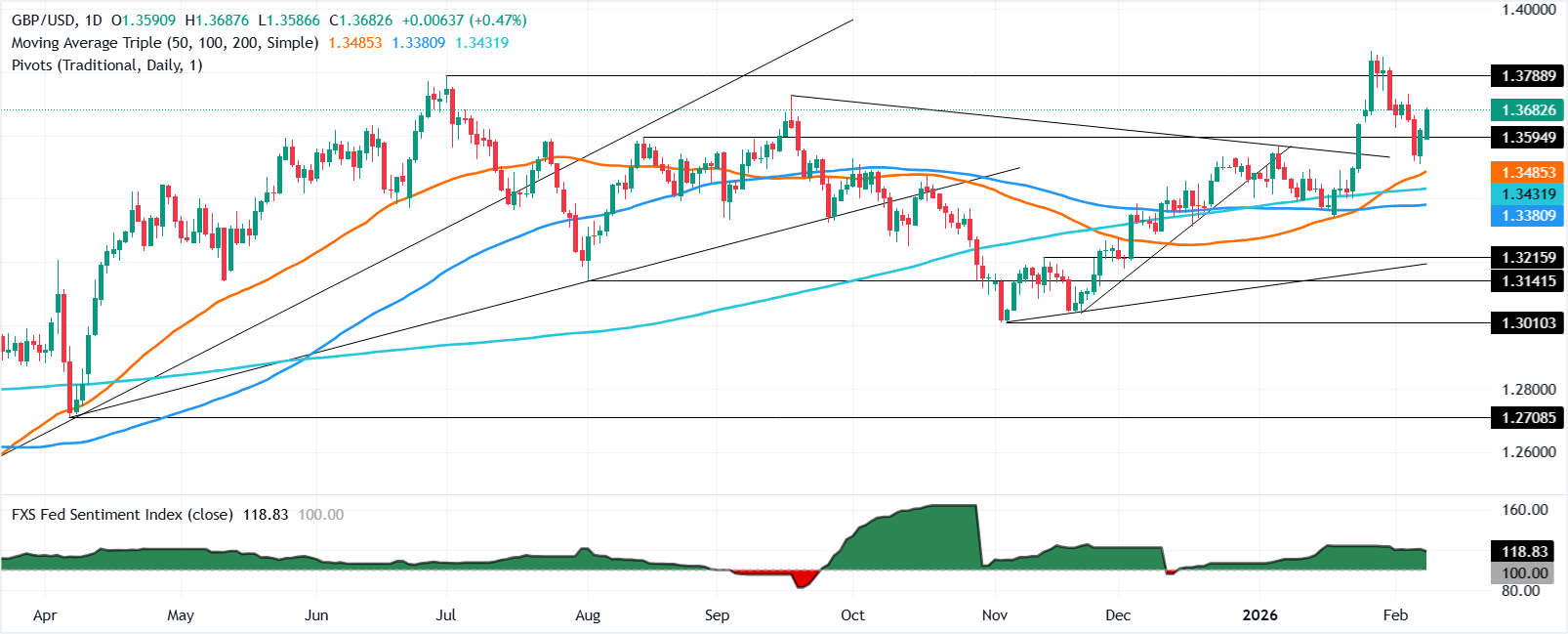
GBP/USD is poised to test 1.3700 amid fears of China’s headlines, prompting investors to ditch the US Dollar. Momentum is turning bullish as depicted by the Relative Strength Index (RSI).
If the pair clears 1.3700, further upside is seen with the next resistance at 1.3733, the February 4 high. Failure in reclaiming the latter clears the path for reaching another lower low past the February 6 swing low of 1.3505, opening the door to challenge the 200-day SMA at 1.3427.
Pound Sterling Price This Month
The table below shows the percentage change of British Pound (GBP) against listed major currencies this month. British Pound was the strongest against the Japanese Yen.
| USD | EUR | GBP | JPY | CAD | AUD | NZD | CHF | |
|---|---|---|---|---|---|---|---|---|
| USD | 0.42% | 0.89% | 1.70% | 0.63% | -0.59% | 0.42% | 0.10% | |
| EUR | -0.42% | 0.47% | 1.26% | 0.19% | -1.00% | -0.00% | -0.32% | |
| GBP | -0.89% | -0.47% | 0.77% | -0.26% | -1.45% | -0.47% | -0.78% | |
| JPY | -1.70% | -1.26% | -0.77% | -1.05% | -2.25% | -1.28% | -1.59% | |
| CAD | -0.63% | -0.19% | 0.26% | 1.05% | -1.21% | -0.22% | -0.53% | |
| AUD | 0.59% | 1.00% | 1.45% | 2.25% | 1.21% | 1.00% | 0.68% | |
| NZD | -0.42% | 0.00% | 0.47% | 1.28% | 0.22% | -1.00% | -0.31% | |
| CHF | -0.10% | 0.32% | 0.78% | 1.59% | 0.53% | -0.68% | 0.31% |
The heat map shows percentage changes of major currencies against each other. The base currency is picked from the left column, while the quote currency is picked from the top row. For example, if you pick the British Pound from the left column and move along the horizontal line to the US Dollar, the percentage change displayed in the box will represent GBP (base)/USD (quote).
Author

Christian Borjon Valencia
FXStreet
Markets analyst, news editor, and trading instructor with over 14 years of experience across FX, commodities, US equity indices, and global macro markets.