FedEx guidance withdrawal affects UPS, Amazon
- FDX stock is down more than 20% in Friday's premarket.
- FedEx drastically missed EPS estimates for FQ1.
- Management withdrew full-year earnings guidance.


FedEx (FDX) stole the headlines on Thursday with its poor quarterly earnings release. What seeped into the sell-off of similar stocks though was the parcel delivery company's withdrawing of full-year guidance. Prior to Thursday's post-market earnings call, FedEx had guided for $22.50 to $24.50 in fiscal 2023 full year earnings per share (EPS).
Instead Thursday saw Fedex release earnings for the three months ending in August (fiscal Q1 2023) of $3.44 in adjusted EPS. This was well below the $5.10 expected by Wall Street. Revenue at $23.2 billion also missed by $319 million.
FedEx stock tanked in the post-market and is currently down 20.7% to $162.37. Other similar stocks like Amazon (AMZN) and United Parcel Service (UPS) also dumped on the news. AMZN is down 2.5% at $123.15, while UPS is off 6.6% at $172.82.
FedEx stock news
FedEx CEO Raj Subramaniam blaming the macroeconomic headwinds rather than any internal shortfalls was the reason the FDX sell-off spread to related stocks.
"Global volumes declined as macroeconomic trends significantly worsened later in the quarter, both internationally and in the US," Subramaniam said.
The fact that the volume declines were later and more severe toward the end of the quarter has many observers viewing this as the start of the much-feared global recession that will likely bleed into the current, unreported quarter. Macro factors and news is getting much more focus than internal firm news, so expect these results to place a shadow on the entire sector for some time.
"FedEx Express results were particularly impacted by macroeconomic weakness in Asia and service challenges in Europe, leading to a revenue shortfall in this segment of approximately $500 million relative to company forecasts," management said in a press release. "FedEx Ground revenue was approximately $300 million below company forecasts."
Saying that it might take multiple quarter to get back on track, Stifel's Bruce Chan wrote to clients, "Much of the shortfall was attributed to global volume weakness in the final weeks of the quarter, but we have a hard time believing that's the full picture, especially since the EBIT miss was substantially worse at 35%, even factoring density and network effect."
FedEx, Amazon, UPS stock forecast
It looks as if FDX stock will end the week with a long red engulfing candle on the weekly chart. Sell-offs this large tend to take months or even years to regain. At this point FDX has trended down to what once was an era of resistance just before the covid pandemic hit. From November 2019 to February 2020, the $160s were resistance. A drop through there will take FedEx stock back to a demand zone from the first half of 2020. This was not the covid lows by any means, when FDX broke below $100, but does constitute an area of volume. The demand zone stretches from $124 to $130.
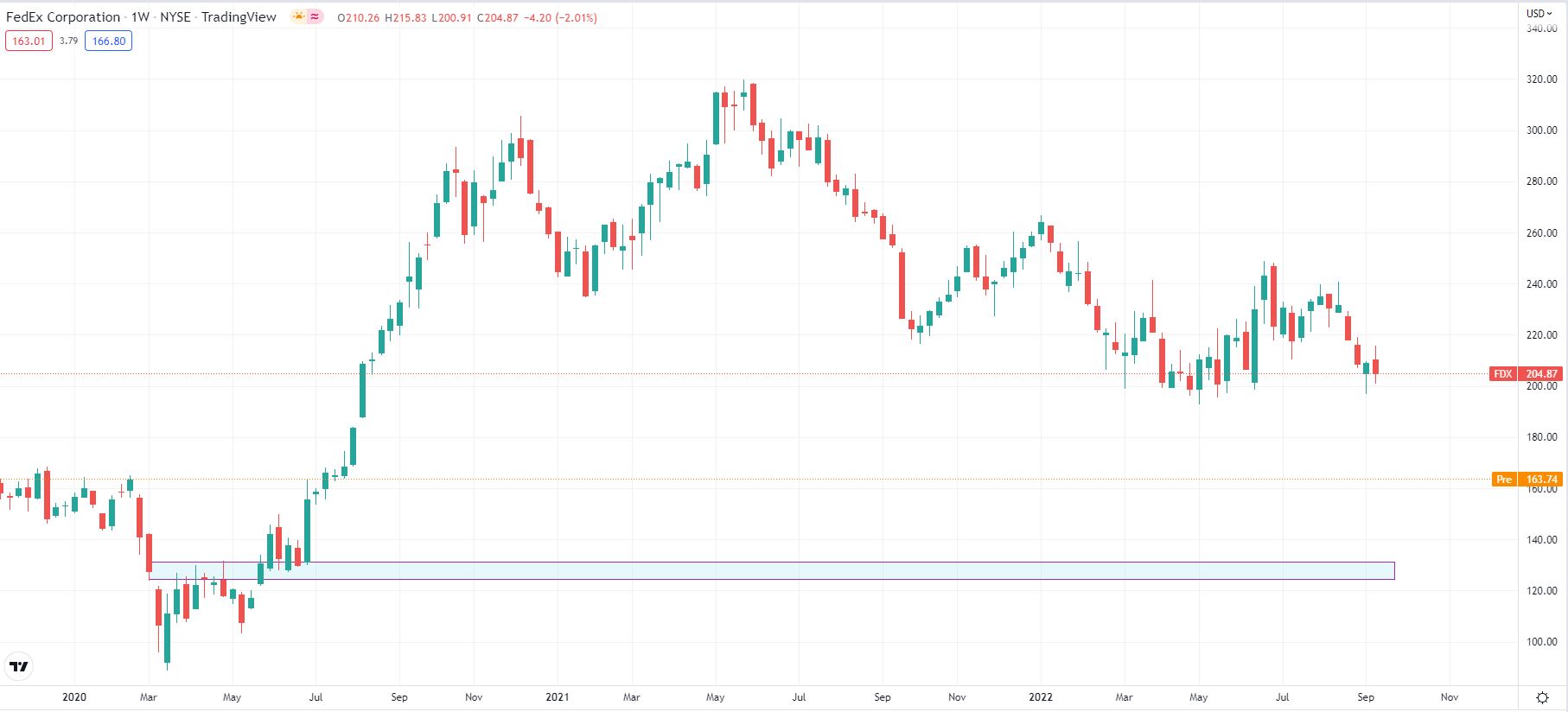
FDX weekly chart
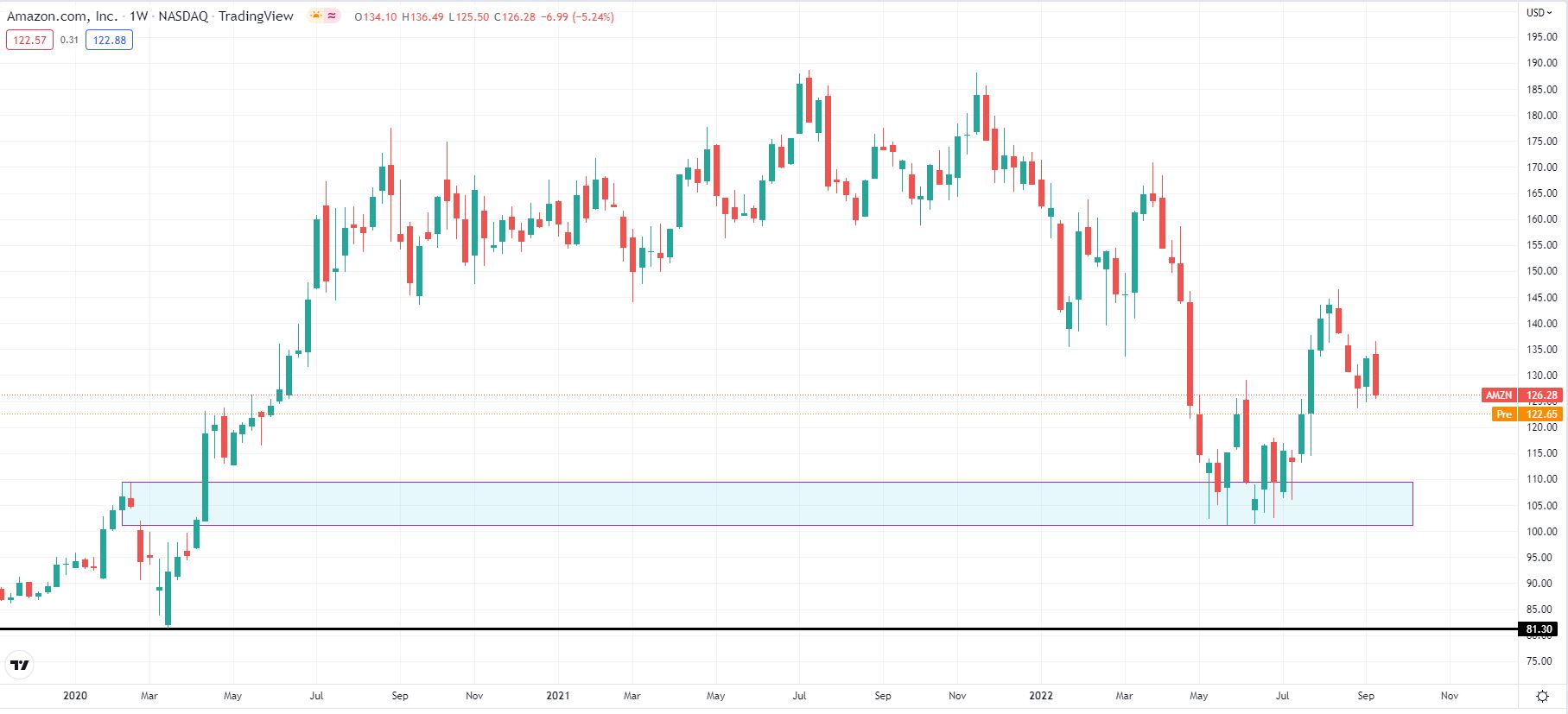
Amazon is already sitting in the premarket near resistance in the high teens/low $120s where the stock found support at its lows earlier in the summer. If it breaks through $122, however, then expect another day or week of selling to push it back down to this summer's support region that stretchs all the way from $101.50 up to $109. This region acts as demand zone wherein traders tend to buy the dip.
The UPS weekly chart is fairly simple. UPS stock is now trading near $173, and support from May and June is just below at $170. The actual range low was nearer to $165 back in May, but that whole area from $165 to $170 should supply decent support. If not, then expect UPS to collapse to support from August 2020 to March 2021 when UPS found its footing between $154.50 and $159.
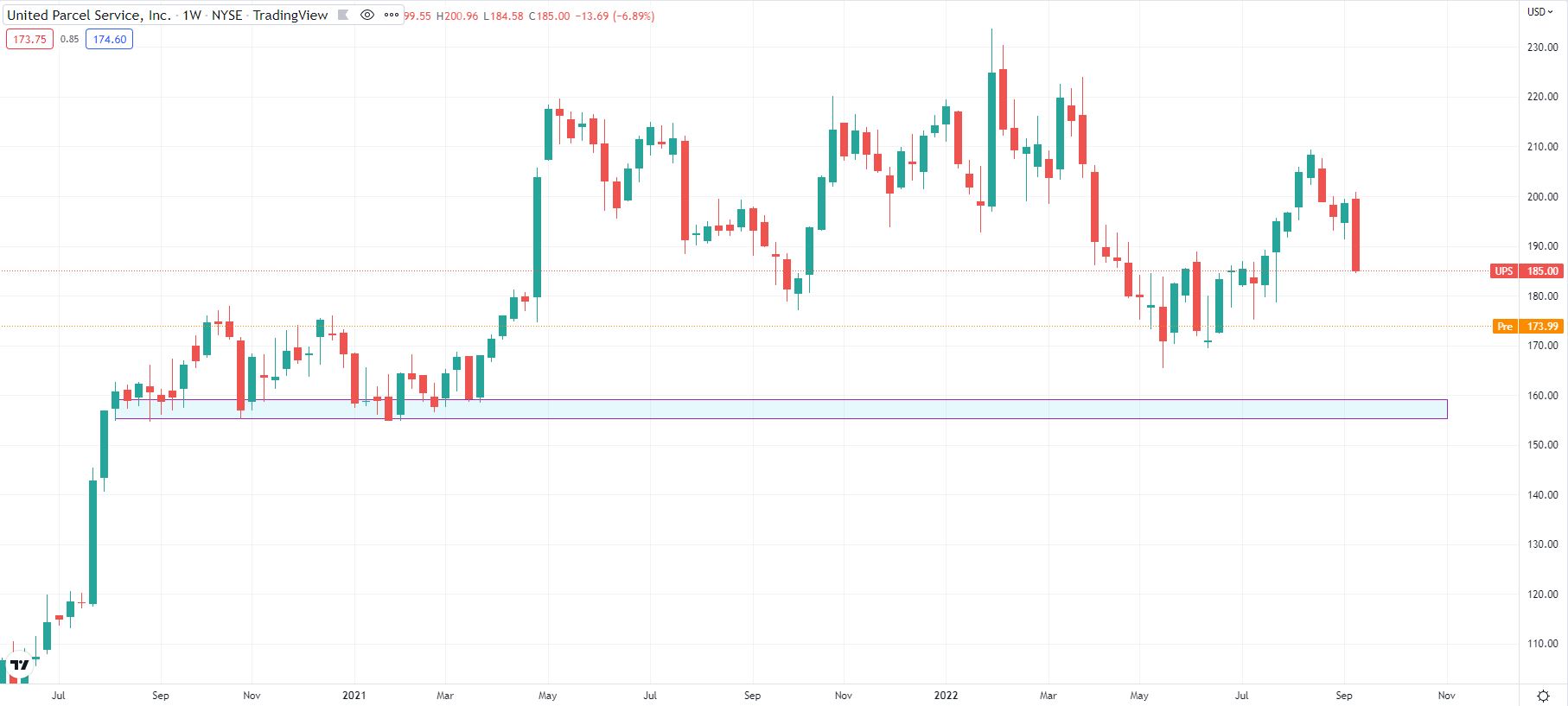
UPS weekly chart
Premium
You have reached your limit of 3 free articles for this month.
Start your subscription and get access to all our original articles.
Author
Clay Webster
FXStreet
Clay Webster grew up in the US outside Buffalo, New York and Lancaster, Pennsylvania. He began investing after college following the 2008 financial crisis.