EUR/USD drops ahead of US-Eurozone data-packed week
- EUR/USD trades cautiously around 1.1350, while investors look for fresh cues on trade relations between the US and China.
- The ECB is expected to cut interest rates again in the June meeting.
- ECB’s Knot sees demand shocks and disinflation due to Trump’s tariffs in the near term.

EUR/USD edges lower to near 1.1345 in North American trading hours on Monday. The major currency pair edges lower as the Euro (EUR) underperforms its peers ahead of the flash Harmonized Index of Consumer Prices (HICP) data of April and Q1 Gross Domestic Product (GDP) from the Eurozone and its major nations, which will be published this week. The inflation and economic growth data will significantly influence market expectations for the European Central Bank’s (ECB) monetary policy outlook.
According to market expectations, the Eurozone headline HICP would return to the ECB target of 2%, the slowest growth in price pressures since October 2024. In March, the inflation data rose by 2.2%. The Eurozone GDP growth is estimated to have grown at a steady pace of 0.2% QoQ in the first quarter. Moderate inflation growth would increase traders’ confidence that the ECB would cut interest rates again in the June policy meeting.
Meanwhile, Reuters reported on Saturday that ECB policymakers are becoming increasingly confident about cutting interest rates in June as inflation continues to fall. Still, there is little to no appetite for a big move. However, the report has not highlighted the names of ECB officials who have guided the chances of further monetary policy expansion.
ECB policymaker and Dutch central bank governor Klaas Knot stated in an interview with Dutch financial daily FD over the weekend that the June monetary policy will be more “complex” as long-term inflation risks have skewed on “both sides”. Knot signaled caution that the tariff policy by the US could lead to a decline in demand and disinflation in the near term. "In the short term, it’s 100% clear that the demand shock will dominate, so inflation will go down," Knot said.
During North American trading hours, ECB policymaker and Finnish central bank governor Olli Rehn indicated that more interest rate cuts would be necessary if inflation undershoots the central bank's target of 2%. Rehn said that he agrees with market expectations that "tariffs will slow down inflation".
On the global front, the uncertainty over trade relations between the US and the Eurozone has also kept the Euro on the sidelines. European Union (EU) Economic Commissioner for Trade Valdis Dombrovskis has expressed concerns over having a deal with the US in the near term, while speaking with reporters on the sidelines of the International Monetary Fund (IMF) meetings in Washington, Reuters reported. "There’s a lot of work ahead to come to more concrete parameters and elements and areas of cooperation which would allow us to avoid the implementation of tariffs," Dombrovskis said.
Euro PRICE Today
The table below shows the percentage change of Euro (EUR) against listed major currencies today. Euro was the strongest against the New Zealand Dollar.
| USD | EUR | GBP | JPY | CAD | AUD | NZD | CHF | |
|---|---|---|---|---|---|---|---|---|
| USD | 0.03% | -0.33% | -0.29% | -0.10% | -0.09% | 0.04% | -0.01% | |
| EUR | -0.03% | -0.42% | -0.33% | -0.15% | -0.22% | 0.00% | -0.06% | |
| GBP | 0.33% | 0.42% | 0.10% | 0.29% | 0.19% | 0.42% | 0.37% | |
| JPY | 0.29% | 0.33% | -0.10% | 0.19% | 0.21% | -1.09% | 0.53% | |
| CAD | 0.10% | 0.15% | -0.29% | -0.19% | -0.12% | 0.14% | 0.10% | |
| AUD | 0.09% | 0.22% | -0.19% | -0.21% | 0.12% | 0.23% | 0.17% | |
| NZD | -0.04% | -0.01% | -0.42% | 1.09% | -0.14% | -0.23% | -0.05% | |
| CHF | 0.00% | 0.06% | -0.37% | -0.53% | -0.10% | -0.17% | 0.05% |
The heat map shows percentage changes of major currencies against each other. The base currency is picked from the left column, while the quote currency is picked from the top row. For example, if you pick the Euro from the left column and move along the horizontal line to the US Dollar, the percentage change displayed in the box will represent EUR (base)/USD (quote).
Daily digest market movers: EUR/USD drops while US Dollar trades with caution
- EUR/USD edges lower on the Euro's underperformance. The US Dollar (USD) trades cautiously amid ambiguity over trade discussions between the United States (US) and China. Contradictory statements from Washington and Beijing over whether US President Donald Trump and Chinese President Xi Jinping have talked on trade terms have forced investors to stay on the sidelines.
- President Trump has stated that trade discussions between Washington and Beijing are going well. However, China has denied these remarks, saying there have been no “economic and trade negotiations between China and the US”. On Friday, a spokesperson from the Chinese embassy said, “China and the US are not having any consultation or negotiation on tariffs,” Reuters reported.
- After comments from Beijing, Trump stated in an interview with Time Magazine that China’s Xi Jinping had called him. “He’s called,” Trump said, and added, “I don’t think that’s a sign of weakness on his behalf.” Trump also clarified late Friday that Xi had called numerous times since he unveiled his tariff plan. "I don’t want to comment on that, but I’ve spoken to him numerous times," Trump said to reporters, Reuters reported.
- Meanwhile, US Treasury Scott Bessent has also not confirmed any trade talks between the presidents of the US and China. "I don’t know if President Trump has spoken with President Xi," Bessent said, ABC reported.
- This week, the major trigger for the US Dollar will be a slew of US economic data, including the Nonfarm payrolls (NFP) on Friday.
Technical Analysis: EUR/USD wobbles around 1.1350
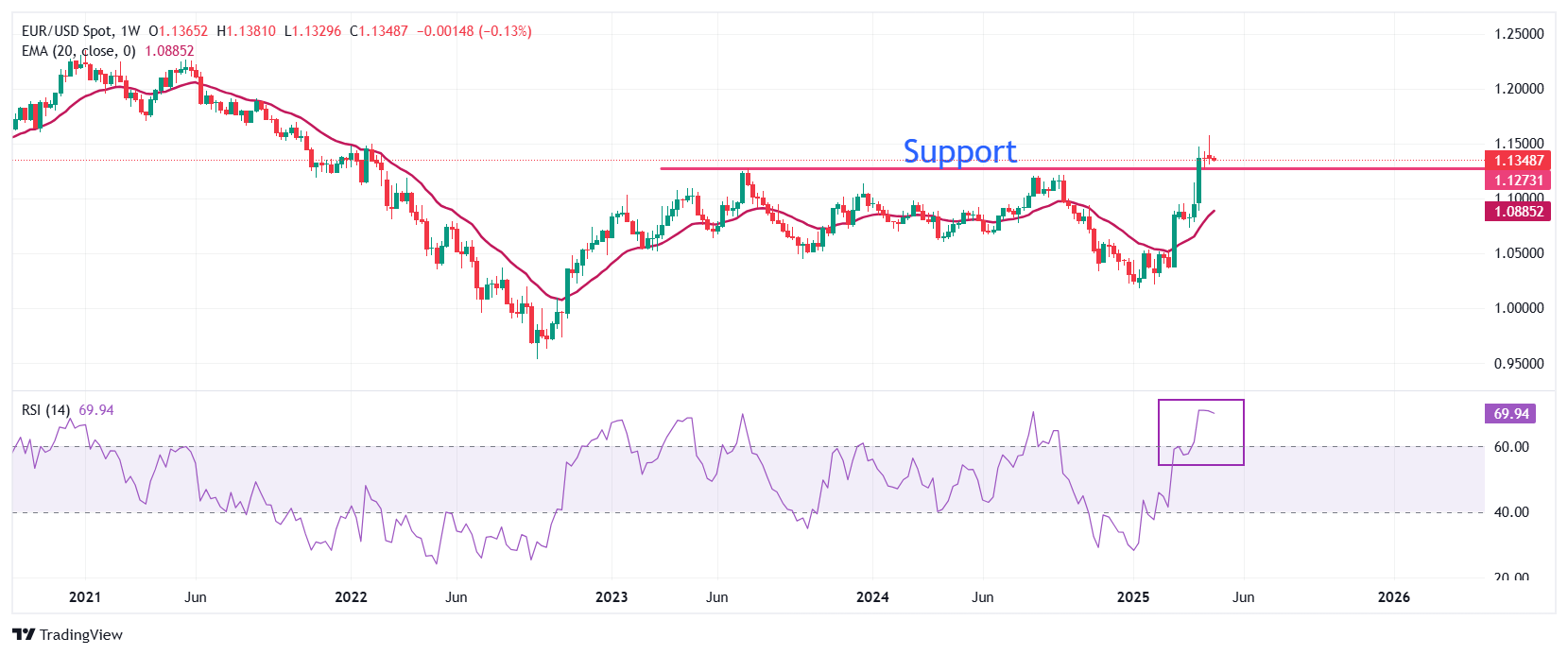
EUR/USD trades back-and-forth around 1.1350 in Monday’s European session. The outlook of the major currency pair remains bullish as the 20-week Exponential Moving Average (EMA) is sloping higher around 1.0885.
The 14-week Relative Strength Index (RSI) climbs to near overbought levels above 70.00 in the weekly chart, which indicates a strong bullish momentum, but chances of some correction cannot be ruled out.
Looking up, the psychological level of 1.1500 will be the major resistance for the pair. Conversely, the July 2023 high of 1.1276 will be a key support for the Euro bulls.
US-China Trade War FAQs
Generally speaking, a trade war is an economic conflict between two or more countries due to extreme protectionism on one end. It implies the creation of trade barriers, such as tariffs, which result in counter-barriers, escalating import costs, and hence the cost of living.
An economic conflict between the United States (US) and China began early in 2018, when President Donald Trump set trade barriers on China, claiming unfair commercial practices and intellectual property theft from the Asian giant. China took retaliatory action, imposing tariffs on multiple US goods, such as automobiles and soybeans. Tensions escalated until the two countries signed the US-China Phase One trade deal in January 2020. The agreement required structural reforms and other changes to China’s economic and trade regime and pretended to restore stability and trust between the two nations. However, the Coronavirus pandemic took the focus out of the conflict. Yet, it is worth mentioning that President Joe Biden, who took office after Trump, kept tariffs in place and even added some additional levies.
The return of Donald Trump to the White House as the 47th US President has sparked a fresh wave of tensions between the two countries. During the 2024 election campaign, Trump pledged to impose 60% tariffs on China once he returned to office, which he did on January 20, 2025. With Trump back, the US-China trade war is meant to resume where it was left, with tit-for-tat policies affecting the global economic landscape amid disruptions in global supply chains, resulting in a reduction in spending, particularly investment, and directly feeding into the Consumer Price Index inflation.
Author

Sagar Dua
FXStreet
Sagar Dua is associated with the financial markets from his college days. Along with pursuing post-graduation in Commerce in 2014, he started his markets training with chart analysis.