EUR/USD rallies as China retaliates with higher counter-tariffs on US
- EUR/USD jumps to near 1.1100 as the US Dollar faces pressures on the brewing trade war between the US and China.
- China warns of countermeasures against Trump’s hefty reciprocal tariffs.
- ECB Šimkus supports an interest rate cut in April.
EUR/USD advances to near 1.1100 in Wednesday’s North American session. The major currency pair strengthens as the US Dollar (USD) plummets on the brewing trade war between the United States (US) and China.
During European trading hours, Beijing has increased additional tariffs on the US to 84%, which will come into effect on April 10, in retaliation to an increase in reciprocal tariffs on China announced by US President Donald Trump on Tuesday.
Market participants were already bracing for a retaliatory move from China as it cleared through the so-called White Paper that Beijing will take countermeasures to “safeguard its rights and interests”, which was released earlier in the day. The White Paper also indicated that China firmly opposes “unilateral and bullying restrictive measures” and will “resolutely counteract and fight to the end”.
On Tuesday, Trump raised import duty to 104% on China following Beijing’s countermeasure of 34% levy on imports from the US.
Market participants worry that the escalating trade war between the world’s biggest powerhouses could push the US economy into a recession. This has led to a sharp increase in traders’ bets supporting the Federal Reserve (Fed) to resume the monetary policy easing cycle, which it paused in January. According to the CME FedWatch tool, the probability for the central bank to cut interest rates in May has increased to 52.5% from 10.6% recorded a week ago. The tool also shows that traders are confident that the central bank will cut interest rates in the June meeting.
During early North American trading hours, Minneapolis Fed Bank President Neel Kashkari also warned that Trump's tariffs will lead to an increase in "near-term inflation" and a decline in the "purchasing power, lower investment and GDP".
Meanwhile, investors await the Federal Open Market Committee (FOMC) minutes of the March policy meeting for fresh cues on the monetary policy outlook. In March, Fed officials guided that interest rates should remain in their current range of 4.25%-4.50% until they get clarity on how the President's policies will shape the monetary policy and the economic outlook.
On the economic front, investors will focus on the US Consumer Price Index (CPI) data for March, which will be released on Thursday. The inflation report is expected to show that the headline and core CPI rose moderately by 2.6% and 3%, respectively.
Daily digest market movers: EUR/USD gains as investors ignore bloating ECB dovish bets
- The strength in the EUR/USD pair is also driven by the Euro’s (EUR) outperformance. The major currency gains after German political parties agreed to form a coalition. The Christian Democratic Union (CDU), led by Frederich Merz, reached a deal with centre-left Social Democrats (SPD) to form a government, Reuters report. A positive development in stabilization in Germany’s government would advance debt-restructuring plans and the creation of the infrastructure fund.
- However, investors brace for volatility in the Euro in the face of Trump-led tariffs. Market participants expect that Trump's imposition of 20% reciprocal tariffs on the Eurozone will dampen the already vulnerable Eurozone economic growth, especially in Germany, the largest exporting nation of the bloc to the US.
- In response to Trump’s higher import duties, finance ministers of all Euro area countries are scheduled to meet in Warsaw on Friday to discuss measures to contain the likely consequences of tariffs imposed by the US. Ahead of the meeting, Poland Finance Minister Andrzej Domański said, "Disrupted supply chains and rising costs for companies will affect European growth ratios and currencies."
- During North American trading hours, European Union (EU) member states agreed to introduce countermeasures against Trump's tariffs. However, these measures could be suspended if the US agreed to a "fair and balanced negotiated outcome", a spokesperson from the European Commission (EC) said.
- Additionally, the deepening expectation of more interest rate cuts from the European Central Bank (ECB) is also expected to exert some pressure on the Euro. On Tuesday, ECB Governing Council member Gediminas Šimkus said that a “25 basis points (bps) rate cut is needed in April.” Šimkus added that the US tariff announcement warrants a “more accommodative” monetary policy, therefore, we need to move to a “less restrictive policy stance”.
Technical Analysis: EUR/USD advances to near 1.1100
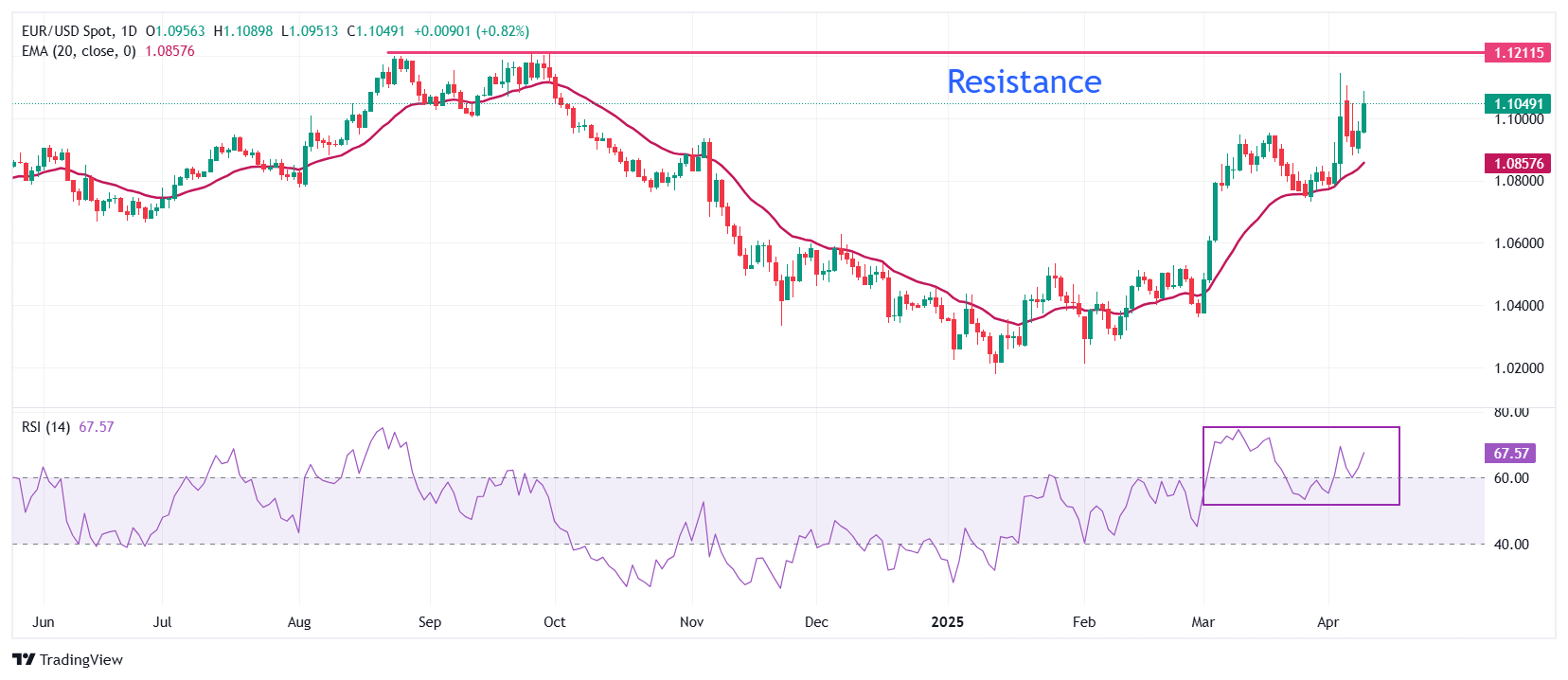
EUR/USD jumps to near 1.1100 on Wednesday and aims to revisit the six-month high of 1.1147. The near-term trend of the major currency pair is bullish as it holds above the 20-day Exponential Moving Average (EMA), which trades around 1.0856.
The 14-day Relative Strength Index (RSI) rebounds higher after cooling down to near 60.00, suggesting that a bullish momentum has resumed.
Looking down, the March 31 high of 1.0850 will act as the major support zone for the pair. Conversely, the September 25 high of 1.1214 will be the key barrier for the Euro bulls.
Tariffs FAQs
Tariffs are customs duties levied on certain merchandise imports or a category of products. Tariffs are designed to help local producers and manufacturers be more competitive in the market by providing a price advantage over similar goods that can be imported. Tariffs are widely used as tools of protectionism, along with trade barriers and import quotas.
Although tariffs and taxes both generate government revenue to fund public goods and services, they have several distinctions. Tariffs are prepaid at the port of entry, while taxes are paid at the time of purchase. Taxes are imposed on individual taxpayers and businesses, while tariffs are paid by importers.
There are two schools of thought among economists regarding the usage of tariffs. While some argue that tariffs are necessary to protect domestic industries and address trade imbalances, others see them as a harmful tool that could potentially drive prices higher over the long term and lead to a damaging trade war by encouraging tit-for-tat tariffs.
During the run-up to the presidential election in November 2024, Donald Trump made it clear that he intends to use tariffs to support the US economy and American producers. In 2024, Mexico, China and Canada accounted for 42% of total US imports. In this period, Mexico stood out as the top exporter with $466.6 billion, according to the US Census Bureau. Hence, Trump wants to focus on these three nations when imposing tariffs. He also plans to use the revenue generated through tariffs to lower personal income taxes.
Author

Sagar Dua
FXStreet
Sagar Dua is associated with the financial markets from his college days. Along with pursuing post-graduation in Commerce in 2014, he started his markets training with chart analysis.