EUR/USD surrenders gains and declines below 1.1100 after US NFP data
- EUR/USD falls back below 1.1100 as the US Dollar bounces back strong despite signs of a slowdown in US labor demand.
- Traders remain split over the Fed's likely interest rate cut size.
- The ECB is expected to cut interest rates two more times this year.

EUR/USD surrenders intraday gains and slides below 1.1100 after posting a fresh weekly high of 1.1150 in Friday's North American session. Decent gains in the shared currency pair have waned due to a firm recovery in the US Dollar (USD). The US Dollar Index (DXY), which tracks the Greenback’s value against six major currencies, jumps to nearly 101.40 after reversing intraday losses.
While the near-term appeal of the US Dollar remains uncertain as the United States (US) Nonfarm Payrolls (NFP) data came in lower-than-expected for August. The report showed that US employers hired 142K job-seekers, lower than estimates of 160K but higher than July’s reading of 89K, downwardly revised from 114K. The Unemployment Rate declined to 4.2%, as expected, from the former release of 4.3%.
The appeal of the US Dollar was already weak as US JOLTS Job Openings data for July and the ADP Employment data for August, released earlier this week, deepened fears of deteriorating labor market conditions. Fresh job vacancies and additions of payrolls in the private sector stood at 7.67 million and 99K, respectively, the lowest in more than three-and-a-half years.
The US ISM Services Purchasing Managers’ Index (PMI) data for August came in better than projected but failed to cushion the US Dollar.
Signs of slowing labor demand have prompted market expectations that the Federal Reserve (Fed) could start cutting interest rates aggressively. According to the CME FedWatch tool, the possibility for the Fed to begin reducing interest rates by 50 basis points (bps) to 4.75%-5.00% has increased to 43% from 34% recorded a week ago.
Meanwhile, the US Average Hourly Earnings data, a key measure of wage growth that influences consumer spending, increased at a faster-than-expected pace in August. Earnings have accelerated to 3.8% from the estimates of 3.7% and from 3.6% in July on a year-on-year basis. The wage growth measure rose at a stronger pace of 0.4% against expectations of 0.3% and the prior release of 0.2% on the month.
Daily digest market movers: EUR/USD fails to maintain winning streak
- EUR/USD falls sharply after a sharp recovery in the US Dollar after the release of the weaker-than-expected US NFP data. By itself, the Euro (ECB) exhibits a mixed performance against its major peers as traders aren’t sure about the European Central Bank (ECB) interest rate path for the remainder of the year.
- The ECB is widely anticipated to cut interest rates again in the September meeting. The central bank started the policy-easing process in June but kept its key borrowing rates unchanged in July. For the last quarter of this year, traders remain split on whether the ECB will cut in the November or December meeting, or in both of them.
- Economists at Bank of America (BofA) said in their latest viewpoint on the Eurozone: "We still see more cuts in 2025/26 than the markets are pricing, with a return to a deposit rate of 2% by 3Q25 (at the latest) and to 1.5% in 2026." BofA analysts said that the recovery in the Eurozone remains fragile and will likely be shallow, pressured by several economic factors including slowing growth in China as well as political factors.
- Further evidence of economic struggle came from the Eurozone’s two largest economies. Industrial production in Germany fell 2.4% on month in July, much more than the 0.3% decline expected by economists. In France, Industrial Output fell by 0.5%.
- According to a Reuters poll carried out between August 30 and September 5, 85% of economists anticipate that the ECB will cut interest rates next week and again in the December meeting.
- Meanwhile, most ECB officials seem to be comfortable with market speculation for interest rate cuts as they remain worried about growing risks to Eurozone economic growth. ECB Executive Board member Piero Cipollone said in an interview with a French newspaper this week that "there is a real risk that [the ECB] stance could become too restrictive."
Technical Analysis: EUR/USD falls back below 1.1100
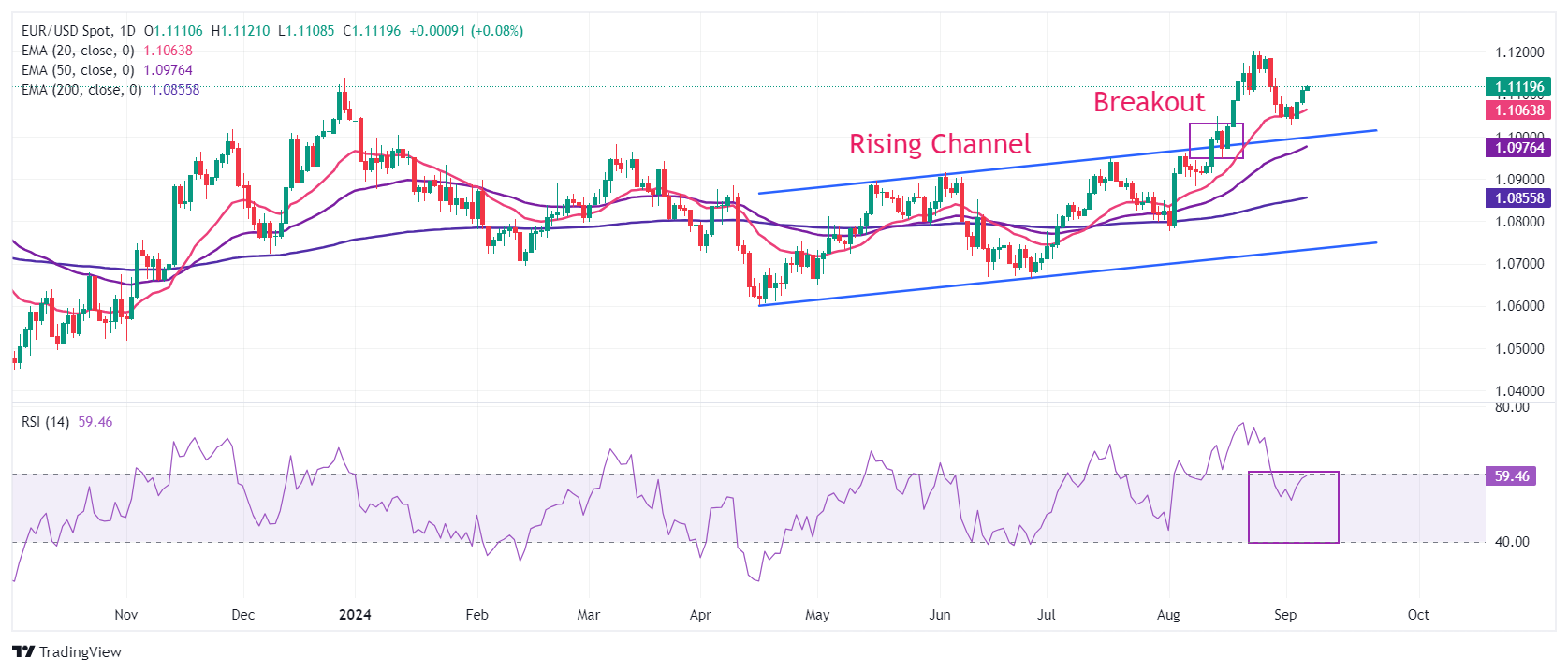
EUR/USD fails to hold gains above the round-level figure of 1.1100. However, the near-term outlook of the major currency pair remains firm as it manages to gain firm footing near the 20-day Exponential Moving Average (EMA) around 1.1055.
The longer-term outlook is also bullish as the 50-day and 200-day EMAs at 1.0970 and 1.0865, respectively, are sloping higher. Also, the shared currency pair holds the Rising Channel breakout on a daily time frame.
The 14-day Relative Strength Index (RSI) has declined below 60.00 after turning overbought near 75.00.
On the upside, the recent high of 1.1200 and the July 2023 high at 1.1275 will be the next stop for the Euro bulls. Meanwhile, the downside is expected to remain cushioned near the psychological support of 1.1000.
Author

Sagar Dua
FXStreet
Sagar Dua is associated with the financial markets from his college days. Along with pursuing post-graduation in Commerce in 2014, he started his markets training with chart analysis.

















