EUR/USD weakens as Fed sees no rush for interest rate cuts
- EUR/USD falls to near 1.0830 as ECB Lagarde expects US President Trump-led trade war could slowdown the Eurozone economic growth.
- The Fed kept borrowing rates steady and stuck to their two interest rate cut in 2025 forecasts on Wednesday.
- The Fed expects Trump’s policies to weigh on US economic growth and accelerate price pressures.

EUR/USD slides to near 1.0830 as the US Dollar (USD) strengthens in North American trading hours on Thursday. The US Dollar Index (DXY), which tracks the Greenback’s value against six major currencies, jumps to near 104.00.
The major currency pair gains as the Federal Reserve (Fed) expressed no rush for monetary policy adjustments amid “unusually elevated” uncertainty on President Donald Trump's policies after leaving key borrowing rates unchanged in the range of 4.25%-4.50%, as expected, on Wednesday. “We are not going to be in any hurry to move on rate cuts,” Fed Chair Jerome Powell said in the press conference. Fed officials also stuck to their guidance of two interest rate cuts this year as projected in the December policy meeting.
The Fed guided a muddy United States economic outlook under the leadership of President Donald Trump as “tariffs tend to bring growth down and inflation up.” Powell said. The central bank revised their forecast for the core Personal Consumption Expenditures Price Index (PCE) for this year to 2.8%, up from the 2.5% projected in the December meeting. The central bank revised this year's Gross Domestic Product (GDP) growth lower to 1.7% from their previous forecast of 2.1% despite remaining confident that labor market conditions are solid.
Contrary to the Fed’s “wait and see approach”, US President Trump said that the central bank should have cut interest rates as the impact of tariffs is transiting into the economy. “The Fed would be much better off cutting rates as US tariffs start to transition (ease!) their way into the economy. Do the right thing,” Trump said in a post on Truth Social after the Fed’s policy decision. Trump has been advocating lower interest rates to ramp up economic growth.
On the economic data front, Initial Jobless Claims for the week ending March 14 have come in almost in line with estimates and the prior release at 223K.
Daily digest market movers: EUR/USD slumps as ECB Lagarde warns of potential Eurozone economic risks
- EUR/USD declines sharply as the Euro (EUR) faces pressure after European Central Bank (ECB) President Christine Lagarde warned of Eurozone economic risks due to potential tariffs by the United States (US).
- Lagarde testified before the Committee on Economic and Monetary Affairs of the European Parliament during European trading hours on Thursday. She said that US tariffs of 25% on imports from Europe, as threatened by US President Donald Trump, would lower “Euro area growth by about 0.3% in the first year”, according to an ECB analysis. The study also shows that retaliatory tariffs from Europe would further increase this to about 0.5%.
- Fears of soft Eurozone economic growth would dampen the Euro’s (EUR) appeal as it will force the ECB to lower interest rates further. However, Germany’s end to over a decade-long fiscal conservatism, aiming to boost domestic consumption and defense spending, would offset the impact of the trade war.
- On the inflation outlook, Christine Lagarde forecasted that retaliatory measures from the European Union (EU) and a weaker Euro exchange rate could lift inflation by around 0.5%. However, the ECB President expects that to be temporary as the effect would ease in the medium term due to “lower economic activity dampening inflationary pressures”.
Euro PRICE Today
The table below shows the percentage change of Euro (EUR) against listed major currencies today. Euro was the strongest against the New Zealand Dollar.
| USD | EUR | GBP | JPY | CAD | AUD | NZD | CHF | |
|---|---|---|---|---|---|---|---|---|
| USD | 0.61% | 0.33% | 0.13% | 0.23% | 1.11% | 1.35% | 0.68% | |
| EUR | -0.61% | -0.28% | -0.47% | -0.38% | 0.49% | 0.74% | 0.07% | |
| GBP | -0.33% | 0.28% | -0.19% | -0.12% | 0.78% | 1.03% | 0.36% | |
| JPY | -0.13% | 0.47% | 0.19% | 0.07% | 0.96% | 1.18% | 0.61% | |
| CAD | -0.23% | 0.38% | 0.12% | -0.07% | 0.88% | 1.12% | 0.45% | |
| AUD | -1.11% | -0.49% | -0.78% | -0.96% | -0.88% | 0.25% | -0.42% | |
| NZD | -1.35% | -0.74% | -1.03% | -1.18% | -1.12% | -0.25% | -0.69% | |
| CHF | -0.68% | -0.07% | -0.36% | -0.61% | -0.45% | 0.42% | 0.69% |
The heat map shows percentage changes of major currencies against each other. The base currency is picked from the left column, while the quote currency is picked from the top row. For example, if you pick the Euro from the left column and move along the horizontal line to the US Dollar, the percentage change displayed in the box will represent EUR (base)/USD (quote).
Technical Analysis: EUR/USD stays above 200-day EMA
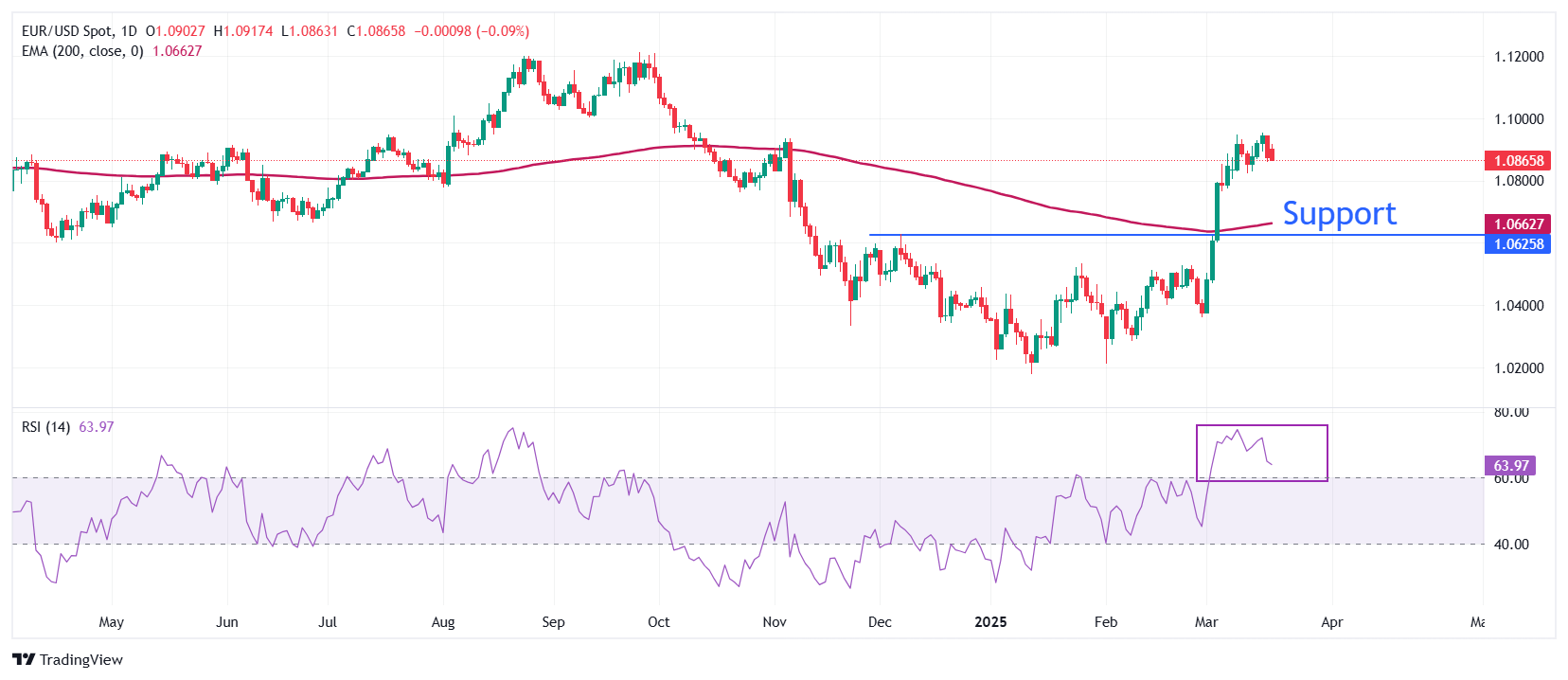
EUR/USD falls to near 1.0830 after failing to hold the key level of 1.0900 on Thursday. However, the long-term outlook of the major currency pair is still bullish as it holds above the 200-day Exponential Moving Average (EMA), which trades around 1.0660.
The pair strengthened after a decisive breakout above the December 6 high of 1.0630 on March 5.
The 14-day Relative Strength Index (RSI) cools down after turning overbought around 75.00, suggesting that the bullish momentum has moderated, but the upside bias is intact.
Looking down, the December 6 high of 1.0630 will act as the major support zone for the pair. Conversely, the psychological level of 1.1000 will be the key barrier for the Euro bulls.
ECB FAQs
The European Central Bank (ECB) in Frankfurt, Germany, is the reserve bank for the Eurozone. The ECB sets interest rates and manages monetary policy for the region. The ECB primary mandate is to maintain price stability, which means keeping inflation at around 2%. Its primary tool for achieving this is by raising or lowering interest rates. Relatively high interest rates will usually result in a stronger Euro and vice versa. The ECB Governing Council makes monetary policy decisions at meetings held eight times a year. Decisions are made by heads of the Eurozone national banks and six permanent members, including the President of the ECB, Christine Lagarde.
In extreme situations, the European Central Bank can enact a policy tool called Quantitative Easing. QE is the process by which the ECB prints Euros and uses them to buy assets – usually government or corporate bonds – from banks and other financial institutions. QE usually results in a weaker Euro. QE is a last resort when simply lowering interest rates is unlikely to achieve the objective of price stability. The ECB used it during the Great Financial Crisis in 2009-11, in 2015 when inflation remained stubbornly low, as well as during the covid pandemic.
Quantitative tightening (QT) is the reverse of QE. It is undertaken after QE when an economic recovery is underway and inflation starts rising. Whilst in QE the European Central Bank (ECB) purchases government and corporate bonds from financial institutions to provide them with liquidity, in QT the ECB stops buying more bonds, and stops reinvesting the principal maturing on the bonds it already holds. It is usually positive (or bullish) for the Euro.
BRANDED CONTENT
If you're looking for the best brokers to trade the EUR/USD pair, explore our selected options. Knowing each broker’s strengths will help you find the ideal fit for your trading strategy.
Author

Sagar Dua
FXStreet
Sagar Dua is associated with the financial markets from his college days. Along with pursuing post-graduation in Commerce in 2014, he started his markets training with chart analysis.