EUR/USD edges up with US Industrial Production, Fed speakers on tap
- EUR/USD picks up to 1.1620 after hitting six-week lows at 1.1593.
- Strong US employment and manufacturing figures boosted the US Dollar on Thursday
- Fed officials Bostic and Schmid warned against cutting rates amid the high inflation levels.

EUR/USD posts minor gains on Friday, trading at 1.1620 at the time of writing, after hitting six-week lows at 1.1593 on the previous day. The pair, however, is on track to complete a three-week losing streak, as strong US economic data has cemented the view that the Federal Reserve (Fed) will keep interest rates unchanged in the coming months.
Figures released by the US Department of Labor on Thursday revealed that Initial Jobless Claims decreased against expectations to their lowest levels since November, easing some of the market's concerns about the labor market deterioration.
At the same time, releases of the New York Empire State Manufacturing Index and the Philadelphia Fed Manufacturing Survey showed readings well beyond expectations, highlighting a strong start to the year for the sector.
Eurozone figures released this Friday confirmed that German consumer Inflation eased to the European Central Bank's target of 2% YoY in December. In the US, the focus will be on December's Industrial Production data and the speeches from the Fed's Vice Chairs Michelle Bowman and Philip Jefferson.
Euro Price Today
The table below shows the percentage change of Euro (EUR) against listed major currencies today. Euro was the strongest against the US Dollar.
| USD | EUR | GBP | JPY | CAD | AUD | NZD | CHF | |
|---|---|---|---|---|---|---|---|---|
| USD | -0.14% | -0.23% | -0.33% | -0.07% | -0.16% | -0.52% | -0.25% | |
| EUR | 0.14% | -0.10% | -0.20% | 0.06% | -0.02% | -0.37% | -0.10% | |
| GBP | 0.23% | 0.10% | -0.11% | 0.16% | 0.07% | -0.28% | -0.01% | |
| JPY | 0.33% | 0.20% | 0.11% | 0.28% | 0.17% | -0.19% | 0.09% | |
| CAD | 0.07% | -0.06% | -0.16% | -0.28% | -0.11% | -0.46% | -0.18% | |
| AUD | 0.16% | 0.02% | -0.07% | -0.17% | 0.11% | -0.36% | -0.08% | |
| NZD | 0.52% | 0.37% | 0.28% | 0.19% | 0.46% | 0.36% | 0.28% | |
| CHF | 0.25% | 0.10% | 0.00% | -0.09% | 0.18% | 0.08% | -0.28% |
The heat map shows percentage changes of major currencies against each other. The base currency is picked from the left column, while the quote currency is picked from the top row. For example, if you pick the Euro from the left column and move along the horizontal line to the US Dollar, the percentage change displayed in the box will represent EUR (base)/USD (quote).
Daily Digest Market Movers: US Dollar remains supported by strong data
- The US Dollar Index (DXY) is trimming gains on Friday but maintains its broader bullish trend intact. Recent US economic reflects a stronger economy, with stubbornly high inflation, prompting investors to dial down their bets for Fed monetary easing in the near-term.
- US Initial Jobless Claims declined to 198K in the week ending January 10, from 207K in the previous week, against the market expectations of an increase to 215K.
- The New York Empire State Manufacturing Index bounced up to a 7.7 reading in January following a 3.7 decline in December. This month's reading beat expectations of a more moderate improvement to 1, which shows a significant strengthening in the sector's business conditions.
- Likewise, the Philadelphia Fed Manufacturing Survey jumped to 12.6 in January from the -8.8 of the previous month, also beating expectations of a -2 reading. New orders and shipments moved higher, the employment index decreased, although showing an overall improvement from previous months, while prices remained above long-run averages.
- In this context, hawkish comments by Fed policymakers provided additional support to the US Dollar. Atlanta Fed President Raphael Bostic and Kansas Fed President Jeffrey Schmid reiterated the need to keep interest rates at restrictive levels as inflationary pressures remain high.
- In the Eurozone, on Friday, Germany's final Harmonized Index of Consumer Prices confirmed that inflation eased to 0.2% in December and to 2.0% in the previous 12 months, after -0.5 and 2.6% respective readings in November. The Euro ticked up from lows following the data release.
Technical Analysis: EUR/USD is trying to break resistance in the 1.1620 area
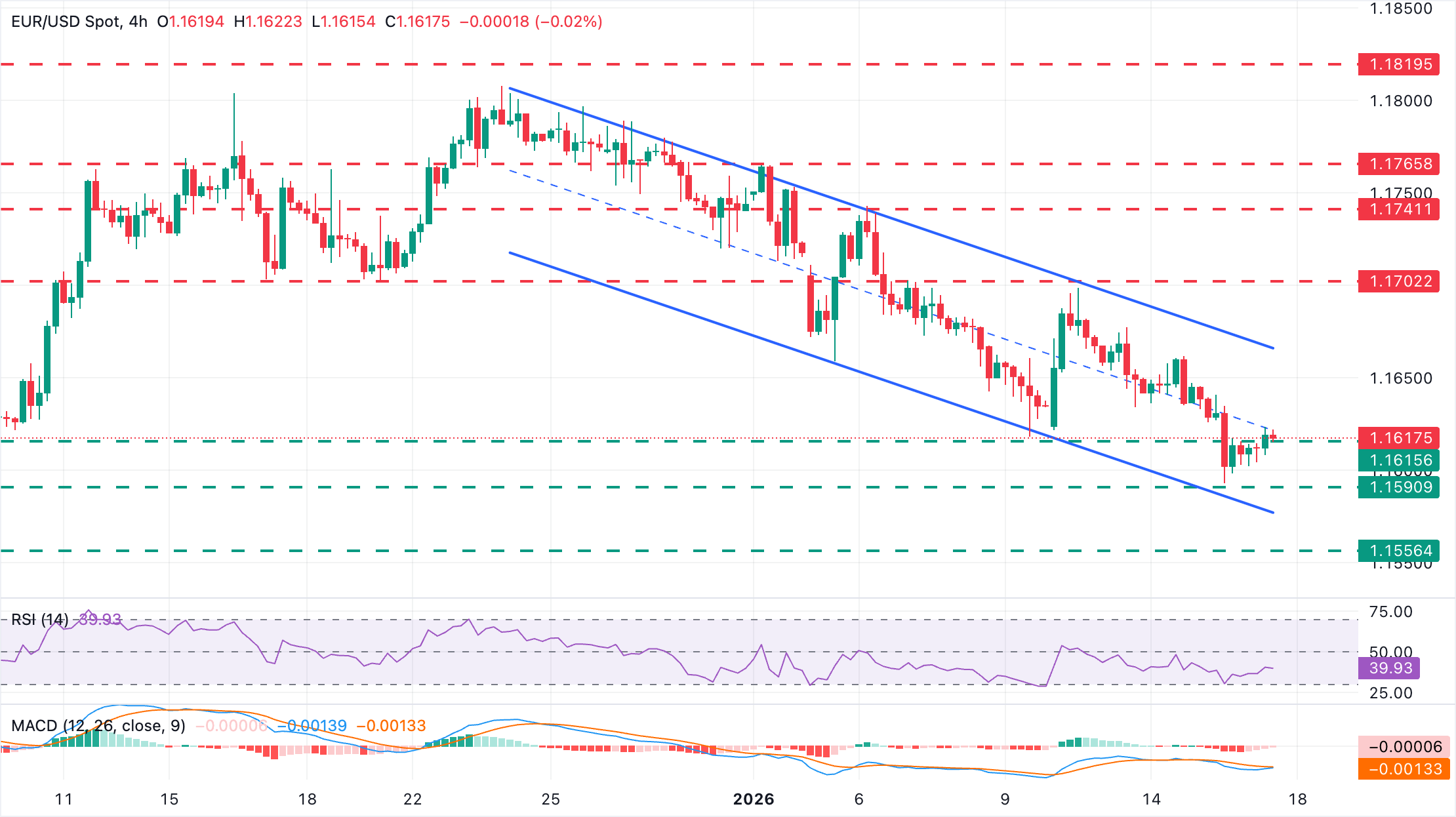
EUR/USD has bounced up from lows and is attempting to confirm above a previous support level, near 1.1620. The Moving Average Convergence Divergence (MACD) is attempting to cross above the Signal line, and the Relative Strength Index (RSI) has risen to 40, reaching a neutral area and highlighting a fading bearish momentum.
A confirmation above 1.1621 (January 12 lows) would shift the focus towards the channel top in the 1.1665 area. To the downside, immediate support is at Thursday's low, near 1.1590, and the channel's bottom, now at the 1.1585 area. Further down, the target is the late-November lows near 1.1560.
(The technical analysis of this story was written with the help of an AI tool.)
Economic Indicator
Industrial Production (MoM)
The Industrial Production released by the Board of Governors of the Federal Reserve shows the volume of production of US industries such as factories and manufacturing. Up trend is regarded as inflationary which may anticipate interest rates to rise. If High industrial production growth comes out, this may generate a positive sentiment (or bullish) for the USD.
Read more.Next release: Fri Jan 16, 2026 14:15
Frequency: Monthly
Consensus: 0.1%
Previous: 0.2%
Source: Federal Reserve
Economic Indicator
Fed's Bowman speech
Michelle W. Bowman" is an American attorney and the Vice Chair for Supervision on the Board of Governors of the Federal Reserve. Bowman has served as a member of the Board of Governors since taking office on November 26, 2018, and her term ends on January 31, 2034.
Read more.Next release: Fri Jan 16, 2026 16:00
Frequency: Irregular
Consensus: -
Previous: -
Source: Federal Reserve
Economic Indicator
Fed's Jefferson speech
Philip N. Jefferson is a member of the Board of Governors of the Federal Reserve system. He took office on May 23, 2022, to fill an unexpired term ending January 31, 2036. Dr. Jefferson had served as vice president for academic affairs and dean of faculty and the Paul B. Freeland Professor of Economics at Davidson College. Previously, among other positions, he had also worked as an economist at the Board of Governors of the Federal Reserve System.
Read more.Next release: Fri Jan 16, 2026 20:30
Frequency: Irregular
Consensus: -
Previous: -
Source: Federal Reserve
Author

Guillermo Alcala
FXStreet
Graduated in Communication Sciences at the Universidad del Pais Vasco and Universiteit van Amsterdam, Guillermo has been working as financial news editor and copywriter in diverse Forex-related firms, like FXStreet and Kantox.