|

EUR/USD: Investors add bearish bets despite weak US data, tighter German-US yield spreads

  • EUR/USD risk reversals fell to near three-month lows yesterday, signaling a rise in demand for bearish bets (put options).
  • Investors added bearish bets even though the US retail sales painted a dismal picture of the world's largest economy and the US-German bond yield spreads tightened. 
  • EUR/USD, therefore, is unlikely to see significant gains. Technically speaking, the bias remains bearish while the pair is held below the 200-week moving average (MA). 

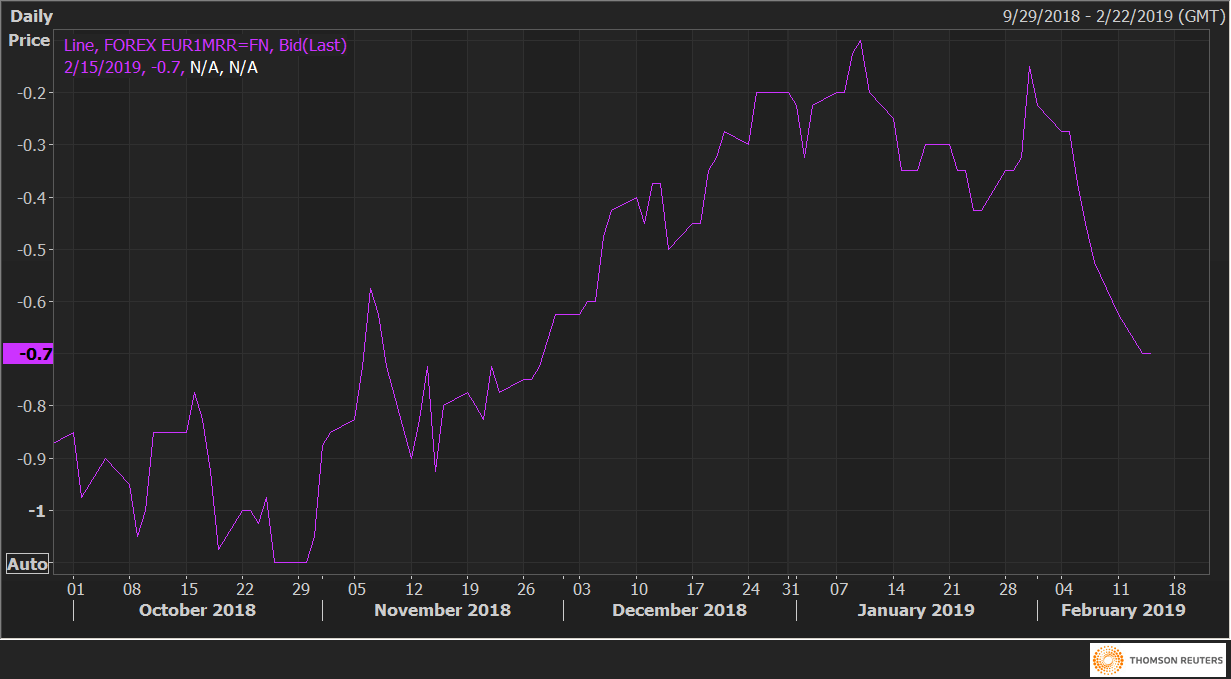
Risk reversals on the EUR, a gauge of puts to calls, fell to their lowest level since November on Thursday, indicating investors are adding bets to position for further weakness in the common currency. 

One-month 25 delta risk reversals (EUR1MRR) dropped to -0.70, a level last seen in Nov. 29, from the previous day's value of -0.675. A negative number indicates the demand (value) for put options (bearish bets) is higher than that for calls. So, the drop from -0.675 to -0.70 means the demand for put options rose yesterday despite weak US data. 

The US Commerce Department reported a 1.2 percent drop in retail sales in January (the largest since Q3 2009), reinforcing dovish Fed expectations. The spread between the 2-year US and German bond yields narrowed to 305 basis points from 310 basis points in the EUR-positive manner. Meanwhile, 10-year yield spread also narrowed to 255 basis points from 258 basis points.  

Even so, risk reversals dropped in favor of puts. Put simply, market sentiment is bearish on EUR/USD and hence, a bounce, if any, could be short-lived. Validating that argument is the last week's bearish close below the 200-week MA. That average is currently located at 1.1329 and the bias will remain bearish as long as the spot is held below that key level. 

EUR/USD Technical Levels

    1. R3 1.1381
    2. R2 1.1346
    3. R1 1.132
  1. PP 1.1284
    1. S1 1.1258
    2. S2 1.1223
    3. S3 1.1197

EUR1MRR

Author

Omkar Godbole

Omkar Godbole

FXStreet Contributor

Omkar Godbole, editor and analyst, joined FXStreet after four years as a research analyst at several Indian brokerage companies.


More from Omkar Godbole
Share:

Editor's Picks

AUD/USD bulls seem hesitant below 0.7050 ahead of RBA on Tuesday

AUD/USD reverses an Asian session dip on Monday as renewed optimism over Iran diplomacy boosts investor confidence, keeping a lid on the safe-haven US Dollar and supporting the risk-sensitive Aussie. Spot prices, however, remain below the one-month high, touched last Thursday, as bulls wait for the crucial RBA decision before taking fresh positions.


USD/JPY climbs to 158.00 neighborhood as BoJ uncertainty weighs on the JPY

The USD/JPY pair gains some positive traction at the start of a new week, recovering further from Friday's post-Bank of Japan (BoJ) swing low to sub-157.00 levels. The momentum lifts spot prices to the 158.00 neighborhood during the Asian session and seems unaffected by fresh intervention warning from Japan's Finance Minister Satsuki Katayama.

Gold rebounds to near $3,900 as Fed hike bets cap upside

Gold price edges at the start of a new week, reclaiming $3,900 during the Asian session and reversing a part of Friday's heavy losses to its lowest level since October 2025. The upside potential, however, seems limited as elevated oil prices and inflation concerns keep Fed rate hike bets firmly on the table.

Zcash rebounds as ZODL founder now supports ending community grants
Zcash (ZEC) shows signs of recovery on Monday, extending gains above $1,250 as the Zcash Open Development Lab (ZODL) founder, Josh Swihart, now supports the compromise proposal to end the 8% block reward share directed to Zcash Community Grants (ZCG).
Middle East War updates: Iran warns of expanded strikes against US despite progress in talks

Here’s a brief recap of the key developments in the Middle East war that occurred over the weekend, which are expected to have a significant impact on markets in the upcoming week.

The 2% inflation target came from a throwaway remark. It now moves trillions
The Federal Reserve's 2% inflation goal grew out of an off-the-cuff remark by a New Zealand politician in 1988. Bond investors still price long-term US debt as if 2% holds, so a change in how the Fed measures inflation would move markets.