EUR/USD holds gains above 1.1100 with Fed policy decision on the horizon
- EUR/USD stays above 1.1100 as firm Fed large rate cut prospects weigh on the US Dollar.
- The Fed is expected to cut interest rates by 100 bps by year-end.
- ECB policymakers push back against market October rate cut prospects.

EUR/USD holds gains above the crucial support of 1.1100 in Tuesday’s New York session. The major currency pair remains broadly amid increasing bets that the Federal Reserve (Fed) will opt for a large interest-rate cut on Wednesday. Market speculation for a large Fed rate cut strengthened after softer-than-expected Producer Price Index (PPI) data for August and media reports pointing that officials keep the door open to such a cut.
According to the CME FedWatch tool, the probability of the Fed reducing interest rates by 50 basis points (bps) to 4.75%-5.00% has increased sharply to 69% from 34% a week ago. Apart from the Fed’s interest rate decision, investors will also focus on the dot plot and economic projections.
The Fed’s dot plot indicates where policymakers see the federal fund rate heading in the medium and long term. Traders see the Fed cutting interest rates by 100 bps to 4.25%-4.50% by year-end, suggesting that the central bank will opt for a large interest rate cut in one of three meetings remaining this year.
Meanwhile, the US Dollar (USD) recovers its intraday losses after the release of the upbeat United States (US) Retail Sales data for August. The report showed that Retail Sales barely rose while investors anticipated to have contracted by 0.2%. In July, the Retail Sales rose strongly by 1.1%, upwardly revised from 1%.
The US Dollar Index (DXY), which tracks the Greenback’s value against six major currencies, bounces back to near 101.00. However, its near-term outlook remains uncertain.
US Dollar PRICE Today
The table below shows the percentage change of US Dollar (USD) against listed major currencies today. US Dollar was the strongest against the Japanese Yen.
| USD | EUR | GBP | JPY | CAD | AUD | NZD | CHF | |
|---|---|---|---|---|---|---|---|---|
| USD | 0.05% | 0.11% | 0.71% | -0.01% | -0.22% | 0.10% | 0.21% | |
| EUR | -0.05% | 0.05% | 0.65% | -0.11% | -0.28% | 0.03% | 0.15% | |
| GBP | -0.11% | -0.05% | 0.60% | -0.13% | -0.32% | -0.02% | 0.09% | |
| JPY | -0.71% | -0.65% | -0.60% | -0.72% | -0.92% | -0.61% | -0.51% | |
| CAD | 0.00% | 0.11% | 0.13% | 0.72% | -0.20% | 0.12% | 0.21% | |
| AUD | 0.22% | 0.28% | 0.32% | 0.92% | 0.20% | 0.30% | 0.40% | |
| NZD | -0.10% | -0.03% | 0.02% | 0.61% | -0.12% | -0.30% | 0.10% | |
| CHF | -0.21% | -0.15% | -0.09% | 0.51% | -0.21% | -0.40% | -0.10% |
The heat map shows percentage changes of major currencies against each other. The base currency is picked from the left column, while the quote currency is picked from the top row. For example, if you pick the US Dollar from the left column and move along the horizontal line to the Japanese Yen, the percentage change displayed in the box will represent USD (base)/JPY (quote).
Daily digest market movers: EUR/USD edges lower as ECB avoids offering pre-defined rate cut path
- EUR/USD remains firm near 1.1150 in North American trading hours. The major currency pair edges lower as the US Dollar attempts a recovery. The Euro (EUR) performs strongly against its major peers as European Central Bank (ECB) officials avoid committing a pre-defined interest rate cut path and prefer to decide on interest rates meeting by meeting. This occurs amid lingering concerns about economic growth in Germany and a decline in Eurozone inflation to 2.2% in August, the lowest rate in three years.
- Less dovish interest-rate guidance from ECB Governing Council member Peter Kazimir on Monday has also contributed to strength in the Euro. Kazimir pushed back market expectations for the ECB cutting interest rates in October by saying in a blog post: "We will almost surely need to wait until December for a clearer picture before making our next move," Reuters reported.
- “The ECB needed to be sure that incoming data confirmed its projections. Otherwise, policymakers might regret rushing to cut borrowing costs before inflation has been sustainably defeated,” he added. Also, ECB Governing Council member Gediminas Šimkus said on Tuesday that the probability of an October rate cut is very small.
- Meanwhile, the ZEW Survey – which measures sentiment from institutional investors – showed that Economic Sentiment in the Eurozone has declined significantly to 9.3 in September, the lowest since November 2023. The sentiment data was estimated to have fallen slightly to 17.6 from 17.9 in August.
Technical Analysis: EUR/USD steadies above 1.1100
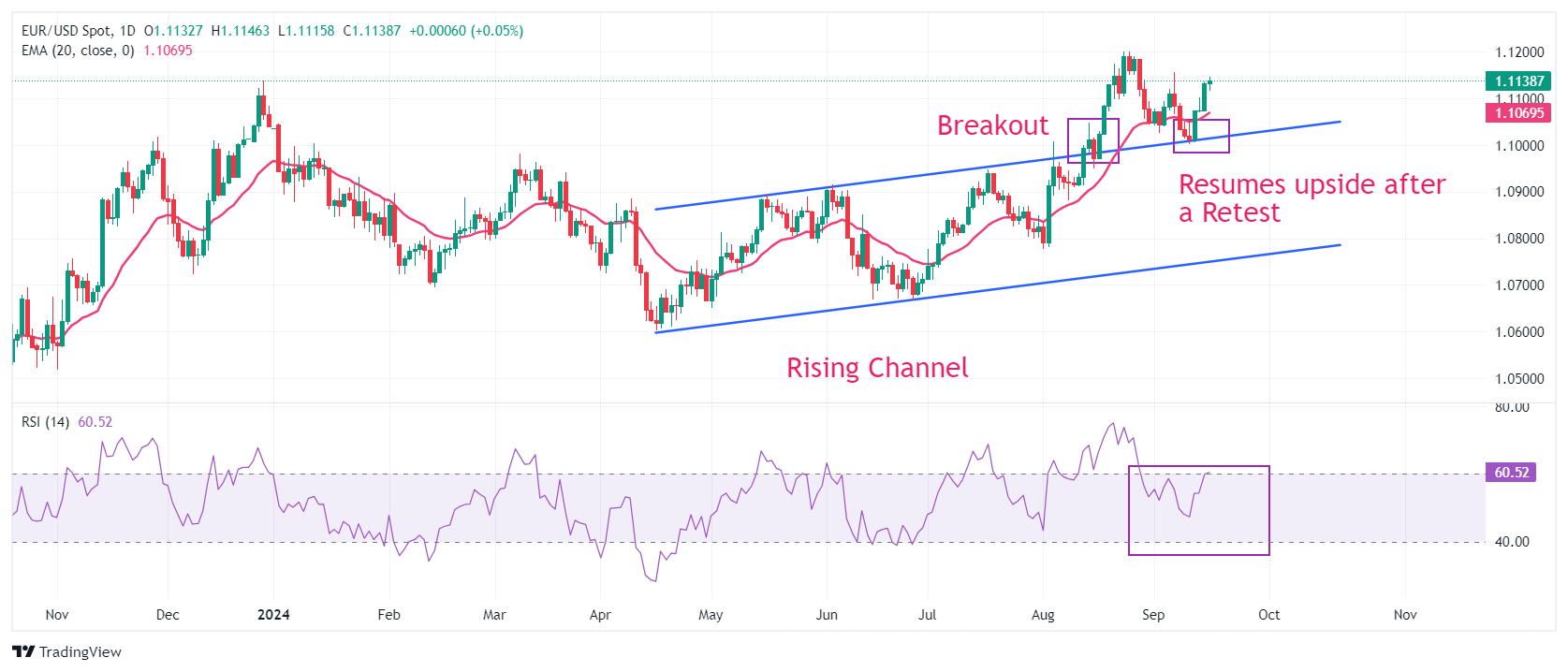
EUR/USD gains further to near 1.1150. The major currency pair strengthened after retesting the breakout of the Rising Channel chart pattern formed on a daily time frame near the psychological support of 1.1000. The near-term outlook of the major currency pair has strengthened as the asset steadies above the 20-day Exponential Moving Average (EMA), which trades around 1.1060.
The 14-day Relative Strength Index (RSI) moves higher to near 60.00. A bullish momentum would trigger if it sustains above the aforementioned level.
Looking up, the high of 1.1155 from September 6 and the round-level resistance of 1.1200 will act as major barricades for the Euro bulls. On the downside, the psychological level of 1.1000 and the July 17 high near 1.0950 will be major support zones.
Fed FAQs
Monetary policy in the US is shaped by the Federal Reserve (Fed). The Fed has two mandates: to achieve price stability and foster full employment. Its primary tool to achieve these goals is by adjusting interest rates. When prices are rising too quickly and inflation is above the Fed’s 2% target, it raises interest rates, increasing borrowing costs throughout the economy. This results in a stronger US Dollar (USD) as it makes the US a more attractive place for international investors to park their money. When inflation falls below 2% or the Unemployment Rate is too high, the Fed may lower interest rates to encourage borrowing, which weighs on the Greenback.
The Federal Reserve (Fed) holds eight policy meetings a year, where the Federal Open Market Committee (FOMC) assesses economic conditions and makes monetary policy decisions. The FOMC is attended by twelve Fed officials – the seven members of the Board of Governors, the president of the Federal Reserve Bank of New York, and four of the remaining eleven regional Reserve Bank presidents, who serve one-year terms on a rotating basis.
In extreme situations, the Federal Reserve may resort to a policy named Quantitative Easing (QE). QE is the process by which the Fed substantially increases the flow of credit in a stuck financial system. It is a non-standard policy measure used during crises or when inflation is extremely low. It was the Fed’s weapon of choice during the Great Financial Crisis in 2008. It involves the Fed printing more Dollars and using them to buy high grade bonds from financial institutions. QE usually weakens the US Dollar.
Quantitative tightening (QT) is the reverse process of QE, whereby the Federal Reserve stops buying bonds from financial institutions and does not reinvest the principal from the bonds it holds maturing, to purchase new bonds. It is usually positive for the value of the US Dollar.
Author

Sagar Dua
FXStreet
Sagar Dua is associated with the financial markets from his college days. Along with pursuing post-graduation in Commerce in 2014, he started his markets training with chart analysis.