EUR/USD caught in chart churn ahead of Wednesday’s HCOB PMIs, US ADP jobs figure
- EUR/USD remains trapped in constrained intraday cycle near 1.0750.
- Tuesday’s EU CPI inflation print warned of an uptick in EU inflation.
- Wednesday brings a packed docket with EU PMIs, PPIs, and US ADP jobs.

EUR/USD spent Tuesday in a churning pattern, cycling just below 1.075 as the pair grapples with finding momentum. Key labor data from the US looms ahead on Friday, and EU economic figures remain scattered throughout the back half of the trading week.
Pan-EU HCOB Core Harmonized Index of Consumer Prices (HICP) inflation held steady at 2.9% MoM in June, holding steady at the previous figure and snubbing the forecast decline to 2.8%. Overall YoY HICP inflation eased to 2.5% as forecast, ticking down from the previous 2.6%, but European inflation figures remain notably above the European Central Bank’s (ECB) 2% target band.
Forex Today: US data and FOMC should dictate the price action
Fedspeak from Federal Reserve (Fed) officials helped to bolster investor mood during Tuesday’s US market session, with key policymakers giving a firmer nod to recent improvements in US inflation data. US JOLTS Job Openings also rose slightly in May, climbing to 8.14 million from the forecast steady print at 7.91 million. Signs of extending slack within the US labor market are beginning to appear, giving rate-cut-hungry financial markets reason to hope that the Fed might get pushed towards a rate trim sooner rather than later.
Wednesday’s upcoming European market session will see final Producer Price Index (PPI) and HCOB Purchasing Managers Index (PMI) figures, while the US trading window features ISM Services PMI figure and the latest ADP Employment Change numbers, a rough preview of Friday’s upcoming US Nonfarm Payrolls (NFP) jobs data dump.
The pan-EU Composite PMI for June is expected to hold steady at 50.8, while May’s annualized European PPI is expected to improve, albeit slightly, to -4.1% YoY from the previous -5.7%.
US ADP Employment Change in June is forecast to rise slightly to 160K from the previous 152K. Meanwhile, June’s ISM Services PMI is expected to cool further to 52.5 MoM from the previous 53.8.
ECB President Christine Lagarde is expected to make an appearance near the end of the European market session, and he Federal Open Market Committee’s (FOMC) latest Meeting Minutes will be released later in the day.
Economic Indicator
ADP Employment Change
The ADP Employment Change is a gauge of employment in the private sector released by the largest payroll processor in the US, Automatic Data Processing Inc. It measures the change in the number of people privately employed in the US. Generally speaking, a rise in the indicator has positive implications for consumer spending and is stimulative of economic growth. So a high reading is traditionally seen as bullish for the US Dollar (USD), while a low reading is seen as bearish.
Read more.Next release: Wed Jul 03, 2024 12:15
Frequency: Monthly
Consensus: 160K
Previous: 152K
Source: ADP Research Institute
Traders often consider employment figures from ADP, America’s largest payrolls provider, report as the harbinger of the Bureau of Labor Statistics release on Nonfarm Payrolls (usually published two days later), because of the correlation between the two. The overlaying of both series is quite high, but on individual months, the discrepancy can be substantial. Another reason FX traders follow this report is the same as with the NFP – a persistent vigorous growth in employment figures increases inflationary pressures, and with it, the likelihood that the Fed will raise interest rates. Actual figures beating consensus tend to be USD bullish.
EUR/USD technical outlook
EUR/USD is extending a near-term consolidation pattern, drifting into the midrange as intraday price continues to get buoyed by a supply zone priced in below 1.0680. The Fiber is cycling median bids near the 200-hour Exponential Moving Average (EMA) near 1.0725.
Daily candlesticks are poised for an upside breakout of recent consolidation, however technical resistance is priced in at the 50-day EMA near 1.0770 and a reversal of market flows will drag EUR/USD back down into the bottom end of a rough descending channel just above the 1.0600 handle.
EUR/USD hourly chart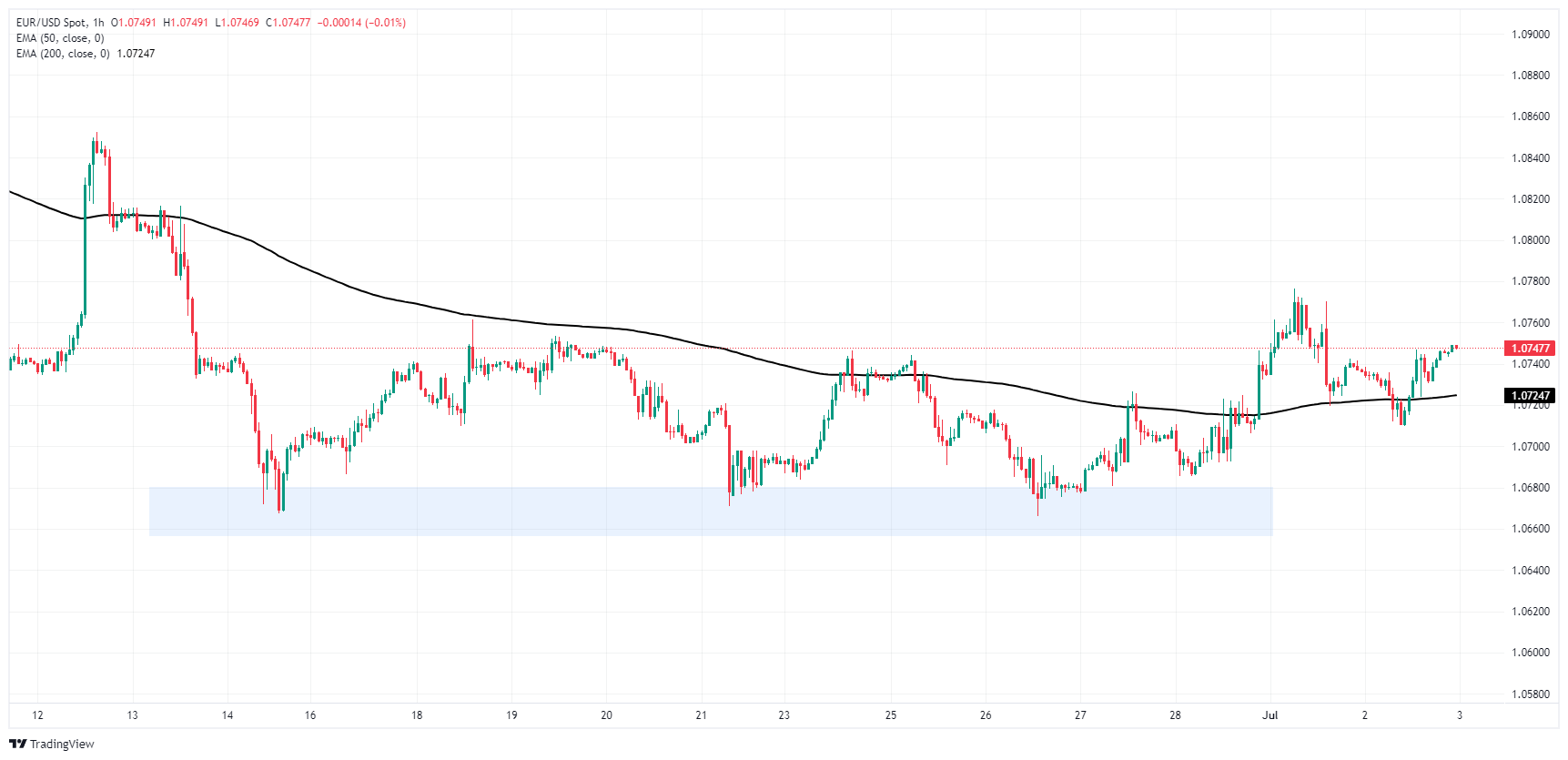
EUR/USD daily chart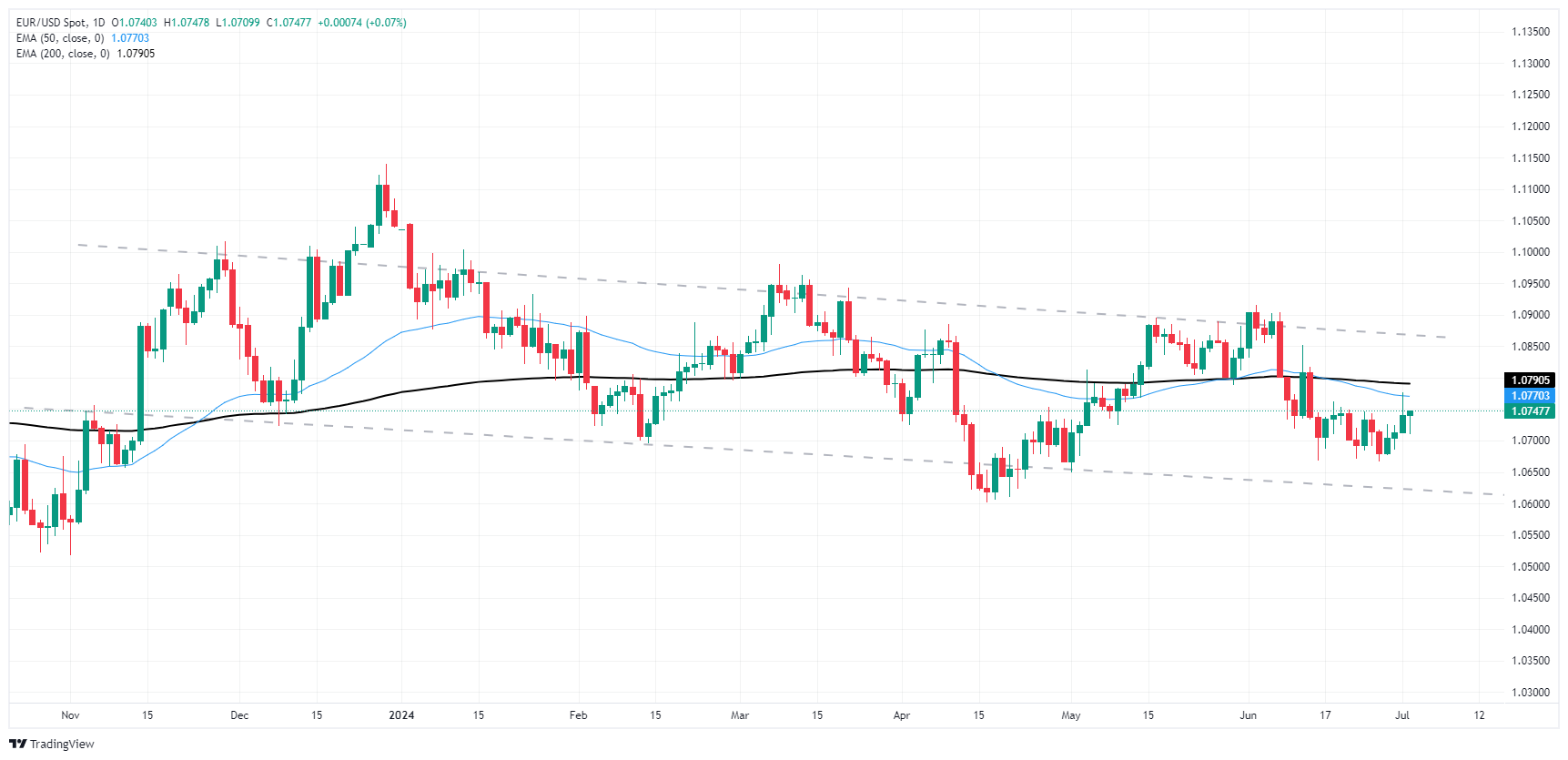
Euro FAQs
The Euro is the currency for the 20 European Union countries that belong to the Eurozone. It is the second most heavily traded currency in the world behind the US Dollar. In 2022, it accounted for 31% of all foreign exchange transactions, with an average daily turnover of over $2.2 trillion a day. EUR/USD is the most heavily traded currency pair in the world, accounting for an estimated 30% off all transactions, followed by EUR/JPY (4%), EUR/GBP (3%) and EUR/AUD (2%).
The European Central Bank (ECB) in Frankfurt, Germany, is the reserve bank for the Eurozone. The ECB sets interest rates and manages monetary policy. The ECB’s primary mandate is to maintain price stability, which means either controlling inflation or stimulating growth. Its primary tool is the raising or lowering of interest rates. Relatively high interest rates – or the expectation of higher rates – will usually benefit the Euro and vice versa. The ECB Governing Council makes monetary policy decisions at meetings held eight times a year. Decisions are made by heads of the Eurozone national banks and six permanent members, including the President of the ECB, Christine Lagarde.
Eurozone inflation data, measured by the Harmonized Index of Consumer Prices (HICP), is an important econometric for the Euro. If inflation rises more than expected, especially if above the ECB’s 2% target, it obliges the ECB to raise interest rates to bring it back under control. Relatively high interest rates compared to its counterparts will usually benefit the Euro, as it makes the region more attractive as a place for global investors to park their money.
Data releases gauge the health of the economy and can impact on the Euro. Indicators such as GDP, Manufacturing and Services PMIs, employment, and consumer sentiment surveys can all influence the direction of the single currency. A strong economy is good for the Euro. Not only does it attract more foreign investment but it may encourage the ECB to put up interest rates, which will directly strengthen the Euro. Otherwise, if economic data is weak, the Euro is likely to fall. Economic data for the four largest economies in the euro area (Germany, France, Italy and Spain) are especially significant, as they account for 75% of the Eurozone’s economy.
Another significant data release for the Euro is the Trade Balance. This indicator measures the difference between what a country earns from its exports and what it spends on imports over a given period. If a country produces highly sought after exports then its currency will gain in value purely from the extra demand created from foreign buyers seeking to purchase these goods. Therefore, a positive net Trade Balance strengthens a currency and vice versa for a negative balance.
Author

Joshua Gibson
FXStreet
Joshua joins the FXStreet team as an Economics and Finance double major from Vancouver Island University with twelve years' experience as an independent trader focusing on technical analysis.

















