EUR/JPY retreats from YTD high with price action falling in a tight range
- EUR/JPY pauses after rising to a fresh YTD high on Wednesday.
- Japan's disappointing Trade Balance and a dovish BoJ remain supportive of EUR/JPY strength.
- EUR/JPY holds above 172.00 as bulls defend support, psychological resistance firms at 173.00


The Euro (EUR) is trading in a narrow range against the Japanese Yen (JPY) on Thursday, after reaching a one-year high of 173.25 on Wednesday. Despite a minor pullback, central bank divergence and a diminishing outlook for Japan's economy remain a key theme.
At the time of writing, EUR/JPY is hovering above the psychological support level of 172.00.
Japan's sluggish trade data and underperformance provide a gloomy outlook for the Yen
Japan released its latest Trade Balance data on Wednesday, which showed that Japan's exports continued to fall as a result of steep tariffs imposed on imports of steel, aluminium and autoparts to the United States (US).
Japan's trade data for June reflected mixed performance, highlighting continued external challenges for the economy. The adjusted merchandise trade balance posted a deficit of ¥-235.5 billion, slightly improved from ¥-291.6 billion previously, while the headline trade balance came in at ¥153.1 billion, missing expectations of ¥353.9 billion and falling sharply from ¥638.6 billion in May.
Exports declined by 0.5% YoY, underperforming forecasts of a 0.5% gain, though an improvement from May’s 1.7% contraction.
On the other hand, imports rose by 0.2%, beating expectations of a 1.6% decline and marking a rebound from the prior 7.7% drop. Additionally, foreign bond and equity investments in Japan fell, signaling weaker foreign capital inflows.
Overall, the data suggests soft external demand and weakening trade momentum, which may continue to pressure the Yen, especially as Japan maintains its accommodative monetary policy stance amid global tightening cycles.
The weaker-than-expected Japanese trade data reinforces the bearish outlook for the Yen, supporting continued strength in EUR/JPY. The decline in exports signals soft external demand, while the fall in foreign investment flows suggests diminishing appetite for Japanese assets, both of which weigh on the Yen.
BoJ-ECB monetary policy divergence supports upside potential for EUR/JPY
At the same time, Japan's sluggish trade performance, coupled with a dovish Bank of Japan (BoJ), contrasts sharply with the European Central Bank’s (ECB) more cautious stance, where rate cut expectations remain subdued due to persistent inflation.
This monetary policy divergence continues to underpin EUR/JPY’s upward trajectory.
EUR/JPY holds above 172.00 as bulls defend support following a fresh YTD tested on Wednesday
After reaching a fresh YTD high of 173.25 on Wednesday, failure to hold above the psychological resistance level of 173.00 allowed bears to drive price action back toward the 172.00 mark.
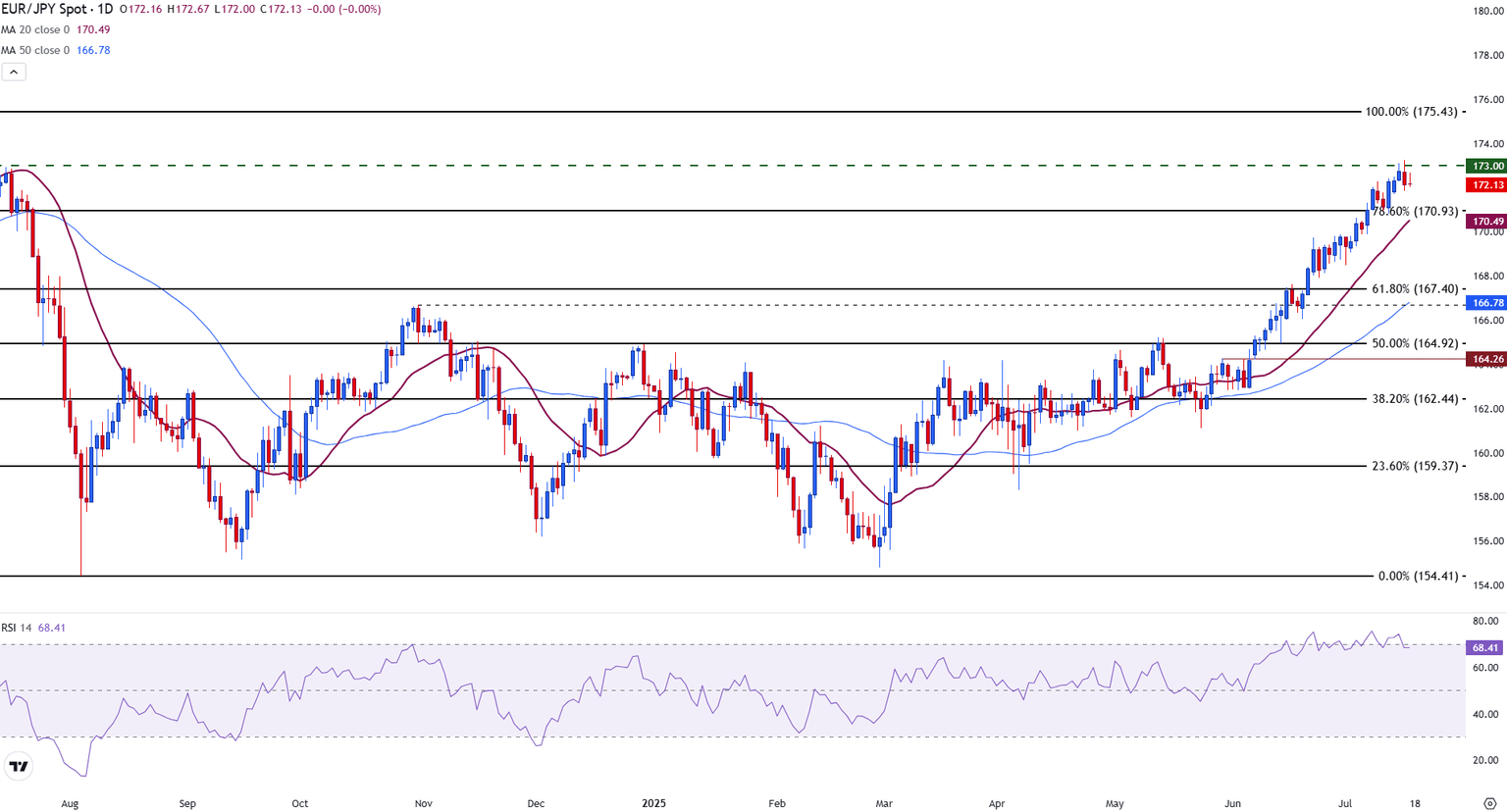
The current daily candle shows bulls attempting to push prices higher, but the upper wick signals that sellers quickly retaliated, pushing the pair into a narrow range.
If bulls manage to gain traction above 173.00, a break of the 174.00 psych level could open the door for a continuation toward the July 2024 high of 175.43.
On the downside, the 78.6% Fibonacci retracement level of the July-August 2024 move is providing support at 170.93, just above the 20-day Simple Moving Average (SMA). A move lower at a break of the 50-day SMA at 166.78 could then trigger an increase in selling pressure toward the 50% Fibo level at 164.92.
Meanwhile, the Relative Strength Index (RSI) near 69 suggests that the pair is close to overbought territory.
Japanese Yen FAQs
The Japanese Yen (JPY) is one of the world’s most traded currencies. Its value is broadly determined by the performance of the Japanese economy, but more specifically by the Bank of Japan’s policy, the differential between Japanese and US bond yields, or risk sentiment among traders, among other factors.
One of the Bank of Japan’s mandates is currency control, so its moves are key for the Yen. The BoJ has directly intervened in currency markets sometimes, generally to lower the value of the Yen, although it refrains from doing it often due to political concerns of its main trading partners. The BoJ ultra-loose monetary policy between 2013 and 2024 caused the Yen to depreciate against its main currency peers due to an increasing policy divergence between the Bank of Japan and other main central banks. More recently, the gradually unwinding of this ultra-loose policy has given some support to the Yen.
Over the last decade, the BoJ’s stance of sticking to ultra-loose monetary policy has led to a widening policy divergence with other central banks, particularly with the US Federal Reserve. This supported a widening of the differential between the 10-year US and Japanese bonds, which favored the US Dollar against the Japanese Yen. The BoJ decision in 2024 to gradually abandon the ultra-loose policy, coupled with interest-rate cuts in other major central banks, is narrowing this differential.
The Japanese Yen is often seen as a safe-haven investment. This means that in times of market stress, investors are more likely to put their money in the Japanese currency due to its supposed reliability and stability. Turbulent times are likely to strengthen the Yen’s value against other currencies seen as more risky to invest in.
Author
Tammy Da Costa, CFTe®
FXStreet
Tammy is an economist and market analyst with a deep passion for financial markets, particularly commodities and geopolitics.